Sathitruangsak Chirawadee, Righolt Christiaan H, Klewes Ludger, Tung Chang Doris, Kotb Rami, Mai Sabine
Department of Cell Biology, University of Manitoba, Research Institute of Hematology and Oncology, CancerCare Manitoba, Winnipeg, Manitoba, Canada.
Division of Medical Oncology, Department of Internal Medicine, Prince of Songkla University, Songkhla, Thailand.
Int J Cancer. 2017 Jan 15;140(2):400-410. doi: 10.1002/ijc.30461. Epub 2016 Oct 22.
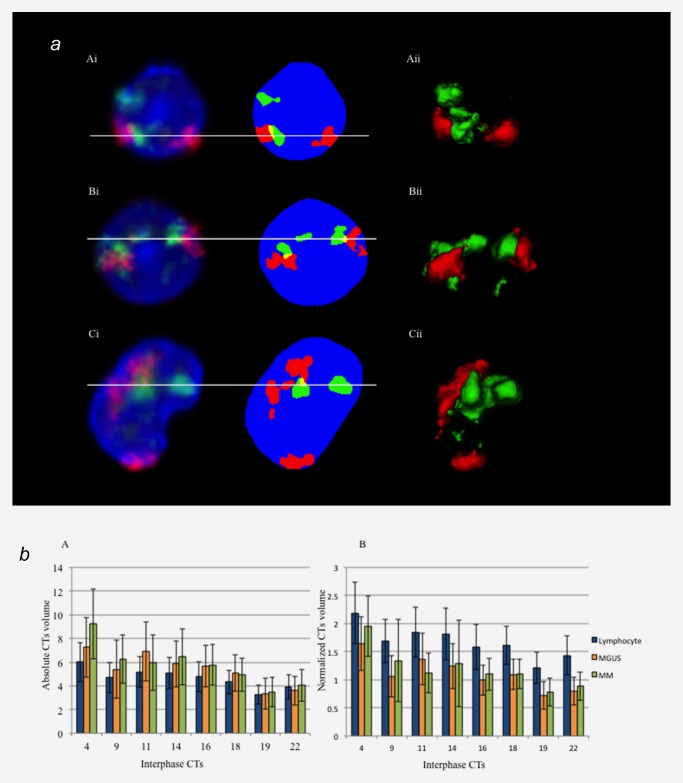
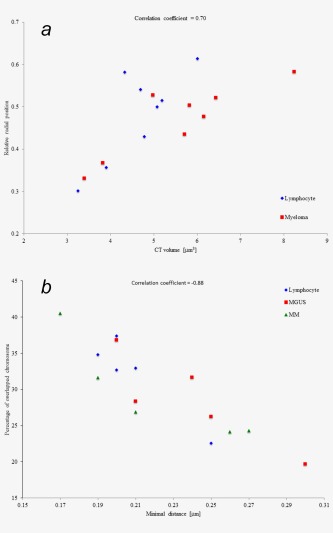
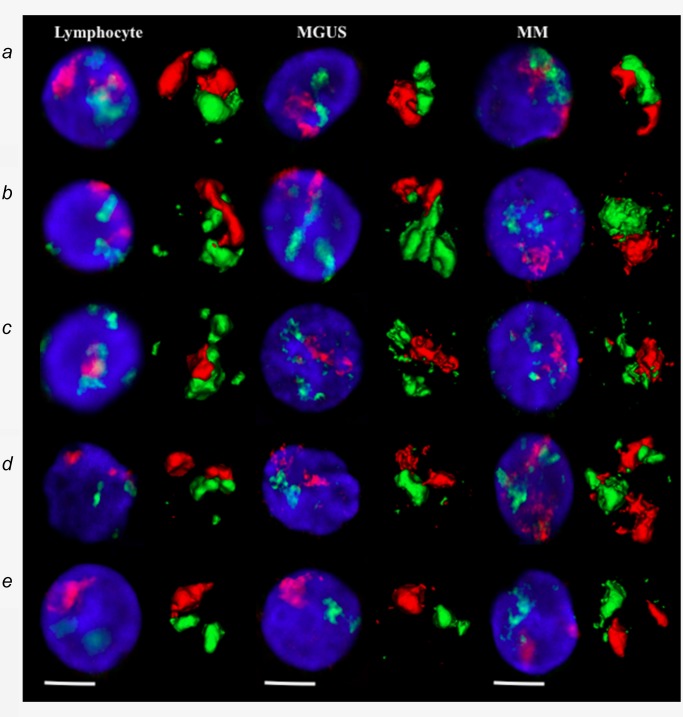
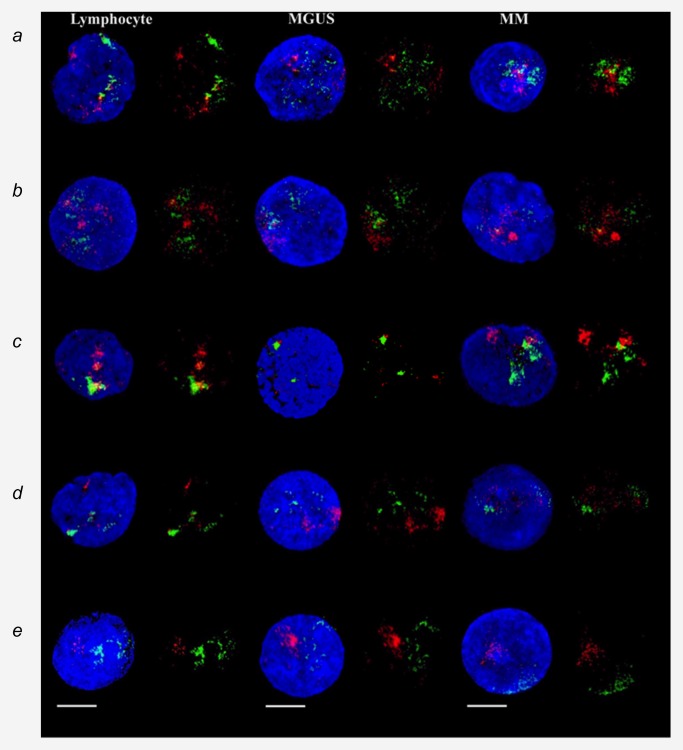
The consistent appearance of specific chromosomal translocations in multiple myeloma has suggested that the positioning of chromosomes in the interphase nucleus might play a role in the occurrence of particular chromosomal rearrangements associated with malignant transformation. Using fluorescence in situ hybridization, we have determined the positions of selected chromosome pairs (18 and 19, 9 and 22, 4 and 14, 14 and 16, 11 and 14) in interphase nuclei of myeloma cells compared to normal lymphocytes of treatment-naïve patients. All chromosome pairs were arranged in a nonrandom pattern. Chromosomes commonly involved in myeloma-associated translocations (4 and 14, 14 and 16, 11 and 14) were found in close spatial proximity, and this is correlated with the occurrence of overlapping chromosome territories. The spatial distribution of chromosomes may increase the possibility of chromosomal translocations in multiple myeloma.
多发性骨髓瘤中特定染色体易位的持续出现表明,染色体在间期核中的定位可能在与恶性转化相关的特定染色体重排的发生中起作用。利用荧光原位杂交技术,我们确定了骨髓瘤细胞间期核中选定染色体对(18和19、9和22、4和14、14和16、11和14)的位置,并与未接受治疗患者的正常淋巴细胞进行了比较。所有染色体对均以非随机模式排列。在骨髓瘤相关易位中常见的染色体(4和14、14和16、11和14)在空间上紧密相邻,这与重叠染色体区域的出现相关。染色体的空间分布可能增加多发性骨髓瘤中染色体重排的可能性。