Myers David R, Qiu Yongzhi, Fay Meredith E, Tennenbaum Michael, Chester Daniel, Cuadrado Jonas, Sakurai Yumiko, Baek Jong, Tran Reginald, Ciciliano Jordan C, Ahn Byungwook, Mannino Robert G, Bunting Silvia T, Bennett Carolyn, Briones Michael, Fernandez-Nieves Alberto, Smith Michael L, Brown Ashley C, Sulchek Todd, Lam Wilbur A
Department of Pediatrics, Division of Pediatric Hematology/Oncology, Aflac Cancer Center and Blood Disorders Service of Children's Healthcare of Atlanta, Emory University School of Medicine, Atlanta, Georgia 30322, USA.
The Wallace H. Coulter Department of Biomedical Engineering, Georgia Institute of Technology &Emory University, Atlanta, Georgia 30332, USA.
Nat Mater. 2017 Feb;16(2):230-235. doi: 10.1038/nmat4772. Epub 2016 Oct 10.
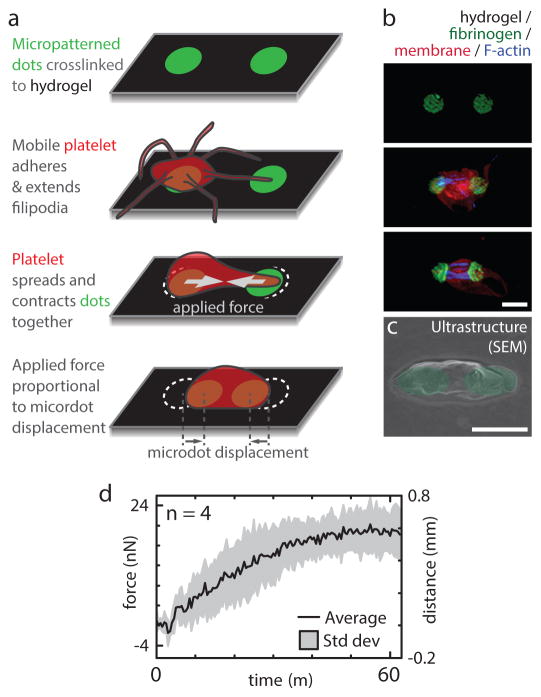
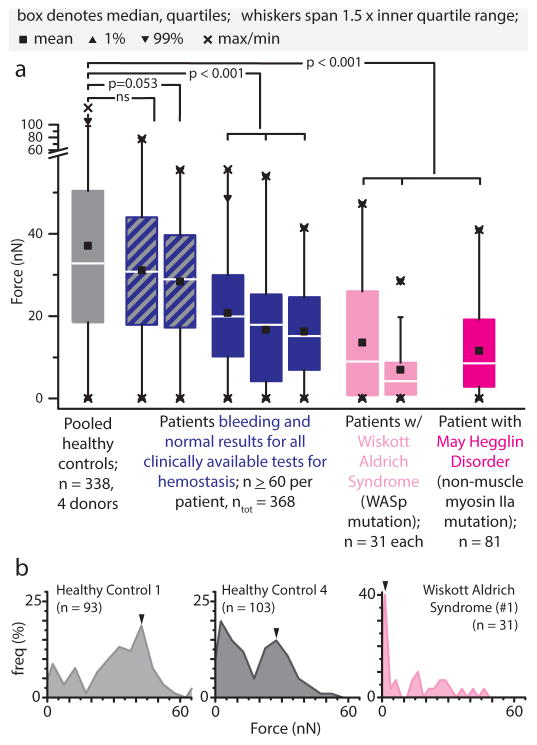
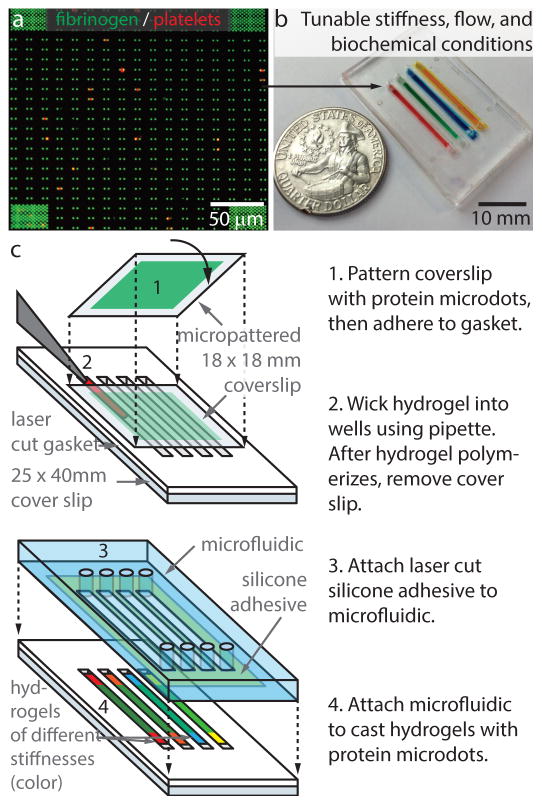
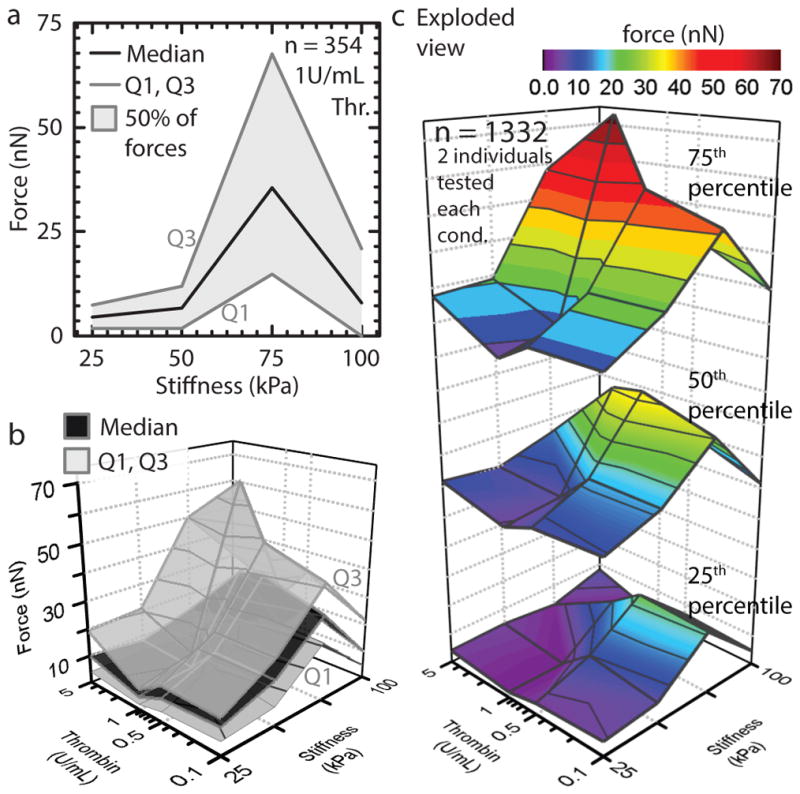
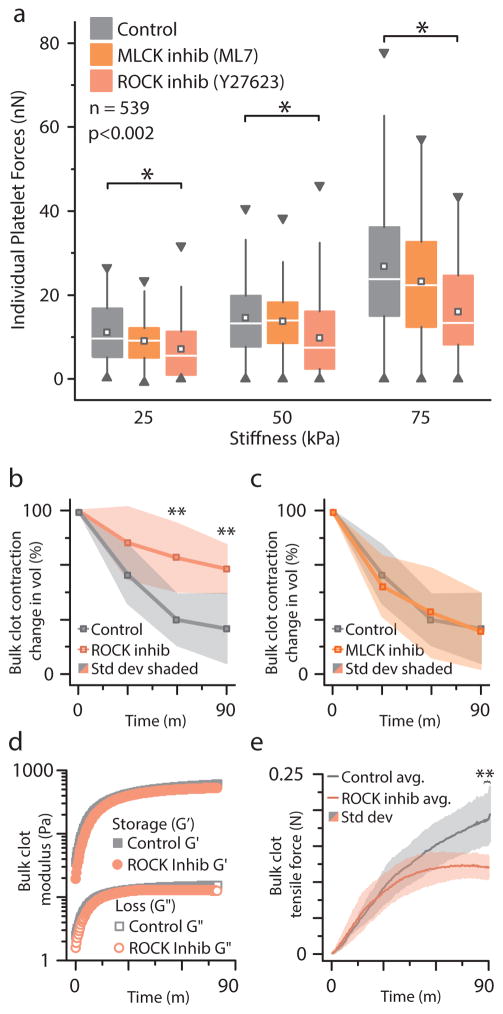
Haemostasis occurs at sites of vascular injury, where flowing blood forms a clot, a dynamic and heterogeneous fibrin-based biomaterial. Paramount in the clot's capability to stem haemorrhage are its changing mechanical properties, the major drivers of which are the contractile forces exerted by platelets against the fibrin scaffold. However, how platelets transduce microenvironmental cues to mediate contraction and alter clot mechanics is unknown. This is clinically relevant, as overly softened and stiffened clots are associated with bleeding and thrombotic disorders. Here, we report a high-throughput hydrogel-based platelet-contraction cytometer that quantifies single-platelet contraction forces in different clot microenvironments. We also show that platelets, via the Rho/ROCK pathway, synergistically couple mechanical and biochemical inputs to mediate contraction. Moreover, highly contractile platelet subpopulations present in healthy controls are conspicuously absent in a subset of patients with undiagnosed bleeding disorders, and therefore may function as a clinical diagnostic biophysical biomarker.
止血发生在血管损伤部位,在那里流动的血液形成凝块,这是一种动态且异质的基于纤维蛋白的生物材料。凝块阻止出血的能力中至关重要的是其不断变化的力学性质,其主要驱动因素是血小板对纤维蛋白支架施加的收缩力。然而,血小板如何转导微环境信号来介导收缩并改变凝块力学尚不清楚。这在临床上具有相关性,因为过度软化和硬化的凝块与出血和血栓形成性疾病有关。在这里,我们报告了一种基于高通量水凝胶的血小板收缩细胞仪,该仪器可量化不同凝块微环境中的单血小板收缩力。我们还表明,血小板通过Rho/ROCK途径协同耦合机械和生化输入来介导收缩。此外,在未确诊的出血性疾病患者的一个亚组中,健康对照中存在的高收缩性血小板亚群明显缺失,因此可能作为临床诊断生物物理生物标志物发挥作用。