Cole Michael W, Ito Takuya, Bassett Danielle S, Schultz Douglas H
Center for Molecular and Behavioral Neuroscience, Rutgers University, Newark, New Jersey, USA.
Department of Bioengineering, University of Pennsylvania, Philadelphia, Pennsylvania, USA.
Nat Neurosci. 2016 Dec;19(12):1718-1726. doi: 10.1038/nn.4406. Epub 2016 Oct 10.
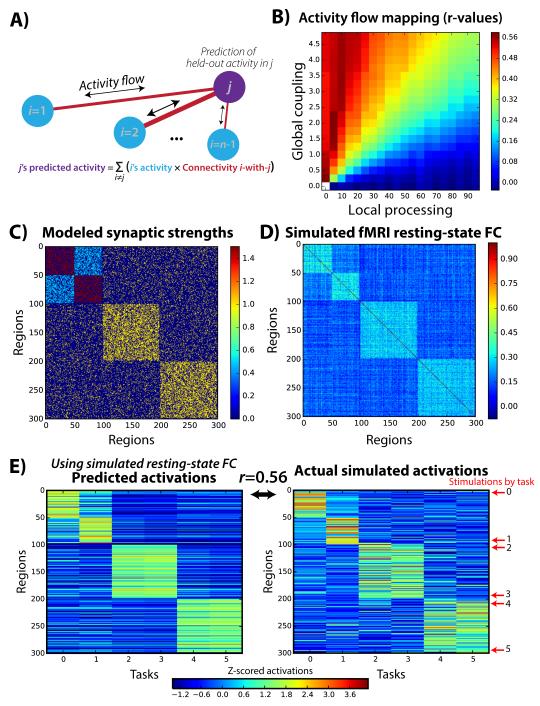
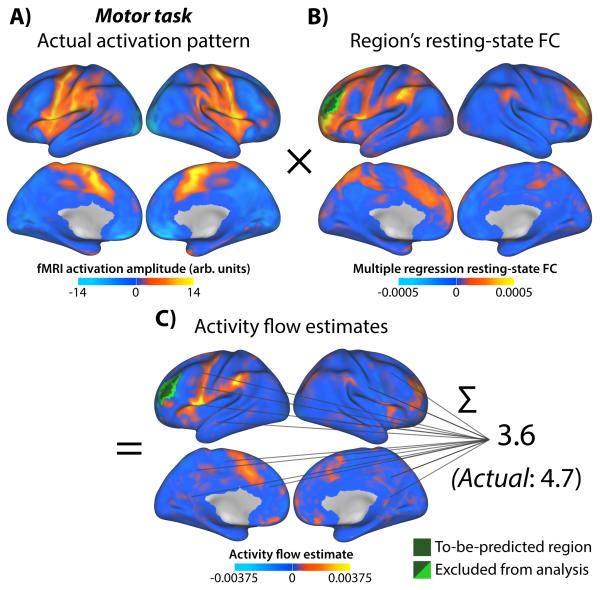
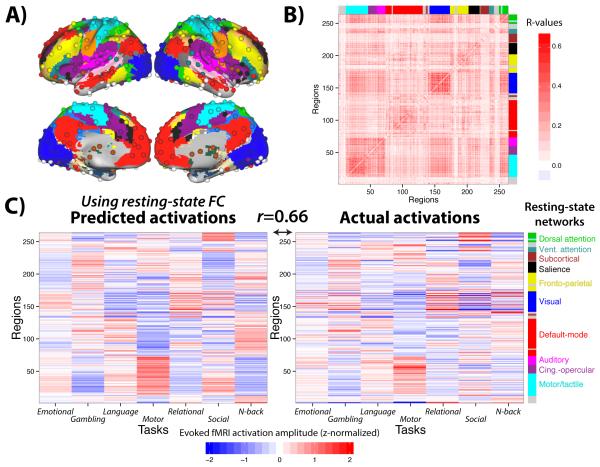
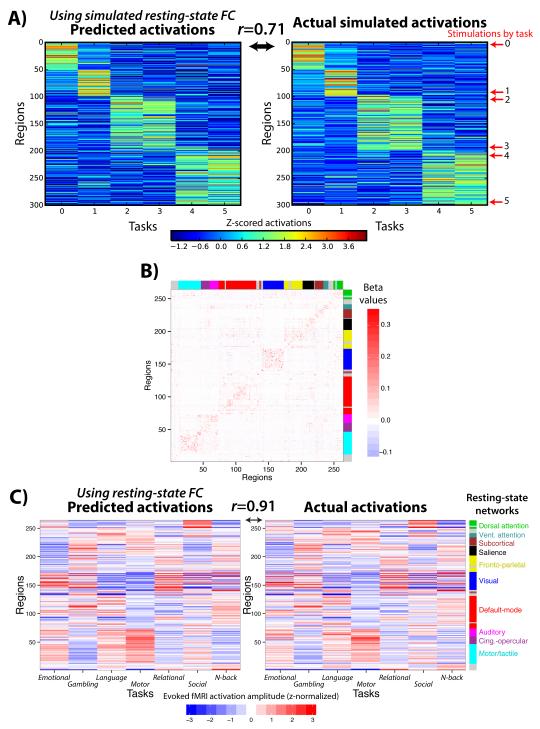
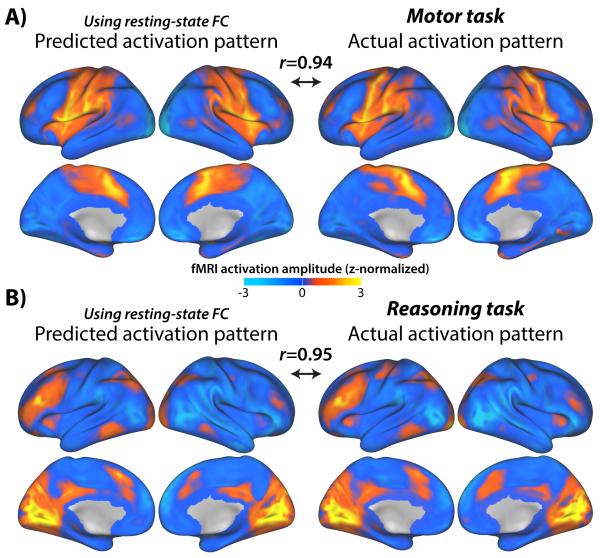
Resting-state functional connectivity (FC) has helped reveal the intrinsic network organization of the human brain, yet its relevance to cognitive task activations has been unclear. Uncertainty remains despite evidence that resting-state FC patterns are highly similar to cognitive task activation patterns. Identifying the distributed processes that shape localized cognitive task activations may help reveal why resting-state FC is so strongly related to cognitive task activations. We found that estimating task-evoked activity flow (the spread of activation amplitudes) over resting-state FC networks allowed prediction of cognitive task activations in a large-scale neural network model. Applying this insight to empirical functional MRI data, we found that cognitive task activations can be predicted in held-out brain regions (and held-out individuals) via estimated activity flow over resting-state FC networks. This suggests that task-evoked activity flow over intrinsic networks is a large-scale mechanism explaining the relevance of resting-state FC to cognitive task activations.
静息态功能连接(FC)有助于揭示人类大脑的内在网络组织,但其与认知任务激活的相关性尚不清楚。尽管有证据表明静息态FC模式与认知任务激活模式高度相似,但不确定性依然存在。确定塑造局部认知任务激活的分布式过程可能有助于揭示为何静息态FC与认知任务激活密切相关。我们发现,在静息态FC网络上估计任务诱发的活动流(激活幅度的传播)能够在大规模神经网络模型中预测认知任务激活。将这一见解应用于经验性功能磁共振成像数据,我们发现,通过在静息态FC网络上估计的活动流,可以在留出的脑区(和留出的个体)中预测认知任务激活。这表明内在网络上的任务诱发活动流是一种大规模机制,解释了静息态FC与认知任务激活的相关性。