Han Jae-Young, Kim Jae-Hong, Park Ju-Hyung, Song Min-Yeong, Song Min-Keun, Kim Dong-Joo, You Young-Nim, Park Gwang-Cheon, Choi Jin-Bong, Cho Myung-Rae, Shin Jeong-Cheol, Cho Ji-Hyun
Department of Physical and Rehabilitation Medicine, Chonnam National University Medical School and Hospital, 42, Jebong-ro, Dong-gu, Gwangju City, 61469, Republic of Korea.
Department of Acupuncture and Moxibustion Medicine, College of Traditional Korean Medicine, Dong-Shin University, 185, Geonjae-ro, Naju City, 58245, Republic of Korea.
Trials. 2016 Oct 11;17(1):490. doi: 10.1186/s13063-016-1611-y.
Scalp acupuncture (SA) and repetitive transcranial magnetic stimulation (rTMS) are effective for treating cerebral infarction. This study aims to examine the efficacy and safety of SA and electromagnetic convergence stimulation (SAEM-CS), which was developed through collaboration between conventional medical physicians and doctors who practice traditional Korean medicine. SAEM-CS was designed to improve function in patients with cerebral infarction, compared to the improvement after conventional stroke rehabilitation, SA, and rTMS therapeutic approaches.
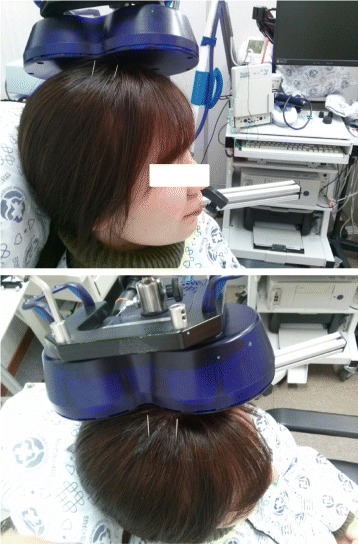
METHODS/DESIGN: This study is a prospective, outcome assessor-blinded, randomized controlled clinical trial with a 1:1:1:1 allocation ratio. Participants with motion or sensory disabilities caused by a first-time cerebral infarction (n = 60) that had occurred within 1 month of the study onset will be randomly assigned to control, SA, rTMS, or SAEM-CS groups. All groups will receive two sessions of conventional rehabilitation treatment per day. The SA group will receive SA on the upper limb area of MS6 and MS7 (at the lesional hemisphere) for 20 min, the rTMS group will receive low-frequency rTMS (LF-rTMS) treatment on the hot spot of the M1 region (motor cortex at the contralesional hemisphere) for 20 min, and the SAEM-CS group will receive LF-rTMS over the contralesional M1 region hot spot while receiving simultaneous SA stimulation on the lesional upper limb area of MS6 and MS7 for 20 min. SA, rTMS, and SAEM-CS treatments will be conducted once/day, 5 days/week (excluding Saturdays and Sundays) for 3 weeks, for a total of 15 sessions. The primary outcome will be evaluated using the Fugl-Meyer Assessment, while other scales assessing cognitive function, activities of daily living, walking, quality of life, and stroke severity are considered secondary outcome measures. Outcome measurements will be conducted at baseline (before intervention), 3 weeks after the first intervention (end of intervention), and 4 weeks after intervention completion.
This study aims to explore the efficacy and safety of SAEM-CS on cerebral infarction. Collaborative research combined traditional Korean and conventional medicines, which can be useful in developing new treatment technologies.
KCT0001768 . Registered on 14 January 2016.
头皮针(SA)和重复经颅磁刺激(rTMS)对治疗脑梗死有效。本研究旨在检验SA与电磁融合刺激(SAEM-CS)的疗效和安全性,SAEM-CS是由传统医学医生和韩国传统医学从业者合作开发的。与传统中风康复、SA和rTMS治疗方法后的改善相比,SAEM-CS旨在改善脑梗死患者的功能。
方法/设计:本研究是一项前瞻性、结果评估者盲法、随机对照临床试验,分配比例为1:1:1:1。在研究开始后1个月内首次发生脑梗死导致运动或感觉障碍的参与者(n = 60)将被随机分配到对照组、SA组、rTMS组或SAEM-CS组。所有组每天将接受两节课的传统康复治疗。SA组将在MS6和MS7的上肢区域(在病灶半球)进行SA治疗20分钟,rTMS组将在M1区域(对侧半球的运动皮层)的热点进行低频rTMS(LF-rTMS)治疗20分钟,SAEM-CS组将在对侧M1区域热点接受LF-rTMS治疗,同时在病灶上肢区域的MS6和MS7接受同步SA刺激20分钟。SA、rTMS和SAEM-CS治疗将每天进行一次,每周5天(周六和周日除外),持续3周,共15次。主要结局将使用Fugl-Meyer评估进行评估,而评估认知功能、日常生活活动、步行、生活质量和中风严重程度的其他量表被视为次要结局指标。结局测量将在基线(干预前)、首次干预后3周(干预结束时)和干预完成后4周进行。
本研究旨在探讨SAEM-CS对脑梗死的疗效和安全性。合作研究结合了韩国传统医学和传统医学,这可能有助于开发新的治疗技术。
KCT0001768。于2016年1月14日注册。