Dorji Kinley
Horticulture Division, Department of Agriculture, Thimphu, Bhutan.
Renewable Natural Resources Research and Development Center, Bajo, Wangdue, Bhutan.
BMC Ecol. 2016 Oct 11;16(1):45. doi: 10.1186/s12898-016-0100-1.
Human beings use plants for a multitude of purposes of which a prominent one across the globe is for their medicinal values. Medicinal plants serve as one of the major sources of income for high altitude inhabitants in the Himalaya, particularly in countries like Nepal, and Bhutan. People here harvest huge volumes of medicinal plants indiscriminately, risking their sustainability. This paper attempts to identify some of the priority medicinal plant species harvested in the wild and assess their ecological status for their judicious utilization, and to help provide policy guidance for possible domestication and support strategic conservation frameworks.
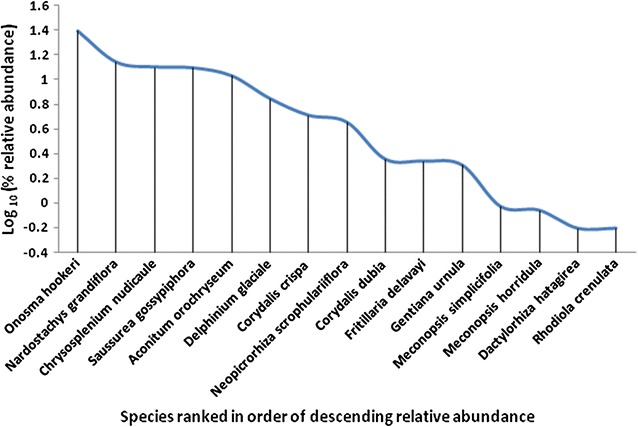
Out of the 16 priority species identified by the expert group, collectors' perception on ecological status of the priority species differed from survey findings. Chrysosplenium nudicaule (clumps) ranked as most threatened species followed by Corydalis dubia, and Meconopsis simplicifolia. Onosma hookeri, Corydalis crispa and Delphinium glaciale were some of the species ranked as threatened species followed by Halenia elliptica (not in priority list). Percent relative abundance showed irregular pattern of species distribution. High species evenness was recorded among Nardostachys grandiflora, Chrysosplenium nudicaule, Saussurea gossypiphora and Aconitum orochryseum with average species density of 8 plant m. Rhodiola crenulata, and Dactylorhiza hatagirea followed by Meconopsis horridula and Meconopsis simplicifolia were ranked as most threatened species with average species density of 0.4, 0.4, 5.6 and 6.0 plant m, respectively. The most abundant (common) species was Onosma hookeri (plant m). Species composition and density also differed with vegetation, altitude, slope and its aspects.
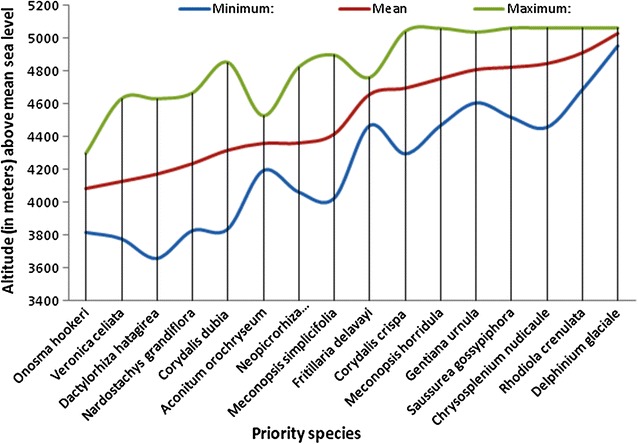
Priority species identified by expert group were found vulnerable and patchy in distribution. Survey results and collectors' perceptions tally to an extent. Some of the species (Dactylorhiza hatagirea, Rhodiola crenulata, Meconopsis simplicifolia and Meconopsis horridula) were critically low in plant density with less than a plant per m while Delphinium glaciale, Fritillaria delavayi and Aconitum orochryseum were confined to narrow altitude range. Collectors were aware that most species identified in priority list are threatened and existing harvesting plan are hardly implemented as it is not pragmatic. Moreover, major chunk of medicinal plants harvested remain unaccounted as illegal harvest and marketing seemed to occur across the borders. Policing and monitoring would continue to be a challenge given the rugged terrain and harsh climate. In-depth study and further monitoring of low density species is suggested to ensure its sustainability through long term strategy development.
人类将植物用于多种目的,其中在全球范围内一个突出的用途是其药用价值。药用植物是喜马拉雅地区高海拔居民的主要收入来源之一,特别是在尼泊尔和不丹等国家。这里的人们无差别地大量采收药用植物,危及它们的可持续性。本文试图确定一些野外采收的重点药用植物物种,并评估它们的生态状况以便合理利用,同时为可能的驯化提供政策指导并支持战略保护框架。
在专家组确定的16种重点物种中,采集者对重点物种生态状况的认知与调查结果不同。裸茎金腰(丛生)被列为受威胁最严重的物种,其次是黄堇和单叶绿绒蒿。西藏微孔草、皱叶黄堇和冰川翠雀花等一些物种被列为受威胁物种,其次是椭圆叶花锚(不在重点名单中)。相对丰度百分比显示出物种分布的不规则模式。在大花甘松、裸茎金腰、棉毛风毛菊和黄草乌中记录到较高的物种均匀度,平均物种密度为每平方米8株植物。粗茎红景天和裂叶舌唇兰,其次是多刺绿绒蒿和单叶绿绒蒿被列为受威胁最严重的物种,平均物种密度分别为每平方米0.4株、0.4株、5.6株和6.0株。最丰富(常见)的物种是西藏微孔草(每平方米植株数)。物种组成和密度也因植被、海拔、坡度及其朝向而异。
专家组确定的重点物种分布脆弱且零散。调查结果与采集者的认知在一定程度上相符。一些物种(裂叶舌唇兰、粗茎红景天、单叶绿绒蒿和多刺绿绒蒿)的植株密度极低,每平方米不到1株,而冰川翠雀花、暗紫贝母和黄草乌则局限于狭窄的海拔范围。采集者意识到重点名单中的大多数物种受到威胁,现有的采收计划几乎无法实施,因为它不切实际。此外,采收的大部分药用植物未入账,因为非法采收和销售似乎跨境发生。鉴于地形崎岖和气候恶劣,监管和监测仍将是一项挑战。建议对低密度物种进行深入研究和进一步监测,以通过制定长期战略确保其可持续性。