Gilchrist Francis J, Belcher John, Jones Andrew M, Smith David, Smyth Alan R, Southern Kevin W, Španěl Patrik, Webb A Kevin, Lenney Warren
Academic Department of Child Health, University Hospital of North Staffordshire, Stoke on Trent, UK; Institute of Science and Technology in Medicine, Keele University, Keele, UK.
School of Computing and Mathematics, Keele University, Keele, UK.
ERJ Open Res. 2015 Nov 16;1(2). doi: 10.1183/23120541.00044-2015. eCollection 2015 Oct.
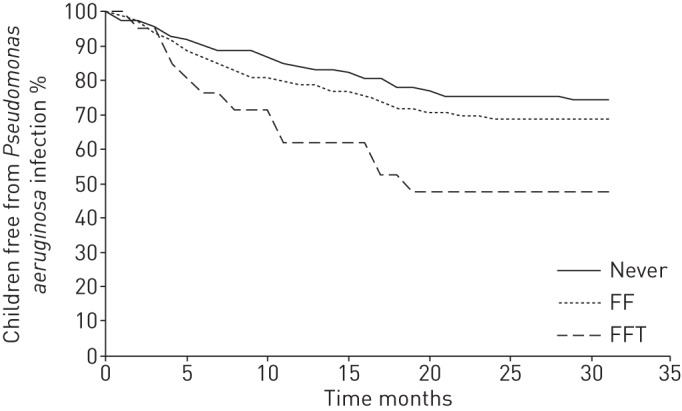
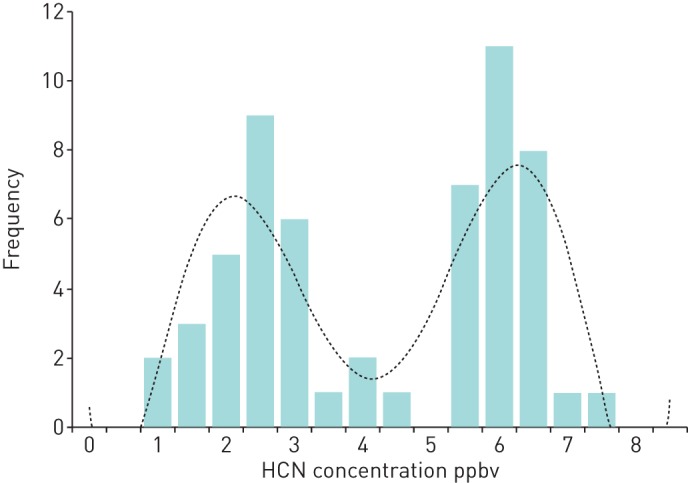
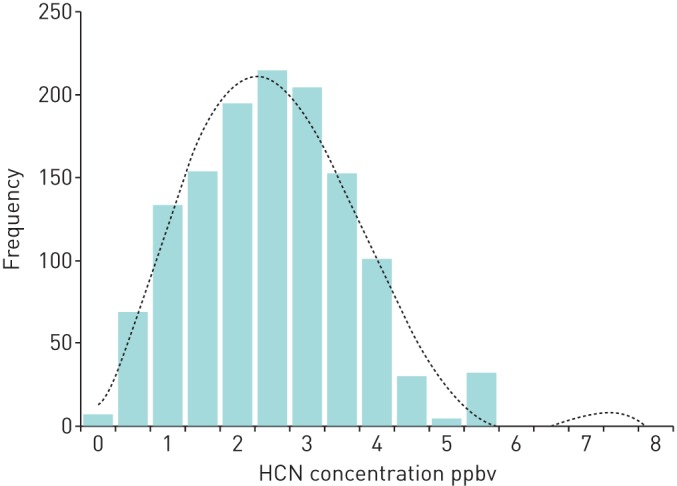
Hydrogen cyanide is readily detected in the headspace above cultures and in the breath of cystic fibrosis (CF) patients with chronic () infection. We investigated if exhaled breath HCN is an early marker of infection. 233 children with CF who were free from infection were followed for 2 years. Their median (interquartile range) age was 8.0 (5.0-12.2) years. At each study visit, an exhaled breath sample was collected for hydrogen cyanide analysis. In total, 2055 breath samples were analysed. At the end of the study, the hydrogen cyanide concentrations were compared to the results of routine microbiology surveillance. was isolated from 71 children during the study with an incidence (95% CI) of 0.19 (0.15-0.23) cases per patient-year. Using a random-effects logistic model, the estimated odds ratio (95% CI) was 3.1 (2.6-3.6), which showed that for a 1- ppbv increase in exhaled breath hydrogen cyanide, we expected a 212% increase in the odds of infection. The sensitivity and specificity were estimated at 33% and 99%, respectively. Exhaled breath hydrogen cyanide is a specific biomarker of new infection in children with CF. Its low sensitivity means that at present, hydrogen cyanide cannot be used as a screening test for this infection.
在培养物上方的顶空中以及患有慢性()感染的囊性纤维化(CF)患者的呼出气体中很容易检测到氰化氢。我们研究了呼出气体中的HCN是否是感染的早期标志物。对233名未感染的CF儿童进行了为期2年的随访。他们的年龄中位数(四分位间距)为8.0(5.0 - 12.2)岁。在每次研究访视时,收集呼出气体样本进行氰化氢分析。总共分析了2055份呼出气体样本。在研究结束时,将氰化氢浓度与常规微生物学监测结果进行比较。在研究期间,从71名儿童中分离出了(),发病率(95%CI)为每患者年0.19(0.15 - 0.23)例。使用随机效应逻辑模型,估计的优势比(95%CI)为3.1(2.6 - 3.6),这表明呼出气体中氰化氢每增加1 ppbv,我们预计感染的几率会增加212%。敏感性和特异性分别估计为33%和99%。呼出气体中的氰化氢是CF儿童新发()感染的特异性生物标志物。其低敏感性意味着目前氰化氢不能用作这种感染的筛查试验。