National Center of Sports Medicine, Warsaw, Poland.
Department of Applied Physiology, Mossakowski Medical Research Centre PAS, Warsaw, Poland.
PLoS One. 2016 Oct 12;11(10):e0164395. doi: 10.1371/journal.pone.0164395. eCollection 2016.
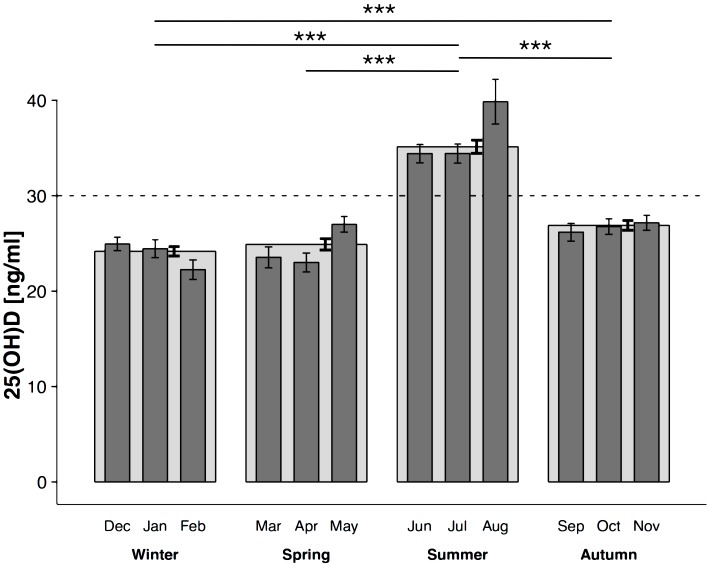
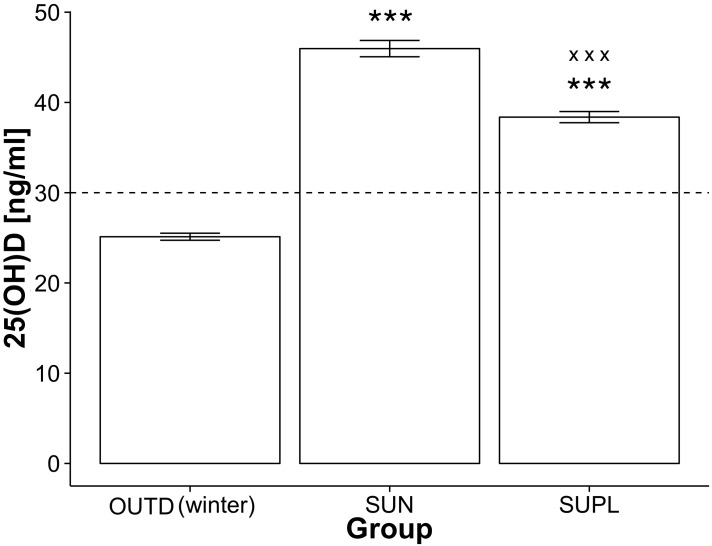
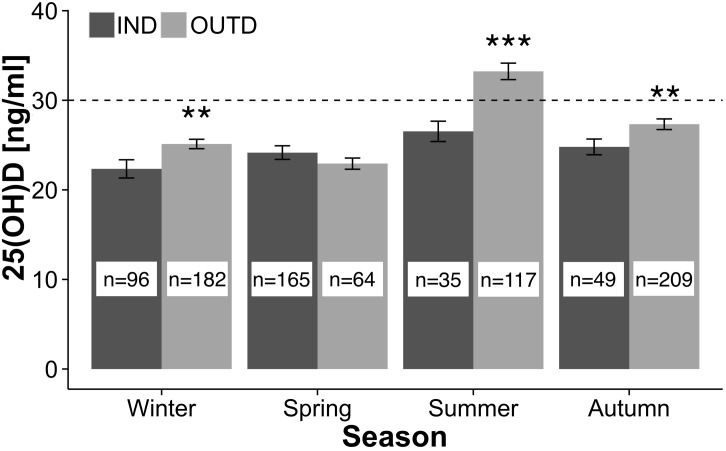
Vitamin D does not only influence the musculoskeletal health and mineral homeostasis but it also affects cardiovascular, endocrine, nervous, immune and mental functions, thus it is of considerable importance for both physically active people and elite athletes. However, vitamin D deficiency is common worldwide and results from inadequate endogenous skin synthesis (insufficient ultraviolet B exposure) and diet. To improve the vitamin D status elite athletes often travel to lower latitude during winter. The aim of the study was to evaluate the seasonal vitamin D status in Polish elite athletes according to the sun exposure and oral supplementation. Serum concentration of 25-hydroxyvitamin D (25(OH)D) was measured in the years 2010-2014 in 409 elite athletes, who were divided into the following groups: OUTD-outdoor sports, represented by track and field athletes, who trained in Poland; IND-weightlifters, handball and volleyball players who trained indoors in Poland; SUN-track and field athletes who trained during Polish winter in lower latitude with high sunshine exposure; SUPL-track and field athletes who trained in Poland, had an inadequate vitamin D status (25(OH)D < 30 ng/ml) and were supplemented orally. Inadequate Vitamin D status was observed in 80% of OUTD and 84% of IND athletes in winter, whereas in summer the values amounted to 42% and 83%, respectively. The athletes exposed to sun in winter had significantly higher vitamin D concentration than OUTD group. Oral supplementation improved vitamin D concentration by 45%, whereas winter sun exposure caused its increase by 85%. Except for a few summer months an inadequate status of vitamin D was found in the majority of Polish elite athletes, with the deficiency level being similar to the one observed in non-athletic population. The most serious deficiency was observed in indoor disciplines. Adequate vitamin D status can be achieved by both increased sun exposure, especially in winter, and oral supplementation. Athletes should therefore routinely assess their vitamin D status and be educated how to approach their sunlight exposure, diet and supplementation.
维生素 D 不仅影响骨骼肌肉健康和矿物质稳态,还影响心血管、内分泌、神经、免疫和精神功能,因此对经常运动的人和精英运动员都非常重要。然而,维生素 D 缺乏在世界范围内很常见,是由于内源性皮肤合成不足(紫外线 B 暴露不足)和饮食造成的。为了改善维生素 D 状况,精英运动员经常在冬季前往低纬度地区。本研究的目的是根据阳光照射和口服补充来评估波兰精英运动员的季节性维生素 D 状况。2010-2014 年,对 409 名精英运动员的血清 25-羟维生素 D(25(OH)D)浓度进行了测量,他们被分为以下几组:OUTD-户外运动组,代表波兰训练的田径运动员;IND-室内运动组,代表波兰室内训练的举重运动员、手球和排球运动员;SUN-田径运动员,在冬季前往低纬度地区接受高阳光照射训练;SUPL-田径运动员,在波兰训练,维生素 D 状态不足(25(OH)D < 30 ng/ml),并口服补充。冬季,80%的 OUTD 和 84%的 IND 运动员存在维生素 D 状态不足,而夏季则分别为 42%和 83%。冬季接受阳光照射的运动员的维生素 D 浓度明显高于 OUTD 组。口服补充可使维生素 D 浓度提高 45%,而冬季阳光照射可使维生素 D 浓度提高 85%。除了少数夏季月份外,大多数波兰精英运动员的维生素 D 状态不足,缺乏水平与非运动员人群相似。室内运动项目中维生素 D 缺乏最为严重。增加阳光照射,尤其是在冬季,以及口服补充都可以使维生素 D 状态达到足够。因此,运动员应定期评估其维生素 D 状况,并接受有关如何接触阳光、饮食和补充剂的教育。