Lee Christopher S, Davis Shane M, Doremus Brittany, Kouk Shalen, Stetson William B
Stetson Powell Orthopedics and Sports Medicine, Burbank, California, USA.
Orthop J Sports Med. 2016 Sep 28;4(9):2325967116667058. doi: 10.1177/2325967116667058. eCollection 2016 Sep.
At present, there is no widely accepted classification system for partial-thickness rotator cuff tears, and as a result, optimal treatment remains controversial.
To examine the interobserver reliability and accuracy of classifying partial rotator cuff tears using the Snyder classification system. We hypothesized that the Snyder classification would be reproducible with high reliability and accuracy.
Cohort study (diagnosis); Level of evidence, 2.
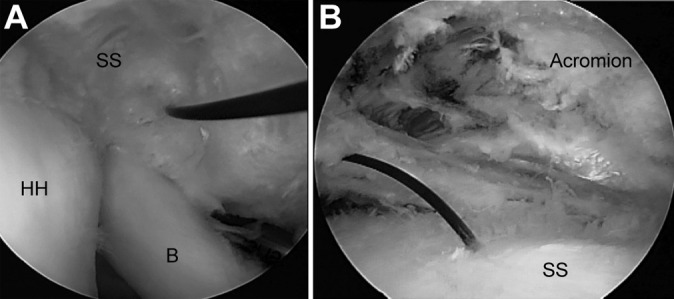
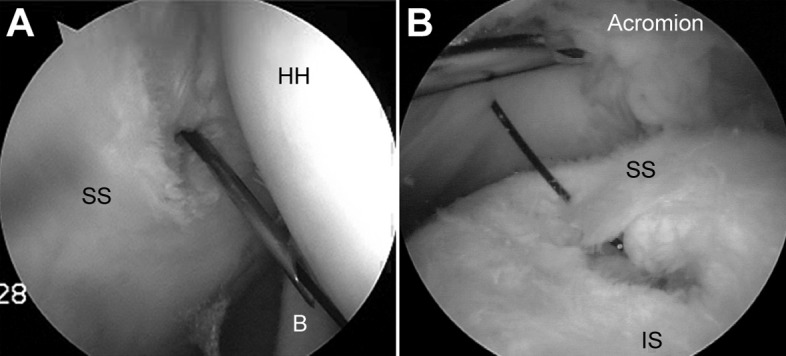
Twenty-seven orthopaedic surgeons reviewed 10 video-recorded shoulder arthroscopies. Each surgeon was provided with a description of the Snyder classification system for partial-thickness rotator cuff tears and was then instructed to use this system to describe each tear. Interrater kappa statistics and percentage agreement between observers were calculated to measure the level of agreement. Surgeon experience as well as fellowship training was evaluated to determine possible correlations.
A kappa coefficient of 0.512 indicated moderate reliability between surgeons using the Snyder classification to describe partial-thickness rotator cuff tears. The mean correct score was 80%, which indicated "very good" agreement. There was no correlation between the number of shoulder arthroscopies performed per year and fellowship training and the number of correct scores.
The Snyder classification system is reproducible and can be used in future research studies in analyzing the treatment options of partial rotator cuff tears.
目前,对于部分厚度肩袖撕裂尚无广泛接受的分类系统,因此,最佳治疗方案仍存在争议。
使用斯奈德分类系统检查观察者间对部分肩袖撕裂进行分类的可靠性和准确性。我们假设斯奈德分类具有高可靠性和准确性且可重复。
队列研究(诊断);证据等级,2级。
27名骨科医生查看了10例肩部关节镜手术的录像。向每位医生提供了关于部分厚度肩袖撕裂的斯奈德分类系统的描述,然后指示他们使用该系统描述每例撕裂。计算观察者间的kappa统计量和百分比一致性以衡量一致程度。评估医生的经验以及专科培训情况以确定可能的相关性。
kappa系数为0.512,表明使用斯奈德分类描述部分厚度肩袖撕裂的医生之间具有中等可靠性。平均正确得分率为80%,表明一致性“非常好”。每年进行的肩部关节镜手术数量、专科培训与正确得分数量之间无相关性。
斯奈德分类系统具有可重复性,可用于未来分析部分肩袖撕裂治疗方案的研究。