Siddiqui Zaigham Faraz, Krempl Georg, Spiliopoulou Myra, Peña Jose M, Paul Nuria, Maestu Fernando
Research Lab "Knowledge Management and Discovery" (KMD), Faculty of Computer Science, Otto-von-Guericke University Magdeburg, Magdeburg, Germany.
CeSViMa Supercomputing and Visualization Center, Technical University of Madrid, Madrid, Spain.
Brain Inform. 2015 Mar;2(1):33-44. doi: 10.1007/s40708-015-0010-6. Epub 2015 Feb 27.
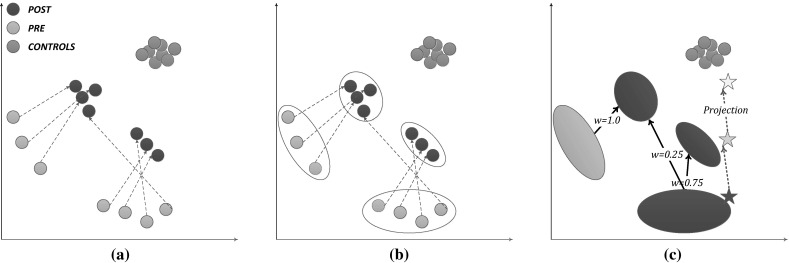
Predicting the evolution of individuals is a rather new mining task with applications in medicine. Medical researchers are interested in the progression of a disease and/or how do patients evolve or recover when they are subjected to some treatment. In this study, we investigate the problem of patients' evolution on the basis of medical tests before and after treatment after brain trauma: we want to understand to what extend a patient can become similar to a healthy participant. We face two challenges. First, we have less information on healthy participants than on the patients. Second, the values of the medical tests for patients, even after treatment started, remain well-separated from those of healthy people; this is typical for neurodegenerative diseases, but also for further brain impairments. Our approach encompasses methods for modelling patient evolution and for predicting the health improvement of different patients' subpopulations, i.e. prediction of label if they recovered or not. We test our approach on a cohort of patients treated after brain trauma and a corresponding cohort of controls.
预测个体的病情发展是一项相对较新的挖掘任务,在医学领域有应用。医学研究人员对疾病的进展以及患者在接受某种治疗时如何演变或康复感兴趣。在本研究中,我们基于脑外伤患者治疗前后的医学检查来研究患者的病情发展问题:我们想了解患者在多大程度上能够变得与健康参与者相似。我们面临两个挑战。第一,与患者相比,我们掌握的健康参与者的信息较少。第二,即使在开始治疗后,患者的医学检查值与健康人的检查值仍有很大差异;这在神经退行性疾病中很典型,在其他脑部损伤中也是如此。我们的方法包括对患者病情发展进行建模以及预测不同患者亚群健康改善情况的方法,即预测他们是否康复的标签。我们在一组脑外伤后接受治疗的患者以及相应的对照组中测试了我们的方法。