Ilie Gabriela, Cusimano Michael D, Li Wenshan
Faculty of Medicine, Dalhousie University, 5790 University Avenue, 4th Floor, Rm. 401, Halifax, NS, B3H 4R2, Canada.
Dalla Lana School of Public Health and Department of Surgery, University of Toronto, Toronto, Canada.
Syst Rev. 2017 Jan 4;6(1):1. doi: 10.1186/s13643-016-0385-3.
Traumatic brain injury (TBI) survivors often report difficulties with understanding and producing paralinguistic cues, as well as understanding and producing basic communication tasks. However, a large range of communicative deficits in this population cannot be adequately explained by linguistic impairment. The review examines prosodic processing performance post-TBI, its relationship with injury severity, brain injury localization, recovery and co-occurring psychiatric or mental health issues post-TBI METHODS: A systematic review using several databases including MEDLINE, EMBASE, Cochrane, LLBA (Linguistics and Language Behaviour Abstract) and Web of Science (January 1980 to May 2015), as well as a manual search of the cited references of the selected articles and the search cited features of PubMed was performed. The search was limited to comparative analyses between individuals who had a TBI and non-injured individuals (control). The review included studies assessing prosodic processing outcomes after TBI has been formally diagnosed. Articles that measured communication disorders, prosodic impairments, aphasia, and recognition of various aspects of prosody were included. Methods of summary included study characteristics, sample characteristics, demographics, auditory processing task, age at injury, brain localization of the injury, time elapsed since TBI, reports between TBI and mental health, socialization and employment difficulties. There were no limitations to the population size, age or gender. Results were reported according to the PRISMA guidelines. Two raters evaluated the quality of the articles in the search, extracted data using data abstraction forms and assessed the external and internal validity of the studies included using STROBE criteria. Agreement between the two raters was very high (Cohen's kappa = .89, P < 0.001). Results are reported according to the PRISMA guidelines.
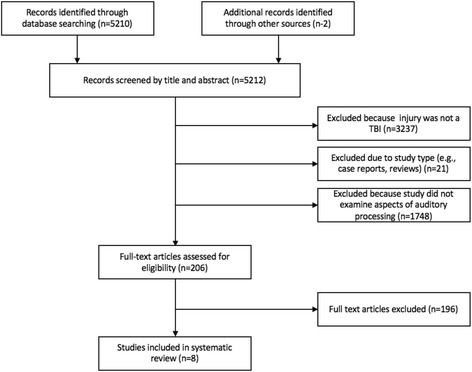
A systematic review of 5212 records between 1980 and 2015 revealed 206 potentially eligible studies and 8 case-control studies (3 perspective and 5 retrospective) met inclusion and exclusion criteria for content and quality. Performance on prosodic processing tasks was found to be impaired among all participants with a history of TBI (ages ranged from 8 to 70 years old), compared to those with no history of TBI, in all eight studies examined. Compared with controls, individuals with a history of TBI had statistically significantly slower reaction time in identifying emotions from prosody and impaired processing of prosodic information that is muffled, non-sense, competing, or in conflict (prosody versus semantics). Heterogeneous findings on correlations between specific brain locations and prosodic processing impairment were reported. Psychiatric issues, employment status or social integration post-TBI were scarcely reported but, when reported, they co-occurred with a history of TBI and prosodic impairments.
The current review confirms the relationship between impaired prosodic processing and history of TBI. Future studies should collect and report comprehensive details about severity of TBI, location of brain injury and time elapsed since injury, as they could key influence factors to the extent of prosodic processing impairments and recovery from auditory processing impairments post-TBI. The exploration of prosodic processing tasks as a possible neuropsychological marker of TBI diagnosis and recovery is warranted.
创伤性脑损伤(TBI)幸存者常常报告在理解和产生副语言线索以及理解和完成基本交流任务方面存在困难。然而,该人群中广泛的交流缺陷无法完全用语言障碍来解释。本综述考察了创伤性脑损伤后的韵律加工表现、其与损伤严重程度、脑损伤定位、恢复情况以及创伤性脑损伤后并发的精神或心理健康问题之间的关系。
采用多个数据库进行系统综述,包括MEDLINE、EMBASE、Cochrane、LLBA(语言学与语言行为摘要)和科学网(1980年1月至2015年5月),同时对手选文章的参考文献及PubMed的搜索引用特征进行手工检索。检索限于创伤性脑损伤个体与未受伤个体(对照)之间的比较分析。该综述纳入了评估创伤性脑损伤正式诊断后韵律加工结果的研究。纳入了测量交流障碍、韵律损伤、失语症以及韵律各方面识别情况的文章。总结方法包括研究特征、样本特征、人口统计学、听觉加工任务、受伤年龄、损伤的脑定位、创伤性脑损伤后的时间、创伤性脑损伤与心理健康、社交及就业困难之间的报告情况。对人群规模、年龄或性别没有限制。结果按照PRISMA指南报告。两名评估者评估检索到的文章质量,使用数据提取表提取数据,并使用STROBE标准评估纳入研究的外部和内部效度。两名评估者之间的一致性非常高(科恩kappa系数=0.89,P<0.001)。结果按照PRISMA指南报告。
对1980年至2015年间的5212条记录进行的系统综述显示,有206项潜在符合条件的研究,8项病例对照研究(3项前瞻性和5项回顾性)符合内容和质量的纳入及排除标准。在所有纳入研究的八项研究中,与无创伤性脑损伤史的参与者相比,所有有创伤性脑损伤史的参与者(年龄范围为8至70岁)在韵律加工任务上的表现均受损。与对照组相比,有创伤性脑损伤史的个体在从韵律中识别情绪时反应时间在统计学上显著更慢,并且在处理模糊、无意义、竞争性或冲突性(韵律与语义)的韵律信息方面存在损伤。报告了特定脑区与韵律加工损伤之间相关性的异质性结果。创伤性脑损伤后的精神问题、就业状况或社会融合情况很少被报告,但一旦报告,它们与创伤性脑损伤史和韵律损伤同时出现。
当前综述证实了韵律加工受损与创伤性脑损伤史之间的关系。未来研究应收集并报告有关创伤性脑损伤严重程度、脑损伤位置以及受伤后时间流逝的全面详细信息,因为它们可能是创伤性脑损伤后韵律加工损伤程度和从听觉加工损伤中恢复情况的关键影响因素。有必要探索将韵律加工任务作为创伤性脑损伤诊断和恢复的一种可能的神经心理学标志物。
