Ting Miriam, Palermo Matthew, Donatelli David P, Gaughan John P, Suzuki Jon B, Jefferies Steven R
Kornberg School of Dentistry, Temple University, 3223 North Broad Street, Philadelphia, PA, 19140, USA.
School of Medicine, Temple University, 3420 N Broad St, Philadelphia, PA, 19140, USA.
Int J Implant Dent. 2015 Dec;1(1):28. doi: 10.1186/s40729-015-0030-2. Epub 2015 Nov 3.
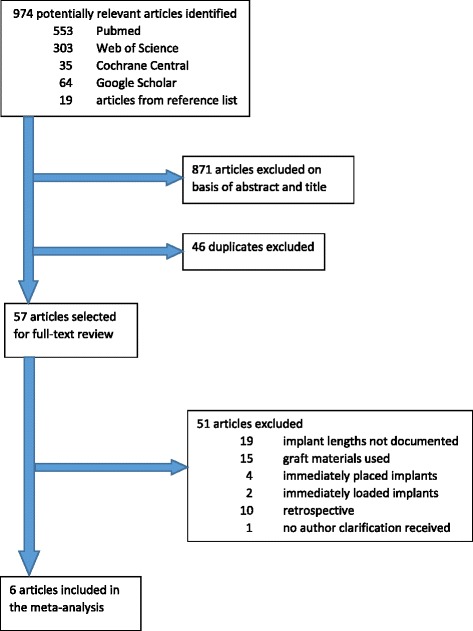
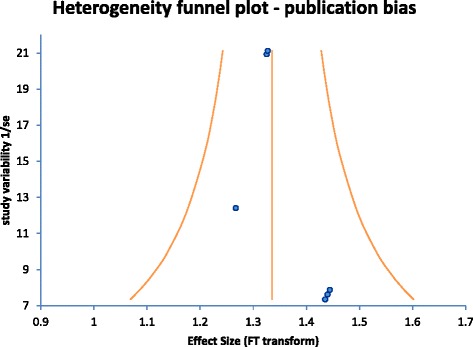
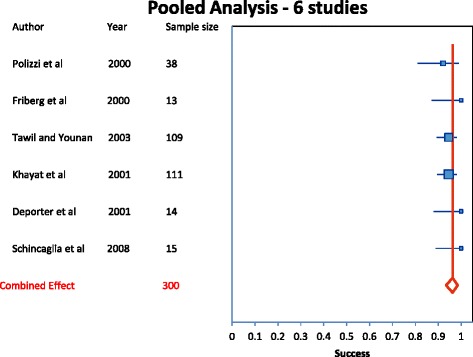
The purposes of the study are to study the implant survival of the wide-diameter implant and to analyze if the length, the implant surface, or the placement location has any effect on its survival. Electronic databases were searched from inception to Dec 2014. Studies included in the review had implants placed in areas of adequate bone width and had clear inclusion and exclusion criteria for patient selection. Immediately placed and immediately loaded implants were excluded. A meta-analysis was done using the "random effects" model on the included studies. And, a meta-regression was used to evaluate the effects of location, length, and surface on the implant survival. Of the six studies selected, three evaluated surface-treated implants and three machined implants. The overall pooled survival rate of the wide implant is 96.3 %. The meta-regression showed that when using a wide implant, neither its surface nor its length nor its position in the maxilla or mandible adversely affected its survival (P > 0.05). This meta-analysis concluded that the location, length, and surface of the wide-diameter implant did not affect its survival and therefore suggested that when the conditions of the implant site corresponded to the inclusion criteria of our meta-analysis, choosing a wide-diameter implant in the posterior mandible or maxilla, where implant length may be limited by the nerve or the sinus, the use of a short implant regardless of its surface would not affect its survival.
本研究的目的是研究大直径种植体的种植体存留情况,并分析长度、种植体表面或植入位置对其存留是否有任何影响。从数据库建立至2014年12月进行电子数据库检索。纳入本综述的研究中,种植体植入骨宽度充足的区域,且对患者选择有明确的纳入和排除标准。即刻植入和即刻加载的种植体被排除。对纳入研究使用“随机效应”模型进行荟萃分析。并且,使用荟萃回归来评估位置、长度和表面对种植体存留的影响。在所选的六项研究中,三项评估了表面处理种植体,三项评估了机械加工种植体。宽种植体的总体合并存留率为96.3%。荟萃回归显示,使用宽种植体时,其表面、长度以及在上颌或下颌中的位置均未对其存留产生不利影响(P>0.05)。本荟萃分析得出结论,大直径种植体的位置、长度和表面不影响其存留,因此表明,当种植部位的条件符合我们荟萃分析的纳入标准时,在下颌或上颌后部选择大直径种植体,此处种植体长度可能受神经或窦的限制,无论其表面如何,使用短种植体均不会影响其存留。