Siegler Jason C, Marshall Paul W M, Bishop David, Shaw Greg, Green Simon
School of Science and Health, Sport and Exercise Science, Western Sydney University, Locked Bag 1792, Penrith, NSW, Australia.
Institute of Sport, Exercise and Active Living (ISEAL), Victoria University, Melbourne, Australia.
Sports Med Open. 2016 Dec;2(1):41. doi: 10.1186/s40798-016-0065-9. Epub 2016 Oct 11.
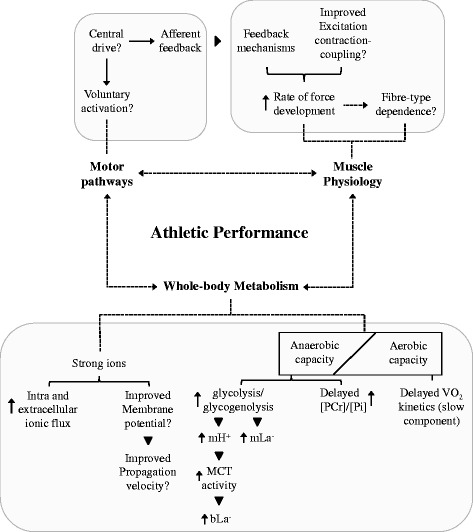
A large proportion of empirical research and reviews investigating the ergogenic potential of sodium bicarbonate (NaHCO) supplementation have focused predominately on performance outcomes and only speculate about underlying mechanisms responsible for any benefit. The aim of this review was to critically evaluate the influence of NaHCO supplementation on mechanisms associated with skeletal muscle fatigue as it translates directly to exercise performance. Mechanistic links between skeletal muscle fatigue, proton accumulation (or metabolic acidosis) and NaHCO supplementation have been identified to provide a more targeted, evidence-based approach to direct future research, as well as provide practitioners with a contemporary perspective on the potential applications and limitations of this supplement. The mechanisms identified have been broadly categorised under the sections 'Whole-body Metabolism', 'Muscle Physiology' and 'Motor Pathways', and when possible, the performance outcomes of these studies contextualized within an integrative framework of whole-body exercise where other factors such as task demand (e.g. large vs. small muscle groups), cardio-pulmonary and neural control mechanisms may outweigh any localised influence of NaHCO. Finally, the 'Performance Applications' section provides further interpretation for the practitioner founded on the mechanistic evidence provided in this review and other relevant, applied NaHCO performance-related studies.
大量关于补充碳酸氢钠(NaHCO)的促力潜能的实证研究和综述主要集中在运动表现结果上,只是推测产生任何益处的潜在机制。本综述的目的是严格评估补充NaHCO对与骨骼肌疲劳相关机制的影响,因为这直接关系到运动表现。已确定骨骼肌疲劳、质子积累(或代谢性酸中毒)与补充NaHCO之间的机制联系,以便提供一种更具针对性、基于证据的方法来指导未来的研究,并为从业者提供关于这种补充剂潜在应用和局限性的当代观点。所确定的机制大致分为“全身代谢”、“肌肉生理学”和“运动通路”几个部分,并在可能的情况下,将这些研究的运动表现结果置于全身运动的综合框架中,在这个框架中,其他因素如任务需求(例如大肌肉群与小肌肉群)、心肺和神经控制机制可能会超过NaHCO的任何局部影响。最后,“性能应用”部分基于本综述提供的机制证据以及其他相关的、应用于NaHCO性能的研究,为从业者提供了进一步的解释。