Kim Soo Jin, Shin Sang Do, Lee Eui Jung, Ro Young Sun, Song Kyoung Jun, Lee Seung Chul
Seoul National University Graduate School of Medicine, Seoul, Korea; Seoul Metropolitan Fire Service Academy, Seoul, Korea.
Department of Emergency Medicine, Seoul National University College of Medicine, Seoul, Korea.
Clin Exp Emerg Med. 2015 Jun 30;2(2):95-103. doi: 10.15441/ceem.15.013. eCollection 2015 Jun.
Suicide remains a serious, preventable public health problem. This study aims to describe the epidemiological characteristics associated with various suicide methods and to investigate outcomes after suicide-associated sudden cardiac arrest (S-SCA), stratified by different suicide attempt methods.
An S-SCA database was constructed from ambulance run sheets and augmented by a review of hospital medical records from 2008 to 2010 in Korea. The cases with non-cardiac etiologies and suicide attempts were initially extracted. Suicide attempts were classified as hanging, poisoning, fall, and other. The primary end point was survival to discharge. Age- and sex-adjusted incidence rates were calculated for each suicide method. Adjusted odds ratios for outcome were calculated with adjustments for potential confounding variables.
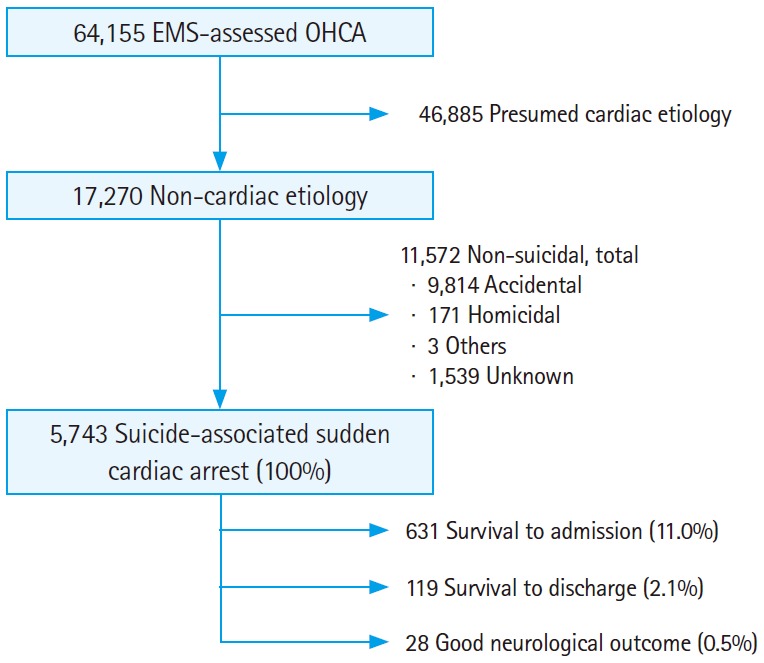
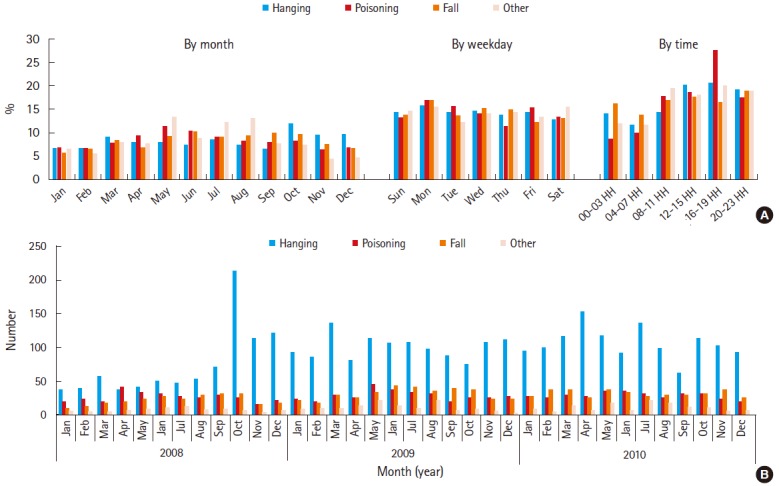
A total 5,743 patients were analyzed as S-SCAs. The most common method of suicide attempt was hanging (58.7%), followed by falls (17.6%), poisoning (17.5%), and others (5.8%). The survival to discharge rates were 2.1% (n=119) overall, 2.4% in hanging, 2.4% in poisoning and 0.5% in fall, respectively. The age- and sex-adjusted incidence rates (male/female) per million persons was 32.7 (35.8/29.7) in 2008, 41.8 (46.0/37.7) in 2009, and 43.0 (50.1/36.0) in 2010. Compared with hanging, adjusted odds ratios (95% confidence intervals) for survival to discharge was 1.05 (0.60 to 1.83) for poisoning and 0.08 (0.03 to 0.21) for falls.
In this nationwide S-SCA cohort study from 2008 to 2010, the standardized incidence rate increased annually. However, the rate of survival to discharge remains very low.
自杀仍然是一个严重的、可预防的公共卫生问题。本研究旨在描述与各种自杀方式相关的流行病学特征,并调查自杀相关的心搏骤停(S-SCA)后的结局,按不同自杀未遂方式进行分层。
从救护车出车记录构建S-SCA数据库,并通过回顾2008年至2010年韩国医院病历进行补充。最初提取非心脏病因和自杀未遂的病例。自杀未遂分为上吊、中毒、坠落和其他。主要终点是出院存活。计算每种自杀方式的年龄和性别调整发病率。对结局的调整比值比通过对潜在混杂变量进行调整来计算。
共5743例患者被分析为S-SCA。最常见的自杀未遂方式是上吊(58.7%),其次是坠落(17.6%)、中毒(17.5%)和其他(5.8%)。总体出院存活率为2.1%(n = 119),上吊为2.4%,中毒为2.4%,坠落为0.5%。2008年每百万人口年龄和性别调整发病率(男性/女性)为32.7(35.8/29.7),2009年为41.8(46.0/37.7),2010年为43.0(50.1/36.0)。与上吊相比,出院存活的调整比值比(95%置信区间)中毒为1.05(0.60至1.83),坠落为0.08(0.03至0.21)。
在这项2008年至2010年的全国性S-SCA队列研究中,标准化发病率逐年上升。然而,出院存活率仍然很低。