Department of Agro-Industry, Assumption University, Bangkok 10240, Thailand.
Taiwan Tea Experiment Station, Council of Agriculture, Taoyuan 326, Taiwan.
Molecules. 2016 Oct 12;21(10):1346. doi: 10.3390/molecules21101346.
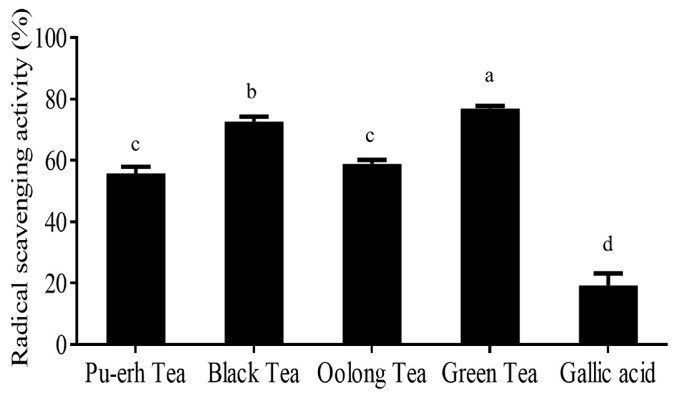
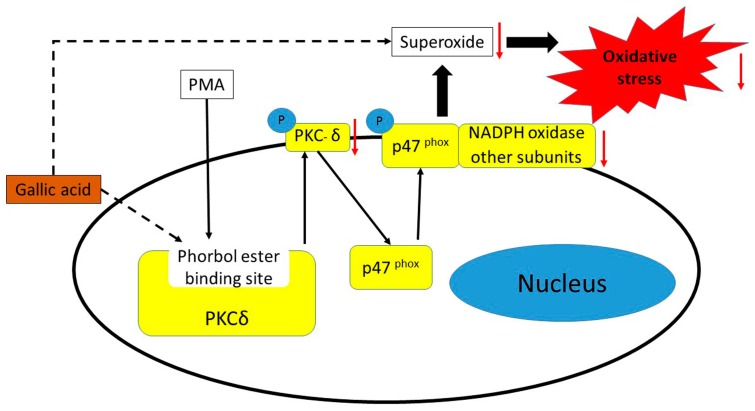
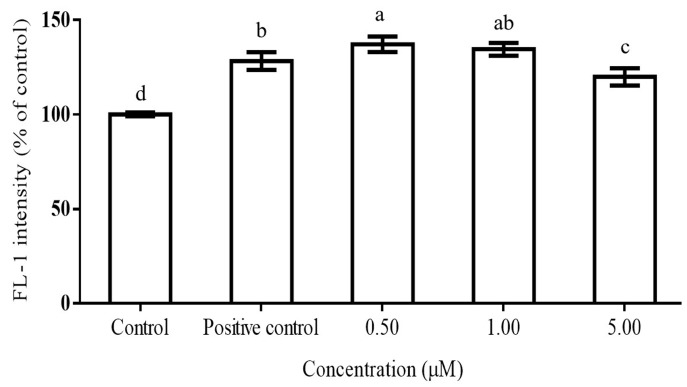
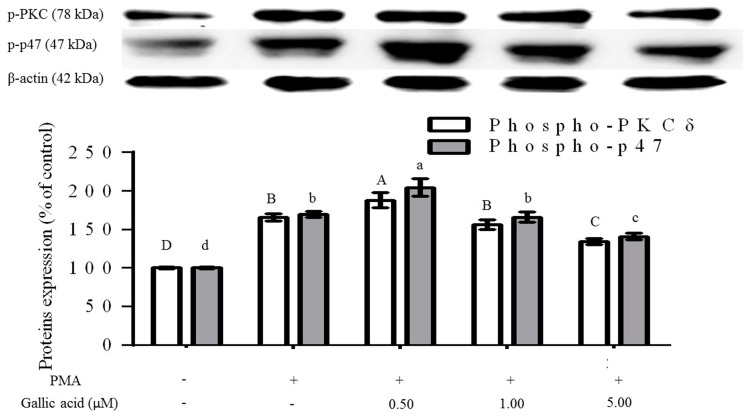
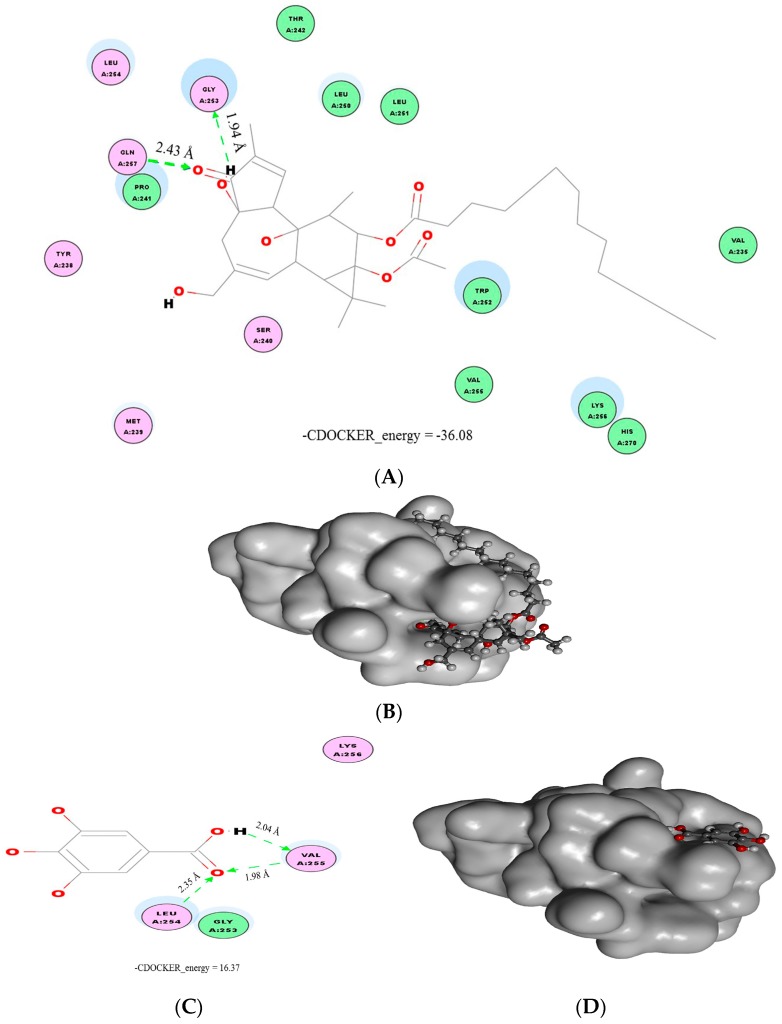
Teas can be classified according to their degree of fermentation, which has been reported to affect both the bioactive components in the teas and their antioxidative activity. In this study, four kinds of commercial Taiwanese tea at different degrees of fermentation, which include green (non-fermented), oolong (semi-fermented), black (fully fermented), and Pu-erh (post-fermented) tea, were profiled for catechin levels by using high performance liquid chromatography (HPLC). The result indicated that the gallic acid content in tea was directly proportional to the degree of fermentation in which the lowest and highest gallic acid content were 1.67 and 21.98 mg/g from green and Pu-erh tea, respectively. The antioxidative mechanism of the gallic acid was further determined by in vitro and in silico analyses. In vitro assays included the use of phorbol ester-induced macrophage RAW264.7 cell model for determining the inhibition of reactive oxygen species (ROS) production, and PKCδ and nicotinamide adenine dinucleotide phosphate (NADPH) oxidase subunit (p47) activations. The results showed that only at a concentration of 5.00 μM could gallic acid significantly ( < 0.05) reduce ROS levels in phorbol ester-activated macrophages. Moreover, protein immunoblotting expressed similar results in which activations of PKCδ and p47 were only significantly ( < 0.05) attenuated by 5.00 μM treatment. Lastly, in silico experiments further revealed that gallic acid could block PKCδ activation by occupying the phorbol ester binding sites of the protein.
茶可以根据其发酵程度进行分类,据报道,这会影响茶中的生物活性成分及其抗氧化活性。在这项研究中,对四种不同发酵程度的台湾商业茶(绿茶、乌龙茶、红茶和普洱茶)进行了儿茶素水平的分析,采用高效液相色谱法(HPLC)。结果表明,茶叶中的没食子酸含量与发酵程度成正比,其中绿茶和普洱茶中的没食子酸含量最低和最高分别为 1.67 和 21.98mg/g。进一步通过体外和计算机模拟分析确定了没食子酸的抗氧化机制。体外试验包括使用佛波酯诱导的巨噬细胞 RAW264.7 细胞模型来确定活性氧(ROS)产生的抑制作用,以及蛋白激酶 Cδ(PKCδ)和烟酰胺腺嘌呤二核苷酸磷酸(NADPH)氧化酶亚基(p47)的激活。结果表明,只有在 5.00μM 的浓度下,没食子酸才能显著(<0.05)降低佛波酯激活的巨噬细胞中的 ROS 水平。此外,蛋白质免疫印迹也表达了相似的结果,只有在 5.00μM 处理时,PKCδ 和 p47 的激活才会被显著(<0.05)减弱。最后,计算机模拟实验进一步表明,没食子酸可以通过占据蛋白的佛波酯结合位点来阻断 PKCδ 的激活。