Alenazi Noof A, Manthorpe Jeffrey M, Lai Edward P C
Department of Chemistry, Carleton University, 1125 Colonel By Drive, Ottawa, ON K1S 5B6, Canada.
Sensors (Basel). 2016 Oct 14;16(10):1697. doi: 10.3390/s16101697.
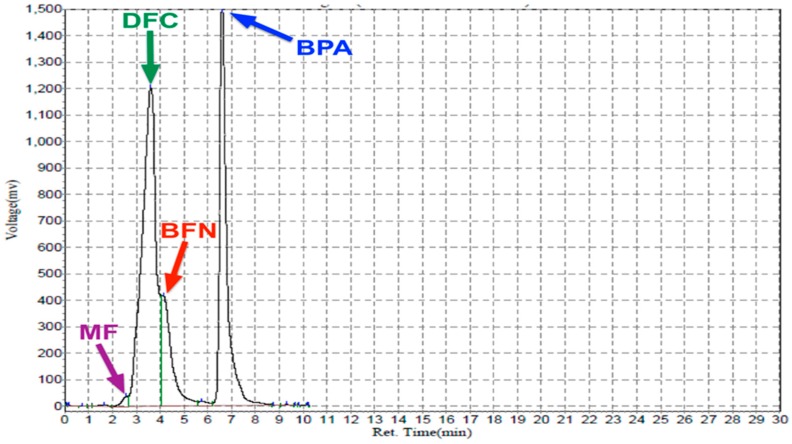
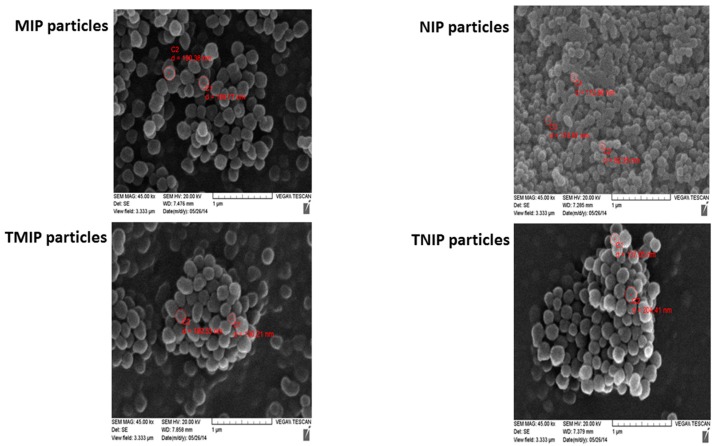
Bisphenol A (BPA) is an estrogen-mimicking chemical that can be selectively detected in water using a chemical sensor based on molecularly imprinted polymers (MIPs). However, the utility of BPA-MIPs in sensor applications is limited by the presence of non-specific binding sites. This study explored a dual approach to eliminating these sites: optimizing the molar ratio of the template (bisphenol A) to functional monomer (methacrylic acid) to cross-linker (ethylene glycol dimethacrylate), and esterifying the carboxylic acid residues outside of specific binding sites by treatment with diazomethane. The binding selectivity of treated MIPs and non-treated MIPs for BPA and several potential interferents was compared by capillary electrophoresis with ultraviolet detection. Baclofen, diclofenac and metformin were demonstrated to be good model interferents to test all MIPs for selective binding of BPA. Treated MIPs demonstrated a significant decrease in binding of the interferents while offering high selectivity toward BPA. These results demonstrate that conventional optimization of the molar ratio, together with advanced esterification of non-specific binding sites, effectively minimizes the residual binding of interferents with MIPs to facilitate BPA sensing.
双酚A(BPA)是一种具有雌激素模拟作用的化学物质,可使用基于分子印迹聚合物(MIP)的化学传感器在水中进行选择性检测。然而,BPA-MIP在传感器应用中的效用受到非特异性结合位点的限制。本研究探索了一种消除这些位点的双重方法:优化模板(双酚A)与功能单体(甲基丙烯酸)与交联剂(乙二醇二甲基丙烯酸酯)的摩尔比,并通过用重氮甲烷处理来酯化特异性结合位点之外的羧酸残基。通过带有紫外检测的毛细管电泳比较了处理过的MIP和未处理的MIP对BPA和几种潜在干扰物的结合选择性。已证明巴氯芬、双氯芬酸和二甲双胍是测试所有MIP对BPA选择性结合的良好模型干扰物。处理过的MIP显示出干扰物结合的显著降低,同时对BPA具有高选择性。这些结果表明,常规的摩尔比优化,以及非特异性结合位点的先进酯化,有效地最小化了干扰物与MIP的残留结合,以促进BPA传感。