Gaihre Santosh, Kyle Janet, Semple Sean, Smith Jo, Subedi Madhu, Marais Debbi
Division of Applied Health Sciences, University of Aberdeen, Room 1.019 Polwarth Building, Foresterhill, Aberdeen, AB25 2ZD, UK.
School of Biological Sciences, University of Aberdeen, Aberdeen, UK.
BMC Public Health. 2016 Oct 18;16(1):1093. doi: 10.1186/s12889-016-3731-4.
Although linkages have been found between agricultural interventions and nutritional health, and the development of clean fuels and improved solid fuel stoves in reducing household air pollution and adverse health effects, the extent of the potential of combined household interventions to improve health, nutrition and the environment has not been investigated. A systematic review was conducted to identify the extent and type of community-based agricultural and household interventions aimed at improving food security, health and the household environment in low and middle income countries.
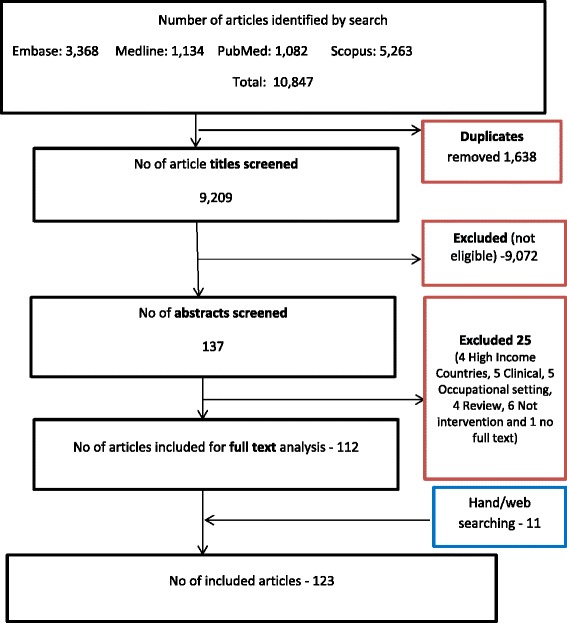
A systematic search of Ovid MEDLINE, PUBMED, EMBASE and SCOPUS databases was performed. Key search words were generated reflecting the "participants, interventions, comparators, outcomes and study design" approach and a comprehensive search strategy was developed following "Preferred Reporting Items for Systematic Reviews and Meta-Analyses" recommendations. Any community-based agricultural and/or household interventions were eligible for inclusion if the focus was to improve at least one of the outcome measures of interest. All relevant study designs employing any of these interventions (alone/in combination) were included if conducted in Low and middle income countries. Review articles, and clinical and occupational studies were excluded.
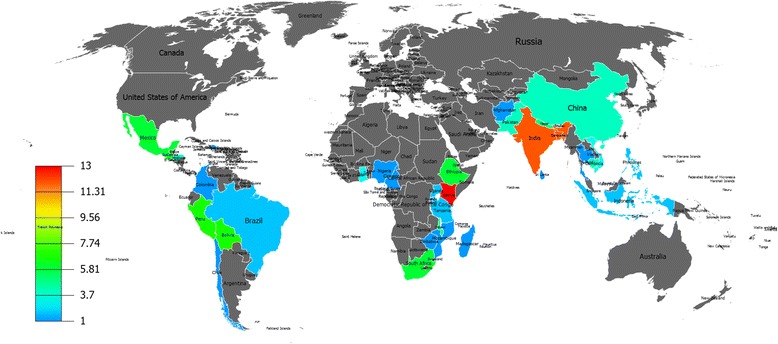
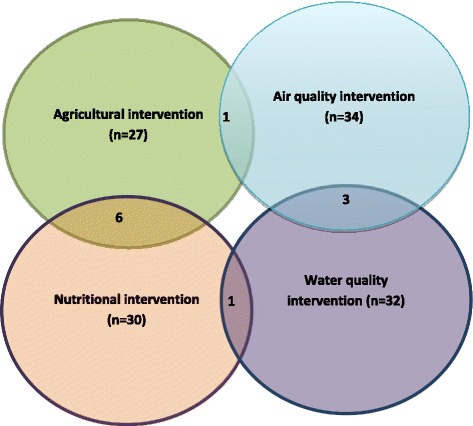
A total of 123 studies were included and grouped into four intervention domains; agricultural (n = 27), air quality (n = 34), water quality (n = 32), and nutritional (n = 30). Most studies were conducted in Asia (39.2 %) or Africa (34.6 %) with the remaining 26.1 % in Latin America. Very few studies (n = 11) combined interventions across more than one domain. The majority of agricultural and nutritional studies were conducted in Africa and Asia, whereas the majority of interventions to improve household air quality were conducted in Latin America.
It is clear that very little trans-disciplinary research has been done with the majority of studies still being discipline specific. It also appears that certain low and middle income countries seem to focus on domain-specific interventions. The review emphasizes the need to develop holistic, cross-domain intervention packages. Further investigation of the data is being conducted to determine the effectiveness of these interventions and whether interdisciplinary interventions provide greater benefit than those that address single health or community problems.
尽管已发现农业干预措施与营养健康之间存在联系,以及清洁燃料的开发和改良固体燃料炉灶在减少家庭空气污染及不良健康影响方面的作用,但家庭综合干预措施在改善健康、营养和环境方面的潜在程度尚未得到研究。开展了一项系统评价,以确定在低收入和中等收入国家中,旨在改善粮食安全、健康和家庭环境的社区农业和家庭干预措施的程度和类型。
对Ovid MEDLINE、PUBMED、EMBASE和SCOPUS数据库进行了系统检索。根据“参与者、干预措施、对照、结局和研究设计”方法生成了关键检索词,并按照“系统评价和荟萃分析优先报告项目”的建议制定了全面的检索策略。如果重点是改善至少一项感兴趣的结局指标,则任何基于社区的农业和/或家庭干预措施均符合纳入标准。如果在低收入和中等收入国家进行,采用这些干预措施(单独或联合)的所有相关研究设计均纳入。综述文章、临床研究和职业研究被排除。
共纳入123项研究,并分为四个干预领域;农业(n = 27)、空气质量(n = 34)、水质(n = 32)和营养(n = 30)。大多数研究在亚洲(39.2%)或非洲(34.6%)进行,其余26.1%在拉丁美洲。很少有研究(n = 11)跨多个领域联合干预措施。大多数农业和营养研究在非洲和亚洲进行,而大多数改善家庭空气质量的干预措施在拉丁美洲进行。
显然,跨学科研究做得很少,大多数研究仍然是特定学科的。似乎某些低收入和中等收入国家似乎侧重于特定领域的干预措施。该综述强调需要制定全面的跨领域干预方案。正在对数据进行进一步调查,以确定这些干预措施的有效性,以及跨学科干预措施是否比解决单一健康或社区问题的干预措施带来更大的益处。