Jones Caroline H D, Glogowska Margaret, Locock Louise, Lasserson Daniel S
Nuffield Department of Primary Care Health Sciences, Radcliffe Observatory Quarter, University of Oxford, Woodstock Road, Oxford, OX2 6GG, UK.
NIHR Oxford Biomedical Research Centre, John Radcliffe Hospital, Oxford University Hospitals NHS Trust, Headley Way, Oxford, OX3 9DU, UK.
BMC Health Serv Res. 2016 Oct 19;16(1):591. doi: 10.1186/s12913-016-1834-3.
Many point of care diagnostic technologies are available which produce results within minutes, and offer the opportunity to deliver acute care out of hospital settings. Increasing access to diagnostics at the point of care could increase the volume and scope of acute ambulatory care. Yet these technologies are not routinely used in many settings. We aimed to explore how point of care testing is used in a setting where it has become 'normalized' (embedded in everyday practice), in order to inform future adoption and implementation in other settings. We used normalization process theory to guide our case study approach.
We used a single case study design, choosing a community based ambulatory care unit where point of care testing is used routinely. A focused ethnographic approach was taken, including non-participant observation of all activities related to point of care testing, and semi-structured interviews, with all clinical staff involved in point of care testing at the unit. Data were analysed thematically, guided by normalization process theory.
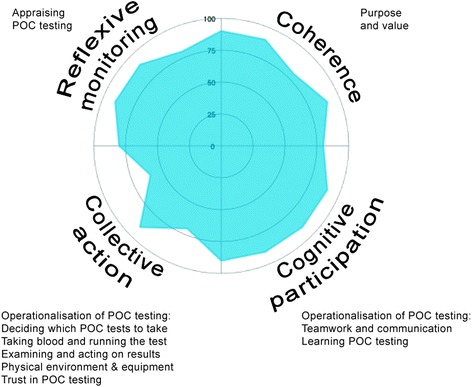
Fourteen days of observation and six interviews were completed. Staff had a shared understanding of the purpose, value and benefits of point of care testing, believing it to be integral to the running of the unit. They organised themselves as a team to ensure that point of care testing worked effectively; and one key individual led a change in practice to ensure more consistency and trust in procedures. Staff assessed point of care testing as worthwhile for the unit, their patients, and themselves in terms of job satisfaction and knowledge. Potential barriers to adoption of point of care testing were evident (including lack of trust in the accuracy of some results compared to laboratory testing; and lack of ease of use of some aspects of the equipment); but these did not prevent point of care testing from becoming embedded, because the importance and value attributed to it were so strong.
This case study offers insights into successful adoption of new diagnostic technologies into every day practice. Such analyses may be critical to realising their potential to change processes of care.
许多即时护理诊断技术能够在数分钟内得出结果,并为在医院外提供急性护理提供了机会。增加即时护理诊断的可及性可能会增加急性门诊护理的数量和范围。然而,这些技术在许多情况下并未得到常规使用。我们旨在探索即时护理检测在已“常态化”(融入日常实践)的环境中的使用方式,以便为未来在其他环境中的采用和实施提供参考。我们使用常态化过程理论来指导我们的案例研究方法。
我们采用单一案例研究设计,选择了一个常规使用即时护理检测的社区门诊护理单元。采用了聚焦民族志方法,包括对与即时护理检测相关的所有活动进行非参与式观察,以及对该单元参与即时护理检测的所有临床工作人员进行半结构化访谈。数据在常态化过程理论的指导下进行主题分析。
完成了14天的观察和6次访谈。工作人员对即时护理检测的目的、价值和益处有共同的理解,认为它是该单元运作不可或缺的一部分。他们作为一个团队进行组织,以确保即时护理检测有效运作;并且一位关键人物引领了实践变革,以确保程序更加一致且值得信赖。工作人员认为即时护理检测对该单元、他们的患者以及他们自己在工作满意度和知识方面都是值得做 的。采用即时护理检测的潜在障碍很明显(包括与实验室检测相比,对某些结果准确性缺乏信任;以及设备某些方面使用不便);但这些并没有阻止即时护理检测的融入,因为赋予它的重要性和价值非常突出。
本案例研究为成功将新诊断技术应用于日常实践提供了见解。此类分析对于实现其改变护理流程的潜力可能至关重要。