Maetens Arno, De Schreye Robrecht, Faes Kristof, Houttekier Dirk, Deliens Luc, Gielen Birgit, De Gendt Cindy, Lusyne Patrick, Annemans Lieven, Cohen Joachim
End of Life Care Research Group, Vrije Universiteit Brussel (VUB), Brussels, Belgium & Ghent University, Ghent, Belgium.
Interuniversity Centre for Health Economics Research (I-CHER), Ghent University, Ghent, Belgium.
BMC Palliat Care. 2016 Oct 18;15(1):86. doi: 10.1186/s12904-016-0159-7.
The use of full-population databases is under-explored to study the use, quality and costs of end-of-life care. Using the case of Belgium, we explored: (1) which full-population databases provide valid information about end-of-life care, (2) what procedures are there to use these databases, and (3) what is needed to integrate separate databases.
Technical and privacy-related aspects of linking and accessing Belgian administrative databases and disease registries were assessed in cooperation with the database administrators and privacy commission bodies. For all relevant databases, we followed procedures in cooperation with database administrators to link the databases and to access the data.
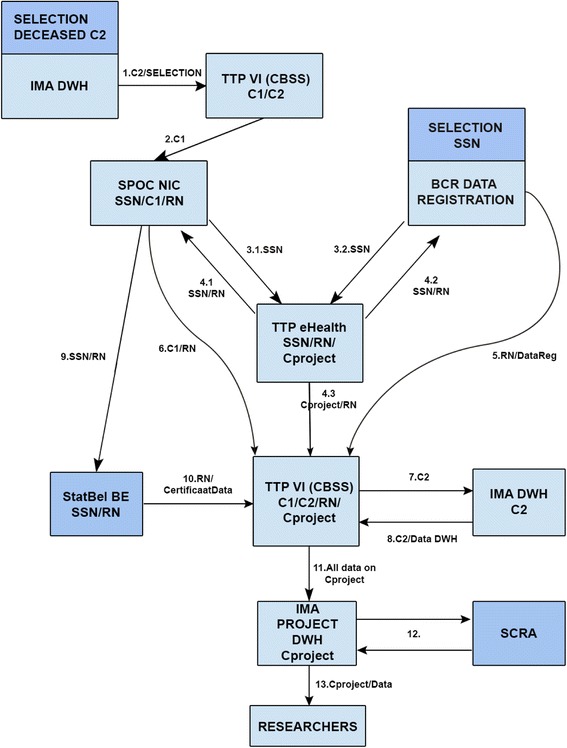
We identified several databases as fitting for end-of-life care research in Belgium: the InterMutualistic Agency's national registry of health care claims data, the Belgian Cancer Registry including data on incidence of cancer, and databases administrated by Statistics Belgium including data from the death certificate database, the socio-economic survey and fiscal data. To obtain access to the data, approval was required from all database administrators, supervisory bodies and two separate national privacy bodies. Two Trusted Third Parties linked the databases via a deterministic matching procedure using multiple encrypted social security numbers.
In this article we describe how various routinely collected population-level databases and disease registries can be accessed and linked to study patterns in the use, quality and costs of end-of-life care in the full population and in specific diagnostic groups.
在研究临终关怀的使用、质量和成本方面,全人群数据库的应用尚未得到充分探索。以比利时为例,我们探讨了:(1)哪些全人群数据库能提供有关临终关怀的有效信息;(2)使用这些数据库有哪些程序;(3)整合独立数据库需要什么条件。
与数据库管理员和隐私委员会机构合作,评估了比利时行政数据库和疾病登记处的链接及访问的技术和隐私相关方面。对于所有相关数据库,我们与数据库管理员合作,按照程序链接数据库并访问数据。
我们确定了几个适合比利时临终关怀研究的数据库:互助机构的全国医疗保健索赔数据登记处、包含癌症发病率数据的比利时癌症登记处,以及比利时统计局管理的数据库,包括死亡证明数据库、社会经济调查和财政数据。要获取数据,需要所有数据库管理员、监管机构和两个独立的国家隐私机构的批准。两个可信第三方通过使用多个加密社会保障号码的确定性匹配程序来链接数据库。
在本文中,我们描述了如何访问和链接各种常规收集的人群层面数据库和疾病登记处,以研究全人群和特定诊断组临终关怀的使用、质量和成本模式。