Tanno Jun, Gatate Yodo, Kasai Takatoshi, Nakano Shintaro, Senbonmatsu Takaaki, Sato Osamu, Ichioka Shigeru, Kuro-O Makoto, Nishimura Shigeyuki
Department of Cardiology, Saitama Medical University, International Medical Center, Saitama, Japan.
Cardiovascular Respiratory Sleep Medicine, Department of Cardiovascular Medicine, Juntendo University Graduate School of Medicine, Tokyo, Japan.
PLoS One. 2016 Oct 19;11(10):e0164756. doi: 10.1371/journal.pone.0164756. eCollection 2016.
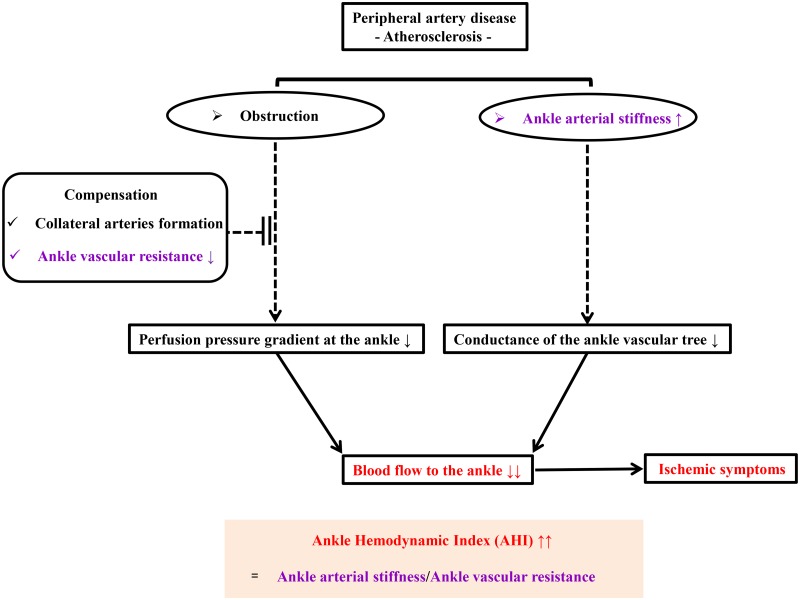
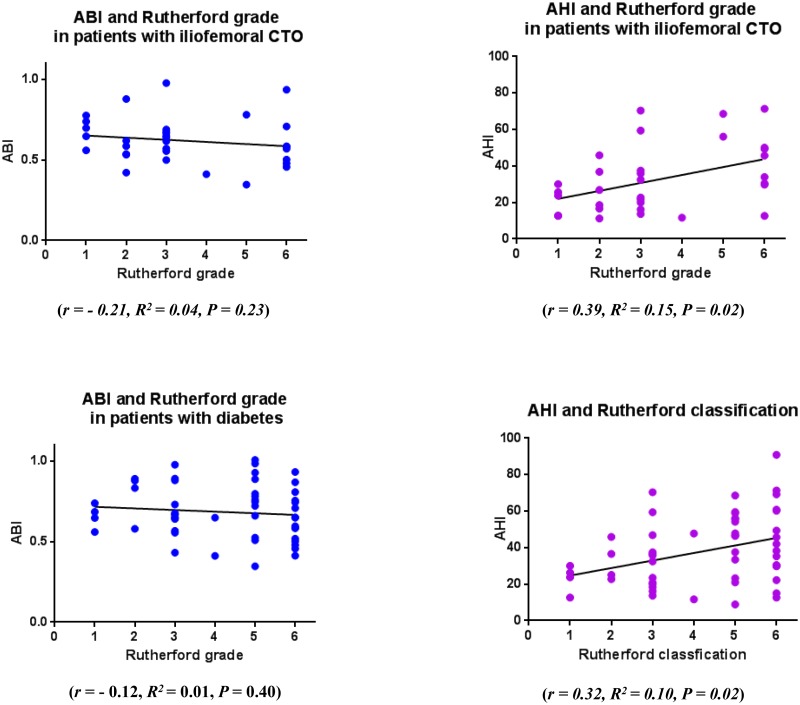
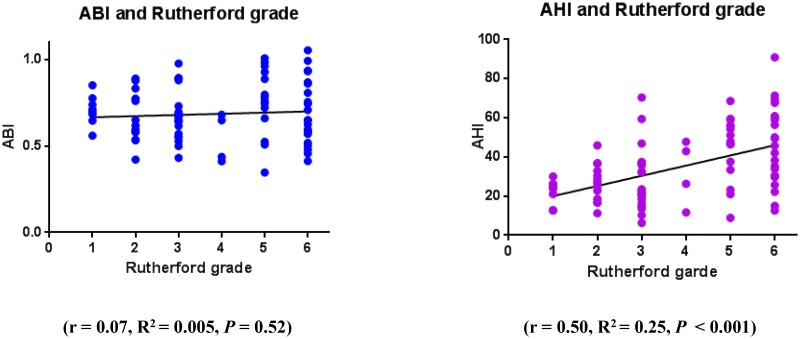
In peripheral arterial disease (PAD) of the lower extremities, the presence of flow-limiting stenoses can be objectively detected by the ankle-brachial index (ABI). However, the severity of ischemic symptoms is not necessarily associated with the ABI value. Atherosclerotic plaque in lower extremity PAD induces ankle arterial stiffness and reduces ankle vascular resistance, which may decrease ankle blood flow and cause ischemic symptoms. We hypothesized that the ankle hemodynamic index (AHI), defined as the ratio of ankle arterial stiffness to ankle vascular resistance, could be used to assess the blood supply deficiency in a diseased lower limb in patients with PAD. The 85 consecutive patients with PAD who were retrospectively analyzed in this study had Rutherford grade 1 to grade 6 ischemia diagnosed as PAD and significant stenotic lesions (>50% diameter stenosis) of the lower extremity on contrast angiography. The AHI was calculated as the product of the ankle pulse pressure and the ratio of heart rate to ankle mean arterial pressure (ankle pulse pressure × heart rate/ankle mean arterial pressure). The Rutherford grade was significantly correlated with the AHI (r = 0.50, P < 0.001), but not with the ABI (r = 0.07, P = 0.52). Multiple ordinal regression analysis showed that anemia (odds ratio 0.66, P = 0.002) and AHI (odds ratio 1.04, P = 0.02) were independently associated with Rutherford grade. Our study shows that AHI, a novel parameter based on the ABI measurement, is well correlated with ischemic symptoms, and may be a useful means to assess the arterial blood supply of the lower extremities of patients with PAD.
在下肢外周动脉疾病(PAD)中,通过踝臂指数(ABI)可客观检测到限流性狭窄的存在。然而,缺血症状的严重程度不一定与ABI值相关。下肢PAD中的动脉粥样硬化斑块会导致踝部动脉僵硬并降低踝部血管阻力,这可能会减少踝部血流并引发缺血症状。我们假设,踝部血流动力学指数(AHI),定义为踝部动脉僵硬与踝部血管阻力之比,可用于评估PAD患者患病下肢的血液供应不足情况。本研究回顾性分析的85例连续PAD患者,经诊断为PAD且造影血管造影显示下肢有明显狭窄病变(直径狭窄>50%),Rutherford分级为1至6级缺血。AHI的计算方法为踝部脉压与心率与踝部平均动脉压之比的乘积(踝部脉压×心率/踝部平均动脉压)。Rutherford分级与AHI显著相关(r = 0.50,P < 0.001),但与ABI无关(r = 0.07,P = 0.52)。多序回归分析显示,贫血(比值比0.66,P = 0.002)和AHI(比值比1.04,P = 0.02)与Rutherford分级独立相关。我们的研究表明,AHI作为基于ABI测量的新参数,与缺血症状密切相关,可能是评估PAD患者下肢动脉血液供应的有用手段。