Mwendera Chikondi A, de Jager Christiaan, Longwe Herbert, Phiri Kamija, Hongoro Charles, Mutero Clifford M
Institute for Sustainable Malaria Control (UP ISMC), School of Health Systems and Public Health, University of Pretoria, Pretoria, South Africa.
Mailman School of Public Health, ICAP at Columbia University, Pretoria, South Africa.
Malar J. 2016 Oct 19;15(1):512. doi: 10.1186/s12936-016-1547-4.
Research on various determinants of health is key in providing evidence for policy development, thereby leading to successful interventions. Utilization of research is an intricate process requiring an understanding of contextual factors. The study was conducted to assess enhancing factors and barriers of research utilization for malaria policy development in Malawi.
Qualitative research approach was used through in-depth interviews with 39 key informants that included malaria researchers, policy makers, programme managers, and key stakeholders. Purposive sampling and snowballing techniques were used in identifying key informants. Interview transcripts were entered in QSR Nvivo 11 software for coding and analysis.
Respondents identified global efforts as key in advancing knowledge translation, while local political will has been conducive for research utilization. Other factors were availability of research, availability of diverse local researchers and stakeholders supporting knowledge translation. While barriers included: lack of platforms for researcher-public engagement, politics, researchers' lack of communication skills, lack of research collaborations, funder driven research, unknown World Health Organization policy position, and the lack of a malaria research repository.
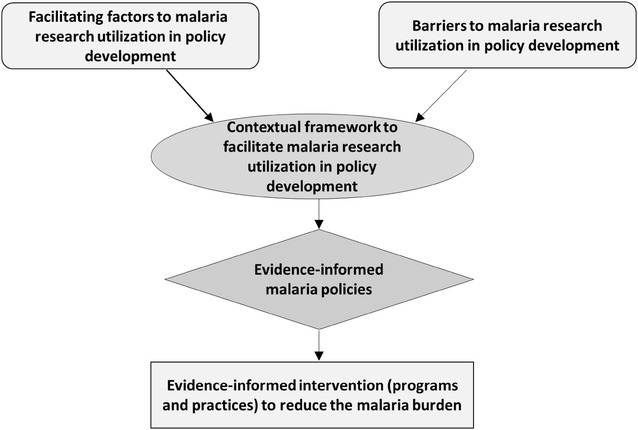
Overall, the study identified facilitating factors to malaria research utilization for policy development in Malawi. These factors need to be systematically coordinated to address the identified barriers and improve on malaria research utilization in policy development. Malaria research can be key in the implementation of evidence-based interventions to reduce the malaria burden and assist in the paradigm shift from malaria control to elimination in Malawi.
对各种健康决定因素的研究是为政策制定提供证据的关键,从而促成成功的干预措施。研究的利用是一个复杂的过程,需要了解背景因素。开展这项研究是为了评估马拉维疟疾政策制定中研究利用的促进因素和障碍。
采用定性研究方法,对39名关键信息提供者进行了深入访谈,这些人包括疟疾研究人员、政策制定者、项目管理人员和关键利益相关者。采用目的抽样和滚雪球技术来确定关键信息提供者。访谈记录被录入QSR Nvivo 11软件进行编码和分析。
受访者认为全球努力是推动知识转化的关键,而当地的政治意愿有利于研究的利用。其他因素包括研究的可获得性、支持知识转化的不同当地研究人员和利益相关者的可获得性。而障碍包括:缺乏研究人员与公众互动的平台、政治因素、研究人员缺乏沟通技巧、缺乏研究合作、资助者驱动的研究、世界卫生组织政策立场不明以及缺乏疟疾研究知识库。
总体而言,该研究确定了马拉维疟疾研究用于政策制定的促进因素。需要系统地协调这些因素,以解决已确定的障碍,并改善疟疾研究在政策制定中的利用。疟疾研究可能是实施循证干预措施以减轻疟疾负担并协助马拉维从疟疾控制向消除转变模式的关键。