Lötsch Jörn, Hummel Thomas, Ultsch Alfred
Institute of Clinical Pharmacology, Goethe - University, Theodor Stern Kai 7, 60590 Frankfurt am Main, Germany.
Fraunhofer Institute of Molecular Biology and Applied Ecology - Project Group Translational Medicine and Pharmacology (IME-TMP), Theodor - Stern - Kai 7, 60590 Frankfurt am Main, Germany.
Sci Rep. 2016 Oct 20;6:35688. doi: 10.1038/srep35688.
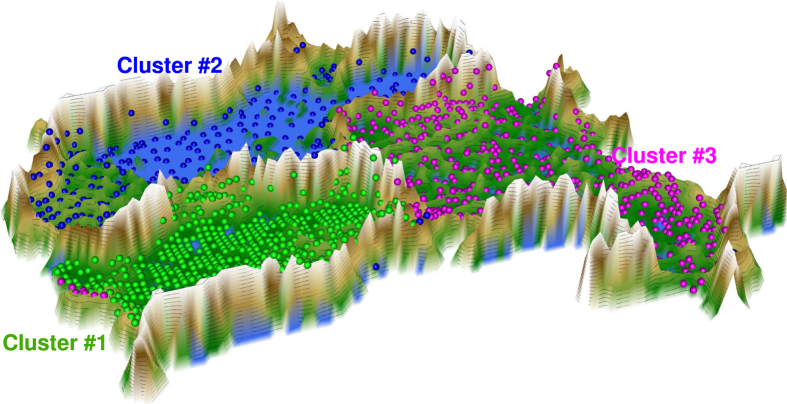
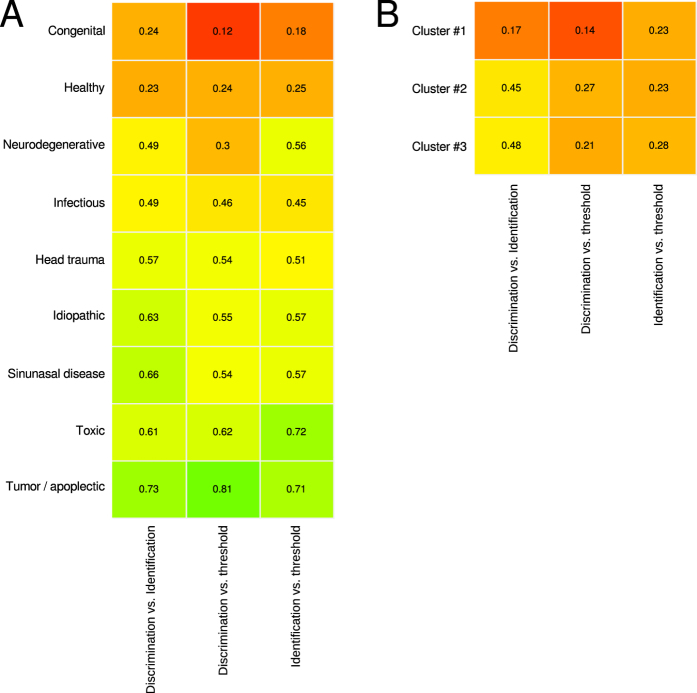
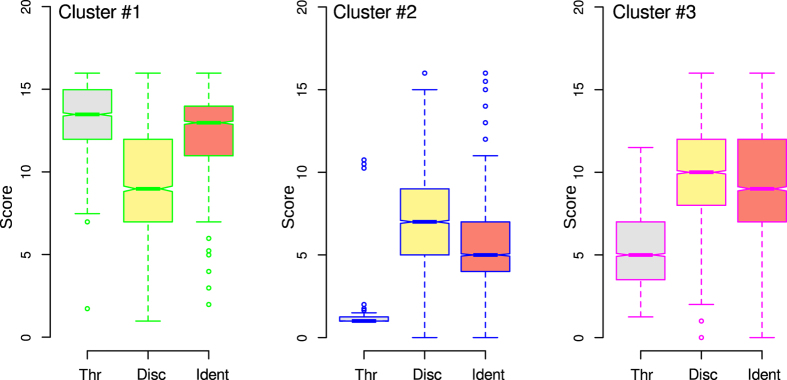
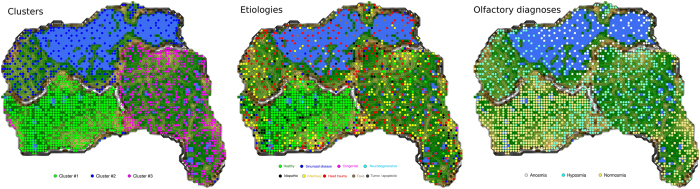
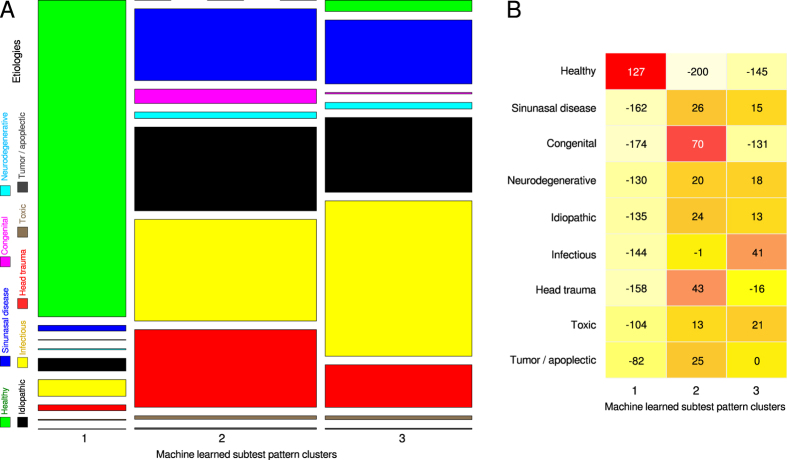
The human sense of smell is often analyzed as being composed of three main components comprising olfactory threshold, odor discrimination and the ability to identify odors. A relevant distinction of the three components and their differential changes in distinct disorders remains a research focus. The present data-driven analysis aimed at establishing a cluster structure in the pattern of olfactory subtest results. Therefore, unsupervised machine-learning was applied onto olfactory subtest results acquired in 10,714 subjects with nine different olfactory pathologies. Using the U-matrix, Emergent Self-organizing feature maps (ESOM) identified three different clusters characterized by (i) low threshold and good discrimination and identification, (ii) very high threshold associated with absent to poor discrimination and identification ability, or (iii) medium threshold, i.e., in the mid-range of possible thresholds, associated with reduced discrimination and identification ability. Specific etiologies of olfactory (dys)function were unequally represented in the clusters (p < 2.2 · 10). Patients with congenital anosmia were overrepresented in the second cluster while subjects with postinfectious olfactory dysfunction belonged frequently to the third cluster. However, the clusters provided no clear separation between etiologies. Hence, the present verification of a distinct cluster structure encourages continued scientific efforts at olfactory test pattern recognition.
人类嗅觉通常被分析为由嗅觉阈值、气味辨别和气味识别能力这三个主要成分组成。这三个成分的相关区别以及它们在不同疾病中的差异变化仍然是一个研究重点。目前的数据驱动分析旨在在嗅觉子测试结果模式中建立一种聚类结构。因此,无监督机器学习被应用于10714名患有九种不同嗅觉疾病的受试者的嗅觉子测试结果。使用U矩阵,涌现自组织特征映射(ESOM)识别出三个不同的聚类,其特征分别为:(i)低阈值以及良好的辨别和识别能力;(ii)非常高的阈值,伴有辨别和识别能力缺失或较差;或者(iii)中等阈值,即在可能阈值的中间范围,伴有辨别和识别能力降低。嗅觉(功能障碍)的特定病因在各聚类中的分布不均衡(p < 2.2·10)。先天性嗅觉缺失患者在第二个聚类中占比过高,而感染后嗅觉功能障碍的受试者经常属于第三个聚类。然而,这些聚类并没有在病因之间提供明确的区分。因此,目前对独特聚类结构的验证鼓励在嗅觉测试模式识别方面继续进行科学研究。