Lötsch Jörn, Hummel Thomas
Institute of Clinical Pharmacology, Goethe - University, Theodor Stern Kai 7, 60590 Frankfurt am Main, Germany.
Fraunhofer Institute of Molecular Biology and Applied Ecology - Project Group Translational Medicine and Pharmacology (IME-TMP), Theodor - Stern - Kai 7, 60590 Frankfurt am Main, Germany.
IBRO Rep. 2019 Jan 7;6:64-73. doi: 10.1016/j.ibror.2019.01.002. eCollection 2019 Jun.
The functional performance of the human sense of smell can be approached via assessment of the olfactory threshold, the ability to discriminate odors or the ability to identify odors. Contemporary clinical test batteries include all or a selection of these components, with some dissent about the required number and choice.
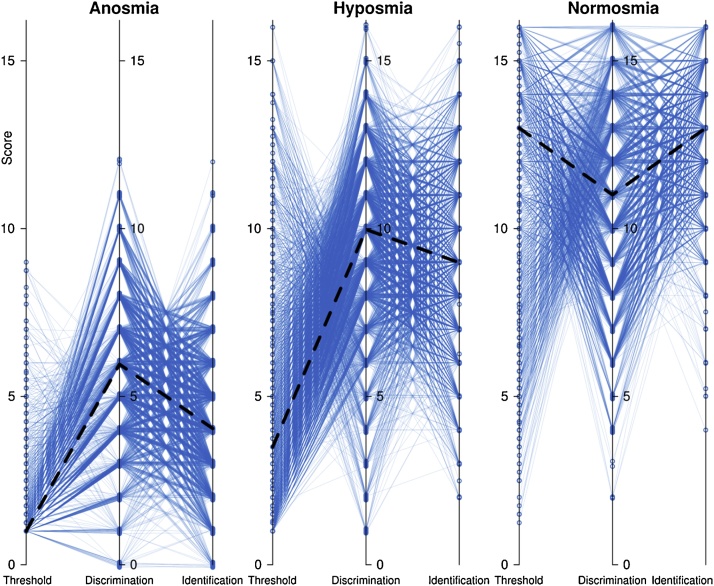
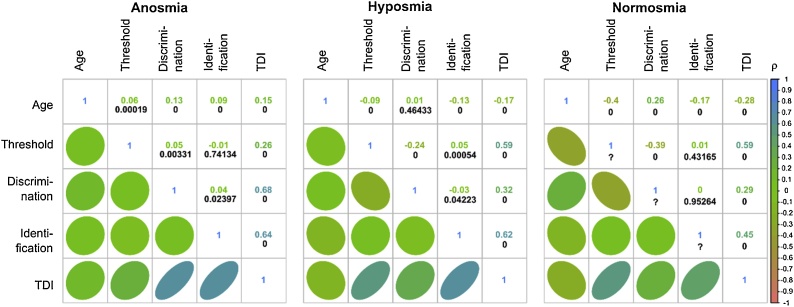
Olfactory thresholds, odor discrimination and odor identification scores were available from 10,714 subjects (3662 with anomia, 4299 with hyposmia, and 2752 with normal olfactory function). To assess, whether the olfactory subtests confer the same information or each subtest confers at least partly non-redundant information relevant to the olfactory diagnosis, we compared the diagnostic accuracy of supervised machine learning algorithms trained with the complete information from all three subtests with that obtained when performing the training with the information of only two or one subtests.
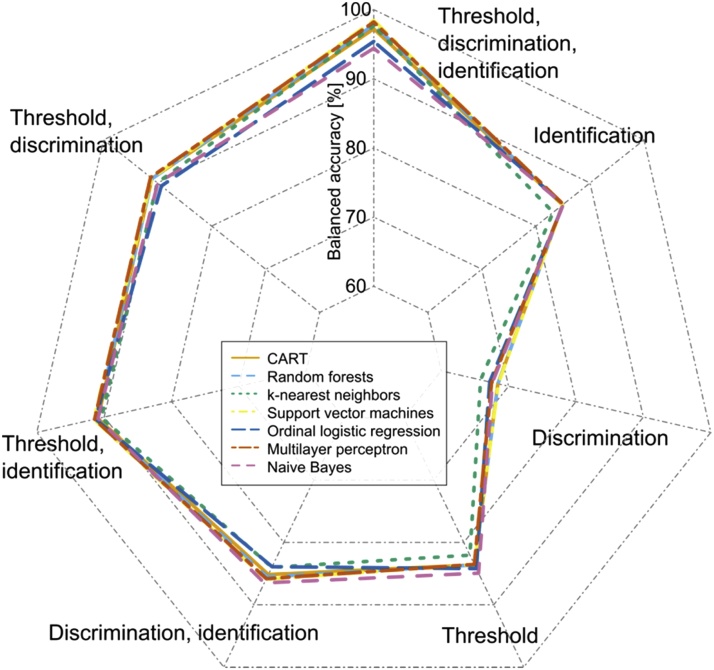
The training of machine-learned algorithms with the full information about olfactory thresholds, odor discrimination and odor identification from 2/3 of the cases, resulted in a balanced olfactory diagnostic accuracy of 98% or better in the 1/3 remaining cases. The most pronounced decrease in the balanced accuracy, to approximately 85%, was observed when omitting olfactory thresholds from the training, whereas omitting odor discrimination or identification was associated with smaller decreases (balanced accuracies approximately 90%).
Results support partly non-redundant contributions of each olfactory subtest to the clinical olfactory diagnosis. Olfactory thresholds provided the largest amount of non-redundant information to the olfactory diagnosis.
人类嗅觉的功能表现可通过评估嗅觉阈值、辨别气味的能力或识别气味的能力来进行研究。当代临床测试组合包含了这些组成部分的全部或部分,对于所需的数量和选择存在一些分歧。
有10714名受试者的嗅觉阈值、气味辨别和气味识别得分数据(3662名嗅觉失认症患者、4299名嗅觉减退患者和2752名嗅觉功能正常者)。为了评估嗅觉子测试是提供相同的信息,还是每个子测试至少部分提供与嗅觉诊断相关的非冗余信息,我们比较了使用所有三个子测试的完整信息训练的监督机器学习算法的诊断准确性与仅使用两个或一个子测试的信息进行训练时获得的诊断准确性。
用2/3病例的嗅觉阈值、气味辨别和气味识别的完整信息训练机器学习算法,在其余1/3病例中产生了98%或更高的平衡嗅觉诊断准确性。当训练中省略嗅觉阈值时,观察到平衡准确性最显著下降,降至约85%,而省略气味辨别或识别时,下降幅度较小(平衡准确性约为90%)。
结果支持每个嗅觉子测试对临床嗅觉诊断有部分非冗余贡献。嗅觉阈值为嗅觉诊断提供了最大量的非冗余信息。