Sankin Alexander, Hakimi Abraham A, Mikkilineni Nina, Ostrovnaya Irina, Silk Mikhail T, Liang Yupu, Mano Roy, Chevinsky Michael, Motzer Robert J, Solomon Stephen B, Cheng Emily H, Durack Jeremy C, Coleman Jonathan A, Russo Paul, Hsieh James J
Urology Service, Department of Surgery, Memorial Sloan-Kettering Cancer Center, New York City, New York.
Cancer Med. 2014 Dec;3(6):1485-92. doi: 10.1002/cam4.293. Epub 2014 Aug 14.
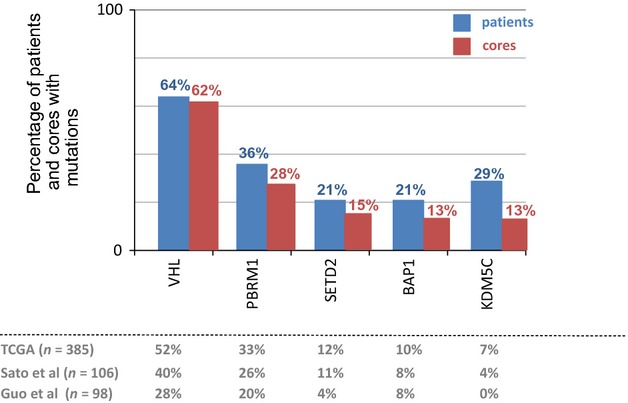
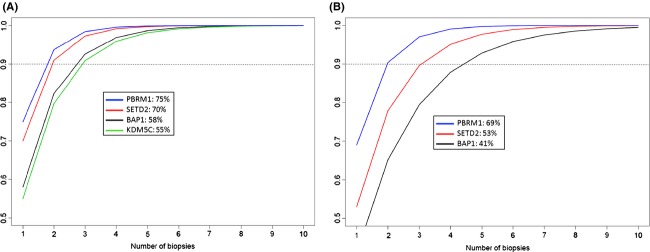
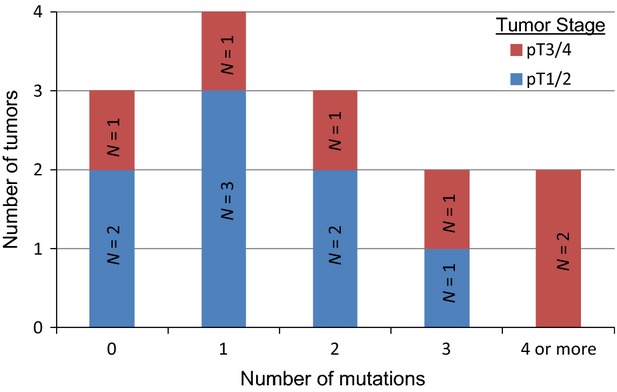
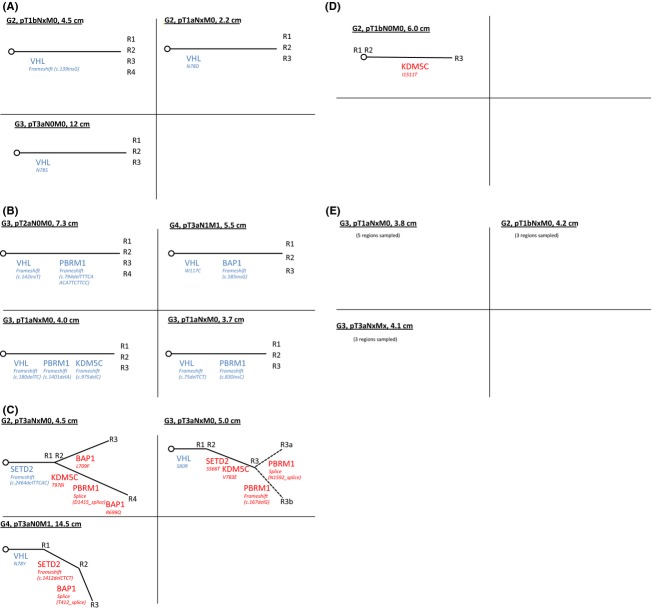
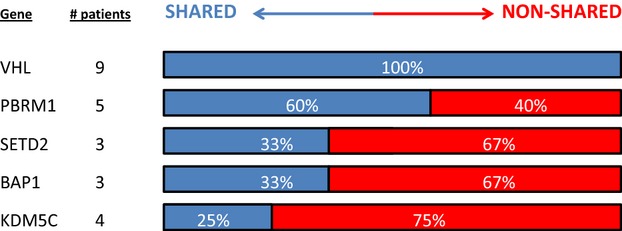
Primary clear cell renal cell carcinoma (ccRCC) genetic heterogeneity may lead to an underestimation of the mutational burden detected from a single site evaluation. We sought to characterize the extent of clonal branching involving key tumor suppressor mutations in primary ccRCC and determine if genetic heterogeneity could limit the mutation profiling from a single region assessment. Ex vivo core needle biopsies were obtained from three to five different regions of resected renal tumors at a single institution from 2012 to 2013. DNA was extracted and targeted sequencing was performed on five genes associated with ccRCC (von-Hippel Lindau [VHL], PBRM1, SETD2, BAP1, and KDM5C). We constructed phylogenetic trees by inferring clonal evolution based on the mutations present within each core and estimated the predictive power of detecting a mutation for each successive tumor region sampled. We obtained 47 ex vivo biopsy cores from 14 primary ccRCC's (median tumor size 4.5 cm, IQR 4.0-5.9 cm). Branching patterns of various complexities were observed in tumors with three or more mutations. A VHL mutation was detected in nine tumors (64%), each time being present ubiquitously throughout the tumor. Other genes had various degrees of regional mutational variation. Based on the mutations' prevalence we estimated that three different tumor regions should be sampled to detect mutations in PBRM1, SETD2, BAP1, and/or KDM5C with 90% certainty. The mutational burden of renal tumors varies by region sampled. Single site assessment of key tumor suppressor mutations in primary ccRCC may not adequately capture the genetic predictors of tumor behavior.
原发性透明细胞肾细胞癌(ccRCC)的基因异质性可能导致从单部位评估中检测到的突变负担被低估。我们试图描述原发性ccRCC中涉及关键肿瘤抑制基因突变的克隆分支程度,并确定基因异质性是否会限制单区域评估的突变谱分析。2012年至2013年,在一家机构从切除的肾肿瘤的三到五个不同区域获取了离体粗针活检样本。提取DNA,并对与ccRCC相关的五个基因(冯-希佩尔-林道[VHL]、PBRM1、SETD2、BAP1和KDM5C)进行靶向测序。我们通过基于每个核心内存在的突变推断克隆进化来构建系统发育树,并估计对每个连续采样的肿瘤区域检测到突变的预测能力。我们从14例原发性ccRCC中获得了47个离体活检核心(肿瘤中位大小4.5 cm,四分位间距4.0 - 5.9 cm)。在具有三个或更多突变的肿瘤中观察到了各种复杂程度的分支模式。在九个肿瘤(64%)中检测到VHL突变,每次在整个肿瘤中普遍存在。其他基因具有不同程度的区域突变变异。根据突变的发生率,我们估计应采样三个不同的肿瘤区域,以90%的确定性检测PBRM1、SETD2、BAP1和/或KDM5C中的突变。肾肿瘤的突变负担因采样区域而异。原发性ccRCC中关键肿瘤抑制基因突变的单部位评估可能无法充分捕捉肿瘤行为的基因预测指标。