Yu Yang, Zhang Qingyun, Meng Qinggui, Zong Chen, Liang Lei, Yang Xue, Lin Rui, Liu Yan, Zhou Yang, Zhang Hongxiang, Hou Xiaojuan, Han Zhipeng, Cheng Jiwen
Department of Urology, Affiliated Tumor Hospital of Guangxi Medical University, Nanning, People's Republic of China.
Tumor Immunology and Gene Therapy Center, Eastern Hepatobiliary Surgery Hospital, the Second Military Medical University, Shanghai, People's Republic of China.
Oncotarget. 2016 Nov 1;7(44):71112-71122. doi: 10.18632/oncotarget.12737.
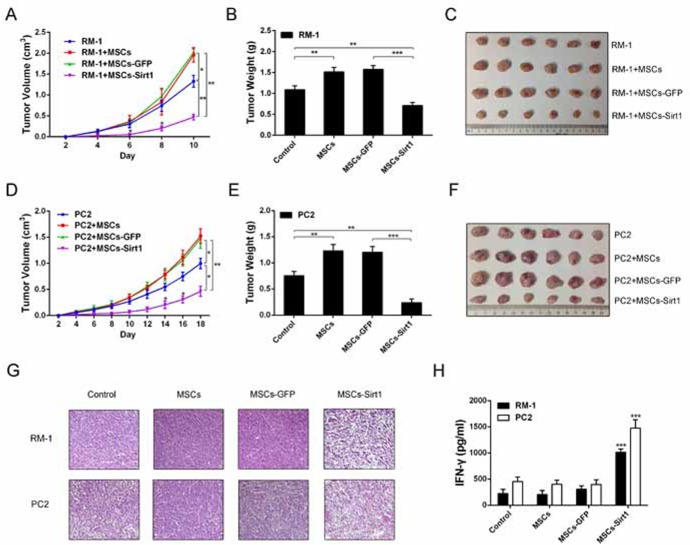
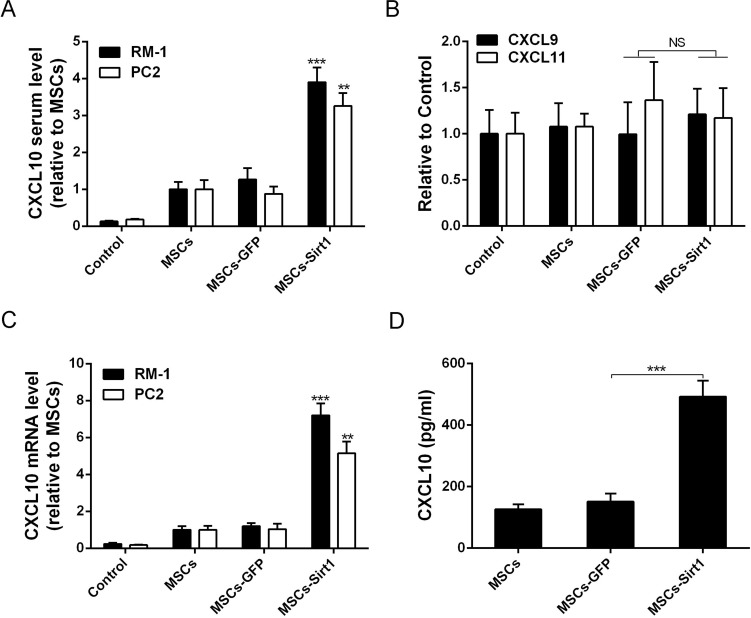
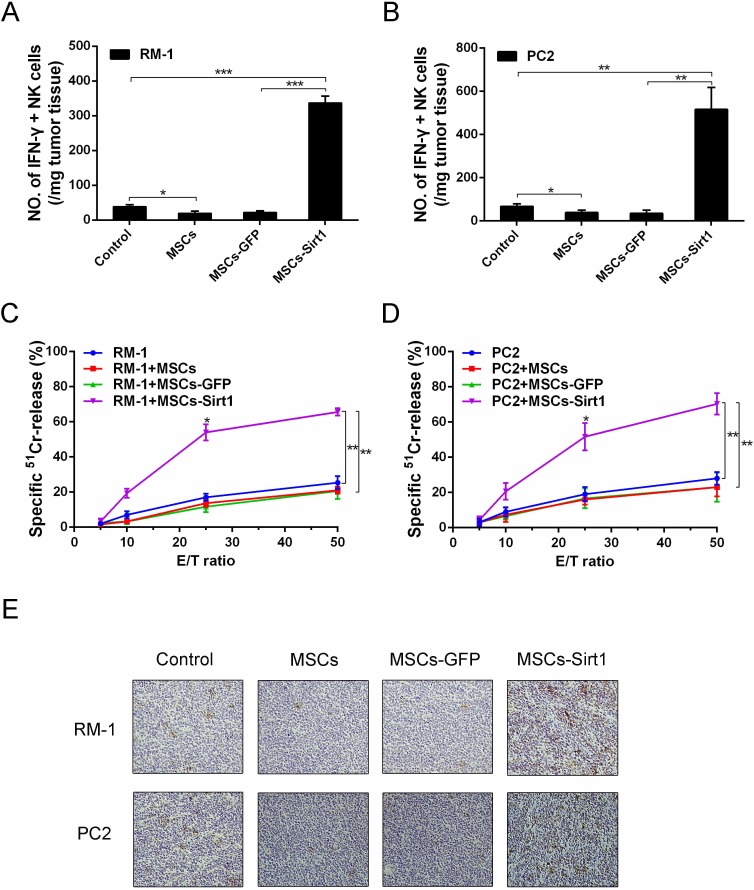
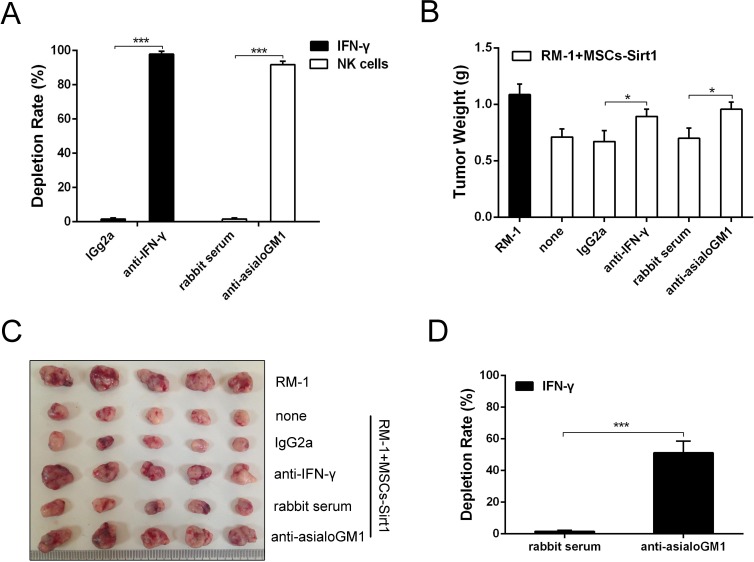
Prostate cancer (PCa) has become the second leading cause of male cancer-related mortality in the United States. Mesenchymal stem cells (MSCs) are able to migrate to tumor tissues, and are thus considered to be novel antitumor carriers. However, due to their immunosuppressive nature, the application of MSCs in PCa therapy remains limited. In this study, we investigated the effect of MSCs overexpressing an NAD-dependent deacetylase sirtuin 1 (MSCs-Sirt1) on prostate tumor growth, and we analyzed the underlying mechanisms. Our results show that MSCs accelerate prostate tumor growth, whereas MSCs-Sirt1 significantly suppresses tumor growth. Natural killer (NK) cells and macrophages are the prominent antitumor effectors of the MSCs-Sirt1-induced antitumor activity. IFN-γ and C-X-C motif chemokine ligand 10 (CXCL10) are highly expressed in MSCs-Sirt1 mice. The antitumor effect of MSCs-Sirt1 is weakened when CXCL10 and IFN-γ are inhibited. These results show that MSCs-Sirt1 can effectively inhibit prostate cancer growthrecruiting NK cells and macrophages in a tumor inflammatory microenvironment.
前列腺癌(PCa)已成为美国男性癌症相关死亡率的第二大原因。间充质干细胞(MSCs)能够迁移至肿瘤组织,因此被认为是新型的抗肿瘤载体。然而,由于其免疫抑制特性,MSCs在PCa治疗中的应用仍然有限。在本研究中,我们调查了过表达烟酰胺腺嘌呤二核苷酸(NAD)依赖性脱乙酰酶沉默调节蛋白1的间充质干细胞(MSCs-Sirt1)对前列腺肿瘤生长的影响,并分析了其潜在机制。我们的结果表明,MSCs促进前列腺肿瘤生长,而MSCs-Sirt1则显著抑制肿瘤生长。自然杀伤(NK)细胞和巨噬细胞是MSCs-Sirt1诱导的抗肿瘤活性的主要抗肿瘤效应细胞。干扰素-γ(IFN-γ)和C-X-C基序趋化因子配体10(CXCL10)在MSCs-Sirt1小鼠中高表达。当CXCL10和IFN-γ受到抑制时,MSCs-Sirt1的抗肿瘤作用减弱。这些结果表明,MSCs-Sirt1可通过在肿瘤炎性微环境中募集NK细胞和巨噬细胞来有效抑制前列腺癌生长。