Domingues Rosa Maria Soares Madeira, Dias Marcos Augusto Bastos, Schilithz Arthur Orlando Corrêa, Leal Maria do Carmo
Instituto Nacional de Infectologia Evandro Chagas/Fundação Oswaldo Cruz, Av. Brasil, 4365 - Manguinhos, Rio de Janeiro, CEP 21040-360, Brasil.
Instituto Nacional de Saúde da Mulher, da Criança e do Adolescente Fernandes Figueira/Fundação Oswaldo Cruz, Av. Rui Barbosa, 716 - Flamengo, Rio de Janeiro, CEP 22250-020, Brasil.
Reprod Health. 2016 Oct 17;13(Suppl 3):115. doi: 10.1186/s12978-016-0232-y.
Maternal near-miss (MNM) audits are considered a useful approach to improving maternal healthcare. The aim of this study was to evaluate the factors associated with maternal near-miss cases in childbirth and the postpartum period in Brazil.
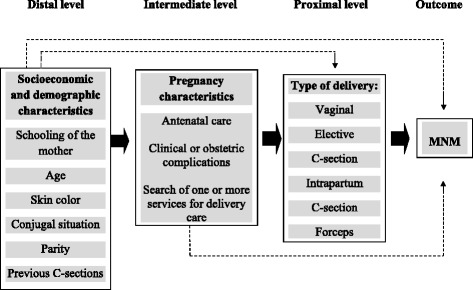
The study is based on data from a nationwide hospital-based survey of 23,894 women conducted in 2011-2012. The data are from interviews with mothers during the postpartum period and from hospital medical files. Univariate and multivariable logistic regressions were performed to analyze factors associated with MNM, including estimation of crude and adjusted odds ratios and their respective 95 % confidence intervals (95 % CI).
The estimated incidence of MNM was 10.2/1,000 live births (95 % CI: 7.5-13.7). In the adjusted analyses, MNM was associated with the absence of antenatal care (OR: 4.65; 95 % CI: 1.51-14.31), search for two or more services before admission to delivery care (OR: 4.49; 95 % CI: 2.12-9.52), obstetric complications (OR: 9.29; 95 % CI: 6.69-12.90), and type of birth: elective C-section (OR: 2.54; 95 % CI: 1.67-3.88) and forceps (OR: 9.37; 95 % CI: 4.01-21.91). Social and demographic maternal characteristics were not associated with MNM, although women who self-reported as white and women with higher schooling had better access to antenatal and maternity care services.
The high proportion of elective C-sections performed among women in better social and economic situations in Brazil is likely attenuating the benefits that could be realized from improved prenatal care and greater access to maternity services. Strategies for reducing the rate of MNM in Brazil should focus on: 1) increasing access to prenatal care and delivery care, particularly among women who are at greater social and economic risk and 2) reducing the rate of elective cesarean section, particularly among women who receive services at private maternity facilities, where C-section rates reach 90 % of births.
孕产妇险些死亡(MNM)审核被认为是改善孕产妇保健的一种有用方法。本研究的目的是评估巴西分娩期和产后与孕产妇险些死亡病例相关的因素。
该研究基于2011 - 2012年对全国23,894名妇女进行的一项基于医院的调查数据。数据来自产后对母亲的访谈以及医院医疗档案。进行单变量和多变量逻辑回归分析与孕产妇险些死亡相关的因素,包括估计粗比值比和调整后的比值比及其各自的95%置信区间(95%CI)。
孕产妇险些死亡的估计发病率为10.2/1000活产(95%CI:7.5 - 13.7)。在调整分析中,孕产妇险些死亡与未进行产前检查(比值比:4.65;95%CI:1.51 - 14.31)、入院分娩前寻求两种或更多服务(比值比:4.49;95%CI:2.12 - 9.52)、产科并发症(比值比:9.29;95%CI:6.69 - 12.90)以及分娩类型:择期剖宫产(比值比:2.54;95%CI:1.67 - 3.88)和产钳助产(比值比:9.37;95%CI:4.01 - 21.91)有关。孕产妇的社会和人口统计学特征与孕产妇险些死亡无关,尽管自我报告为白人的妇女和受教育程度较高的妇女能更好地获得产前和孕产妇保健服务。
在巴西,社会和经济状况较好的女性中择期剖宫产的比例较高,这可能会削弱改善产前护理和增加获得孕产妇服务机会所带来的益处。巴西降低孕产妇险些死亡率的策略应侧重于:1)增加获得产前护理和分娩护理的机会,特别是在社会和经济风险较高的女性中;2)降低择期剖宫产率,特别是在私立产科机构接受服务的女性中,那里剖宫产率达到分娩总数的90%。