Showalter Allan M, Keppler Brian D, Liu Xiao, Lichtenberg Jens, Welch Lonnie R
Department of Environmental and Plant Biology, Molecular and Cellular Biology Program, Ohio University, 504 Porter Hall, Athens, OH, 45701-2979, USA.
Russ College of Engineering and Technology, Center for Intelligent, Distributed and Dependable Systems, Ohio University, Athens, OH, 45701-2979, USA.
BMC Plant Biol. 2016 Oct 21;16(1):229. doi: 10.1186/s12870-016-0912-3.
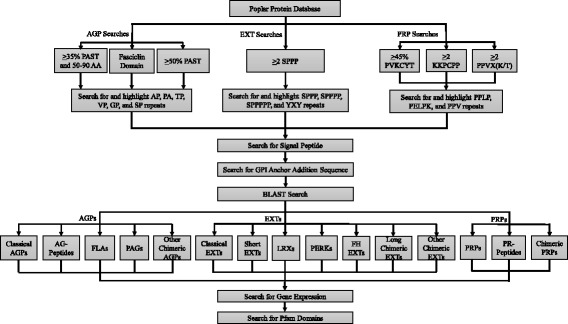
Hydroxyproline-rich glycoproteins (HRGPs) constitute a plant cell wall protein superfamily that functions in diverse aspects of growth and development. This superfamily contains three members: the highly glycosylated arabinogalactan-proteins (AGPs), the moderately glycosylated extensins (EXTs), and the lightly glycosylated proline-rich proteins (PRPs). Chimeric and hybrid HRGPs, however, also exist. A bioinformatics approach is employed here to identify and classify AGPs, EXTs, PRPs, chimeric HRGPs, and hybrid HRGPs from the proteins predicted by the completed genome sequence of poplar (Populus trichocarpa). This bioinformatics approach is based on searching for biased amino acid compositions and for particular protein motifs associated with known HRGPs with a newly revised and improved BIO OHIO 2.0 program. Proteins detected by the program are subsequently analyzed to identify the following: 1) repeating amino acid sequences, 2) signal peptide sequences, 3) glycosylphosphatidylinositol lipid anchor addition sequences, and 4) similar HRGPs using the Basic Local Alignment Search Tool (BLAST).
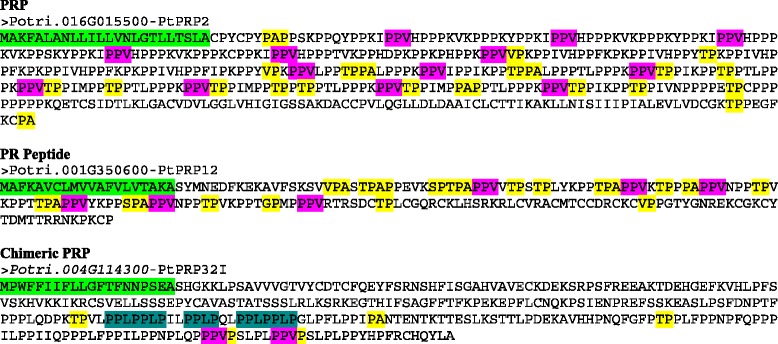
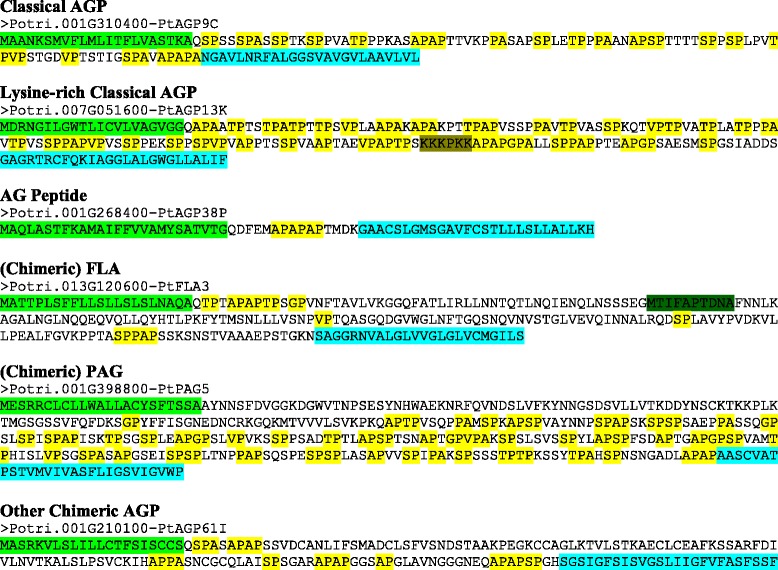
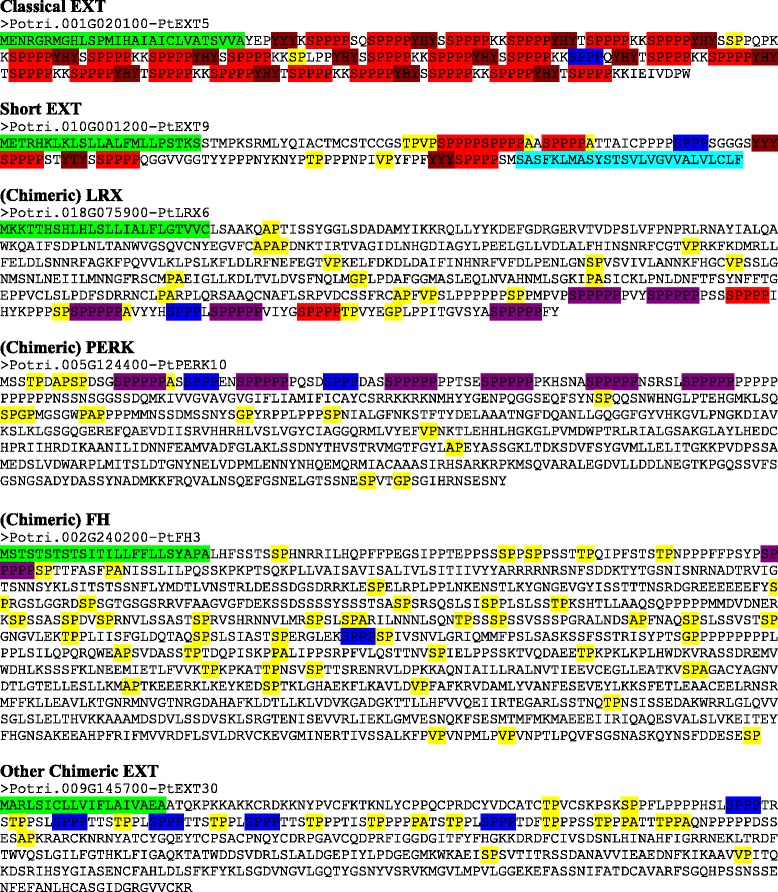
The program was used to identify and classify 271 HRGPs from poplar including 162 AGPs, 60 EXTs, and 49 PRPs, which are each divided into various classes. This is in contrast to a previous analysis of the Arabidopsis proteome which identified 162 HRGPs consisting of 85 AGPs, 59 EXTs, and 18 PRPs. Poplar was observed to have fewer classical EXTs, to have more fasciclin-like AGPs, plastocyanin AGPs and AG peptides, and to contain a novel class of PRPs referred to as the proline-rich peptides.
The newly revised and improved BIO OHIO 2.0 bioinformatics program was used to identify and classify the inventory of HRGPs in poplar in order to facilitate and guide basic and applied research on plant cell walls. The newly identified poplar HRGPs can now be examined to determine their respective structural and functional roles, including their possible applications in the areas plant biofuel and natural products for medicinal or industrial uses. Additionally, other plants whose genomes are sequenced can now be examined in a similar way using this bioinformatics program which will provide insight to the evolution of the HRGP family in the plant kingdom.
富含羟脯氨酸的糖蛋白(HRGPs)构成了一个植物细胞壁蛋白超家族,在生长和发育的多个方面发挥作用。这个超家族包含三个成员:高度糖基化的阿拉伯半乳聚糖蛋白(AGPs)、中度糖基化的伸展蛋白(EXTs)和轻度糖基化的富含脯氨酸的蛋白(PRPs)。然而,嵌合和杂交的HRGPs也存在。本文采用生物信息学方法,从杨树(毛果杨)全基因组序列预测的蛋白质中鉴定和分类AGPs、EXTs、PRPs、嵌合HRGPs和杂交HRGPs。这种生物信息学方法基于使用新修订和改进的BIO OHIO 2.0程序搜索有偏向性的氨基酸组成以及与已知HRGPs相关的特定蛋白质基序。随后对该程序检测到的蛋白质进行分析,以识别以下内容:1)重复氨基酸序列,2)信号肽序列,3)糖基磷脂酰肌醇脂质锚定添加序列,以及4)使用基本局部比对搜索工具(BLAST)识别相似的HRGPs。
该程序用于从杨树中鉴定和分类271种HRGPs,包括162种AGPs、60种EXTs和49种PRPs,它们各自又分为不同类别。这与之前对拟南芥蛋白质组的分析形成对比,后者鉴定出162种HRGPs,包括85种AGPs、59种EXTs和18种PRPs。研究发现杨树的经典EXTs较少,类成束蛋白AGPs、质体蓝素AGPs和AG肽较多,并且包含一类新的PRPs,称为富含脯氨酸的肽。
新修订和改进的BIO OHIO 2.0生物信息学程序用于鉴定和分类杨树中HRGPs的清单,以便促进和指导植物细胞壁的基础研究和应用研究。现在可以对新鉴定出的杨树HRGPs进行研究,以确定它们各自的结构和功能作用,包括它们在植物生物燃料以及药用或工业用天然产物领域的可能应用。此外,现在可以使用这个生物信息学程序以类似的方式研究其他已测序基因组的植物,这将为植物界HRGP家族的进化提供见解。