Guo Shengnan, Wang Yuanyuan, Gao Yu, Zhang Yinxu, Chen Mingzi, Xu Minghao, Hu Lu, Jing Yu, Jing Fangyu, Li Chen, Wang Qingjun, Zhu Zhitu
Department of Oncology, The First Affiliated Hospital of Jinzhou Medical University, Jinzhou, Liaoning, China (mainland).
Med Sci Monit. 2016 Oct 24;22:3951-3960. doi: 10.12659/msm.900880.
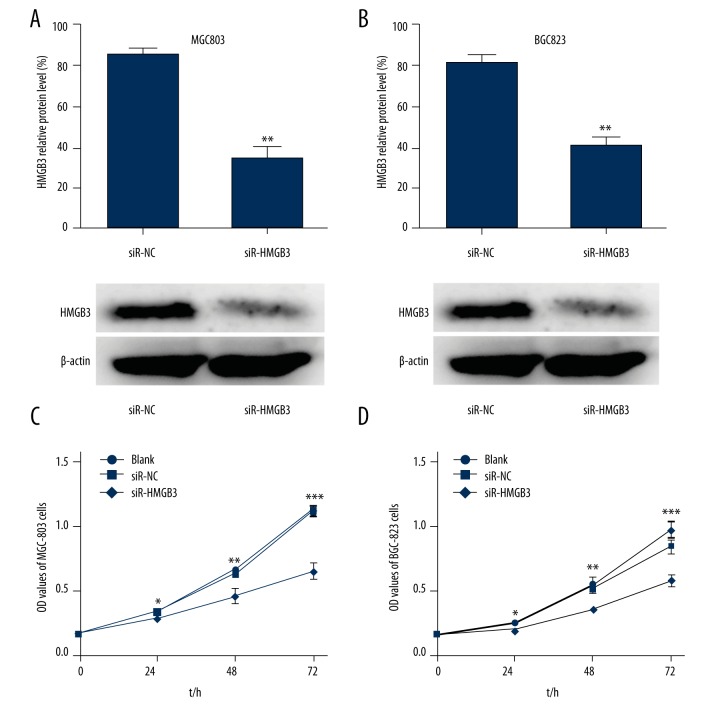
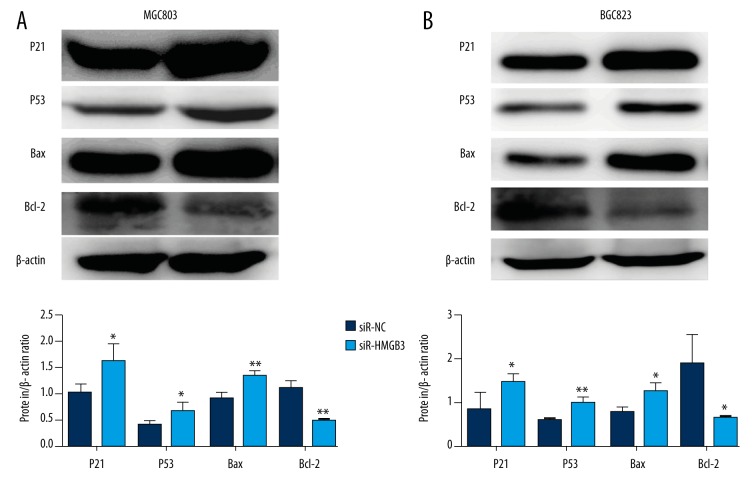
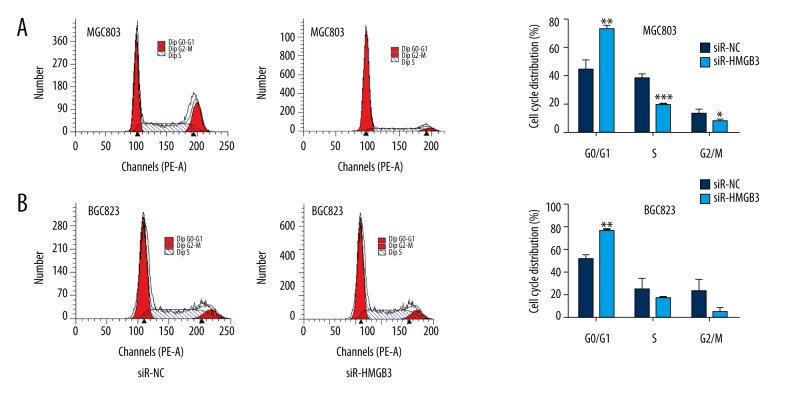
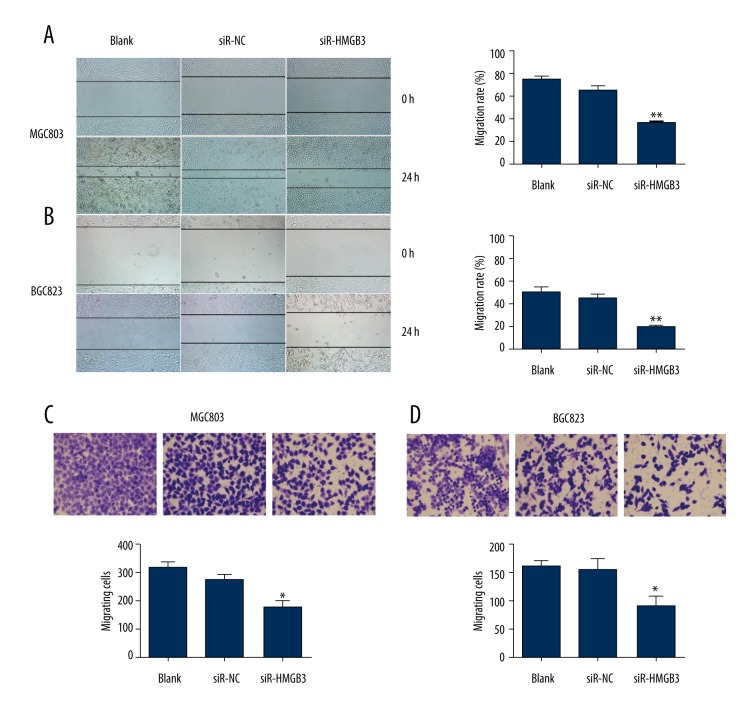
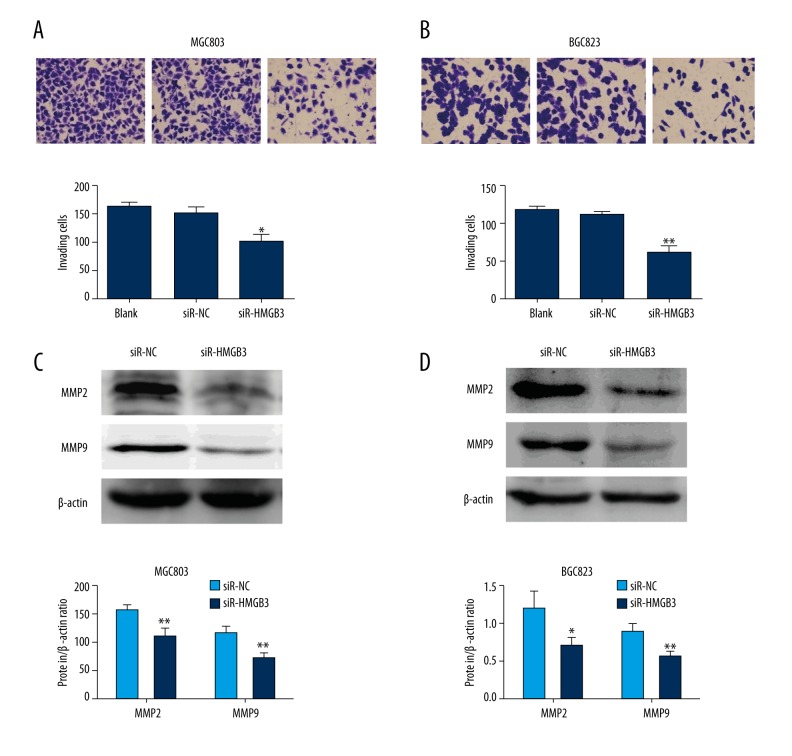
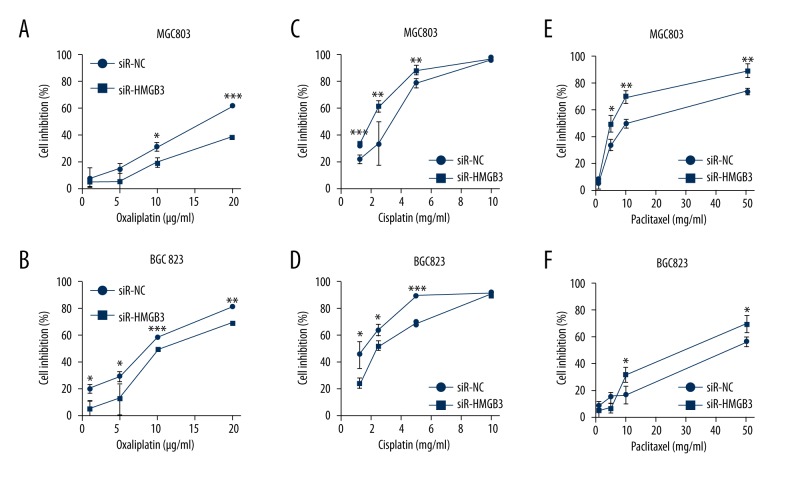
BACKGROUND High mobility group-box 3 (HMGB3) has been shown to affect tumor initiation and progression. This research aimed to investigate the role of HMGB3 in gastric cancer (GC) cell proliferation, migration, invasion, chemoresistance, and its potential molecular mechanisms. MATERIAL AND METHODS GC MGC803 and BGC823 cells were transfected with siRNA targeting the HMGB3 gene. The expressions of HMGB3 protein in MGC803 and BGC823 cells after transfection were detected by Western blot assays. We detected cell proliferation and cell cycle by MTT and flow cytometry assay. Cell migration and invasion were determined by wound scratch and transwell assay. MGC803 and BGC823 cells were treated with various concentrations of oxaliplatin, cisplatin, and paclitaxel. After 24 hours of drug exposure, we performed MTT assays to investigate chemoresistance in both groups. Western blot assays were used to detect related proteins expression. RESULTS Silencing of HMGB3 inhibited cell proliferation and induced G0/G1 phase arrest of GC cells partly via modulating p53 and p21 pathways, and downregulating Bcl-2/Bax ratio. RNA interference of HMGB3 inhibited cell invasion and migration by downregulating MMP2 and MMP9. Silencing of HMGB3 enhanced sensitive to cisplatin and paclitaxel, and reduced sensitive to oxaliplatin. CONCLUSIONS These findings suggest the importance of HMGB3 in the regulation of growth, migration, and apoptosis of GC, improve our understanding of the mechanisms of GC pathogenesis, and may promote the development of novel targeted therapies.
背景 高迁移率族蛋白盒3(HMGB3)已被证明会影响肿瘤的起始和进展。本研究旨在探讨HMGB3在胃癌(GC)细胞增殖、迁移、侵袭、化疗耐药中的作用及其潜在分子机制。
材料与方法 用靶向HMGB3基因的小干扰RNA(siRNA)转染GC的MGC803和BGC823细胞。通过蛋白质免疫印迹法检测转染后MGC803和BGC823细胞中HMGB3蛋白的表达。通过MTT法和流式细胞术检测细胞增殖和细胞周期。通过划痕实验和Transwell实验检测细胞迁移和侵袭能力。用不同浓度的奥沙利铂、顺铂和紫杉醇处理MGC803和BGC823细胞。药物作用24小时后,通过MTT实验研究两组细胞的化疗耐药性。用蛋白质免疫印迹法检测相关蛋白的表达。
结果 沉默HMGB3可抑制GC细胞增殖并诱导其G0/G1期阻滞,部分是通过调节p53和p21信号通路以及下调Bcl-2/Bax比值实现的。HMGB3的RNA干扰通过下调基质金属蛋白酶2(MMP2)和基质金属蛋白酶9(MMP9)抑制细胞侵袭和迁移。沉默HMGB3可增强细胞对顺铂和紫杉醇的敏感性,并降低对奥沙利铂的敏感性。
结论 这些发现表明HMGB3在GC生长、迁移和凋亡调控中具有重要作用,有助于加深我们对GC发病机制的理解,并可能推动新型靶向治疗的发展。