Flueck Joelle Leonie, Schaufelberger Fabienne, Lienert Martina, Schäfer Olstad Daniela, Wilhelm Matthias, Perret Claudio
Institute of Sports Medicine, Swiss Paraplegic Centre, Nottwil, Switzerland.
Institute of Human Movement Sciences and Sport, ETH Zurich, Switzerland.
PLoS One. 2016 Oct 24;11(10):e0165034. doi: 10.1371/journal.pone.0165034. eCollection 2016.
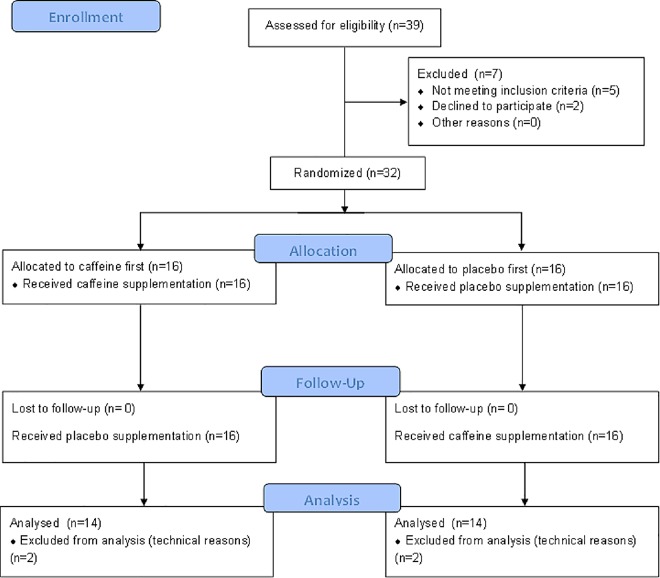
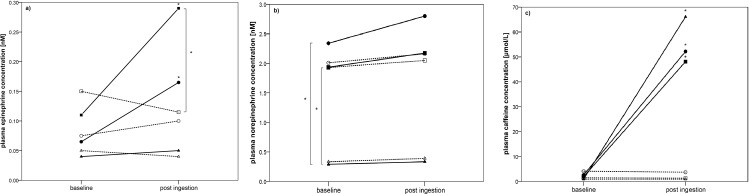
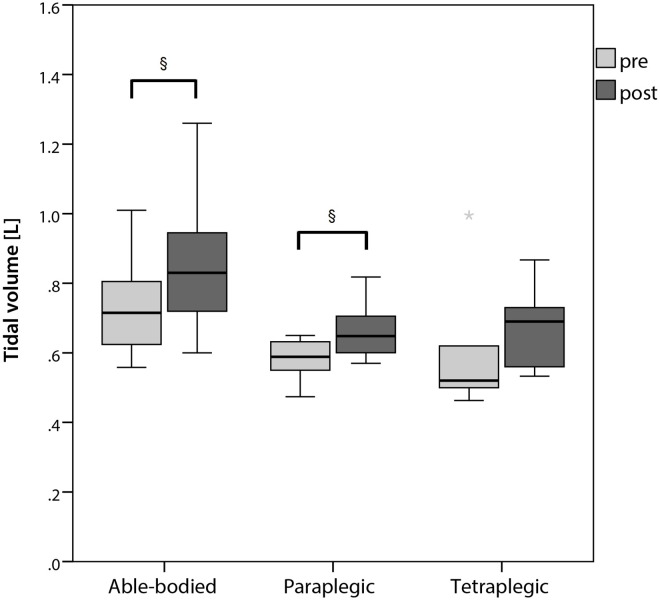
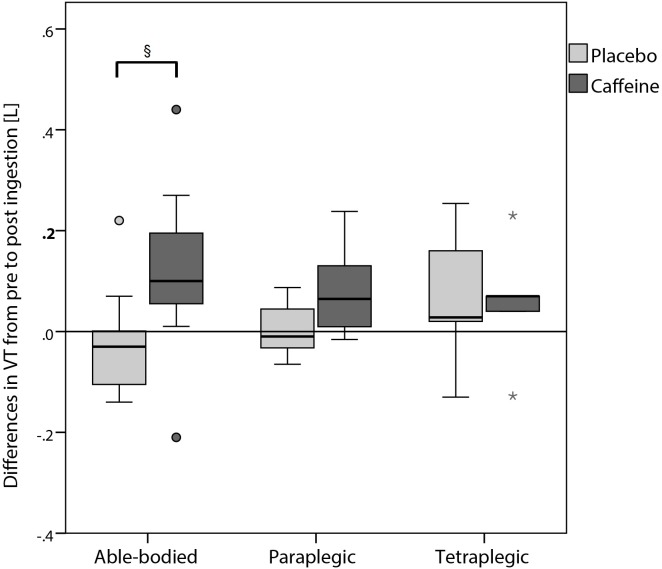
Caffeine increases sympathetic nerve activity in healthy individuals. Such modulation of nervous system activity can be tracked by assessing the heart rate variability. This study aimed to investigate the influence of caffeine on time- and frequency-domain heart rate variability parameters, blood pressure and tidal volume in paraplegic and tetraplegic compared to able-bodied participants. Heart rate variability was measured in supine and sitting position pre and post ingestion of either placebo or 6 mg caffeine in 12 able-bodied, 9 paraplegic and 7 tetraplegic participants in a placebo-controlled, randomized and double-blind study design. Metronomic breathing was applied (0.25 Hz) and tidal volume was recorded during heart rate variability assessment. Blood pressure, plasma caffeine and epinephrine concentrations were analyzed pre and post ingestion. Most parameters of heart rate variability did not significantly change post caffeine ingestion compared to placebo. Tidal volume significantly increased post caffeine ingestion in able-bodied (p = 0.021) and paraplegic (p = 0.036) but not in tetraplegic participants (p = 0.34). Systolic and diastolic blood pressure increased significantly post caffeine in able-bodied (systolic: p = 0.003; diastolic: p = 0.021) and tetraplegic (systolic: p = 0.043; diastolic: p = 0.042) but not in paraplegic participants (systolic: p = 0.09; diastolic: p = 0.33). Plasma caffeine concentrations were significantly increased post caffeine ingestion in all three groups of participants (p<0.05). Plasma epinephrine concentrations increased significantly in able-bodied (p = 0.002) and paraplegic (p = 0.032) but not in tetraplegic participants (p = 0.63). The influence of caffeine on the autonomic nervous system seems to depend on the level of lesion and the extent of the impairment. Therefore, tetraplegic participants may be less influenced by caffeine ingestion.
ClinicalTrials.gov NCT02083328.
咖啡因会增加健康个体的交感神经活动。这种神经系统活动的调节可通过评估心率变异性来追踪。本研究旨在调查与健全参与者相比,咖啡因对截瘫和四肢瘫患者时域和频域心率变异性参数、血压和潮气量的影响。在一项安慰剂对照、随机双盲研究设计中,对12名健全参与者、9名截瘫患者和7名四肢瘫患者在摄入安慰剂或6毫克咖啡因前后的仰卧位和坐位心率变异性进行了测量。在心率变异性评估期间采用了节律性呼吸(0.25赫兹)并记录潮气量。分析了摄入前后的血压、血浆咖啡因和肾上腺素浓度。与安慰剂相比,大多数心率变异性参数在摄入咖啡因后没有显著变化。健全参与者(p = 0.021)和截瘫患者(p = 0.036)摄入咖啡因后潮气量显著增加,但四肢瘫患者(p = 0.34)没有。健全参与者(收缩压:p = 0.003;舒张压:p = 0.021)和四肢瘫患者(收缩压:p = 0.043;舒张压:p = 0.042)摄入咖啡因后收缩压和舒张压显著升高,但截瘫患者(收缩压:p = 0.09;舒张压:p = 0.33)没有。三组参与者摄入咖啡因后血浆咖啡因浓度均显著升高(p<0.05)。健全参与者(p = 0.002)和截瘫患者(p = 0.032)血浆肾上腺素浓度显著升高,但四肢瘫患者(p = 0.