Li Mu, Dai Chen-Yang, Wang Yu-Ning, Chen Tao, Wang Long, Yang Ping, Xie Dong, Mao Rui, Chen Chang
Department of Thoracic Surgery, Shanghai Pulmonary Hospital, Tongji University School of Medicine, Shanghai, People's Republic of China.
Deloitte and Touche Financial Advisory Services Limited, Shanghai, People's Republic of China.
Oncotarget. 2016 Nov 22;7(47):77152-77162. doi: 10.18632/oncotarget.12809.
Although marital status is an independent prognostic factor in many cancers, its prognostic impact on tracheal cancer has not yet been determined. The goal of this study was to examine the relationship between marital status and survival in patients with tracheal cancer.
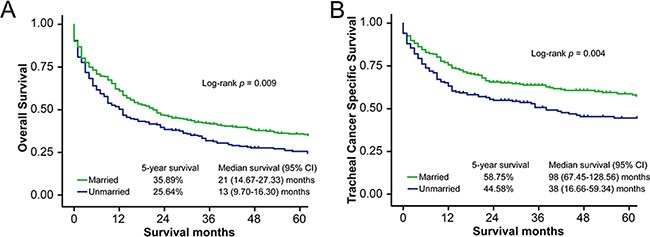
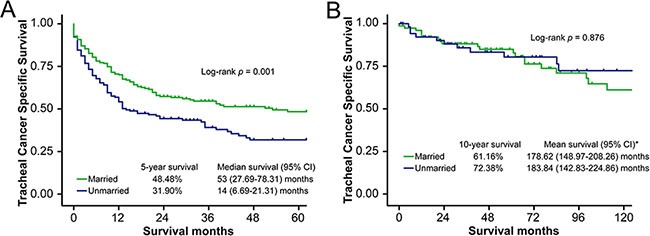
Compared with unmarried patients (42.67%), married patients (57.33%) had better 5-year OS (25.64% vs. 35.89%, p = 0.009) and 5-year TCSS (44.58% vs. 58.75%, p = 0.004). Results of multivariate analysis indicated that marital status is an independent prognostic factor, with married patients showing better OS (hazard ratio [HR] = 0.78, 95% confidence interval [CI] 0.64-0.95, p = 0.015) and TCSS (HR = 0.70, 95% CI 0.54-0.91, p = 0.008). In addition, subgroup analysis suggested that marital status plays a more important role in the TCSS of patients with non-low-grade malignant tumors (HR = 0.71, 95% CI 0.53-0.93, p = 0.015).
We extracted 600 cases from the Surveillance, Epidemiology, and End Results (SEER) database. Variables were compared by Pearson chi-squared test, t-test, log-rank test, and multivariate Cox regression analysis. Overall survival (OS) and tracheal cancer-specific survival (TCSS) were compared between subgroups with different pathologic features and tumor stages.
Marital status is an independent prognostic factor for survival in patients with tracheal cancer. For that reason, additional social support may be needed for unmarried patients, especially those with non-low-grade malignant tumors.
尽管婚姻状况是许多癌症的独立预后因素,但其对气管癌的预后影响尚未确定。本研究的目的是探讨气管癌患者婚姻状况与生存之间的关系。
与未婚患者(42.67%)相比,已婚患者(57.33%)的5年总生存率(OS)更高(25.64%对35.89%,p = 0.009),5年气管癌特异性生存率(TCSS)也更高(44.58%对58.75%,p = 0.004)。多因素分析结果表明,婚姻状况是一个独立的预后因素,已婚患者的OS更好(风险比[HR]=0.78,95%置信区间[CI]0.64 - 0.95,p = 0.015),TCSS也更好(HR = 0.70,95%CI 0.54 - 0.91,p = 0.008)。此外,亚组分析表明,婚姻状况在非低级别恶性肿瘤患者的TCSS中发挥更重要的作用(HR = 0.71,95%CI 0.53 - 0.93,p = 0.015)。
我们从监测、流行病学和最终结果(SEER)数据库中提取了600例病例。通过Pearson卡方检验、t检验、对数秩检验和多因素Cox回归分析对变量进行比较。比较了不同病理特征和肿瘤分期亚组之间的总生存(OS)和气管癌特异性生存(TCSS)。
婚姻状况是气管癌患者生存的独立预后因素。因此,未婚患者可能需要额外的社会支持,尤其是那些患有非低级别恶性肿瘤的患者。