Geophysical Institute, University of Bergen, Bergen 5007, Norway.
Bjerknes Centre for Climate Research, Bergen 5007, Norway.
Nat Commun. 2016 Oct 27;7:13244. doi: 10.1038/ncomms13244.
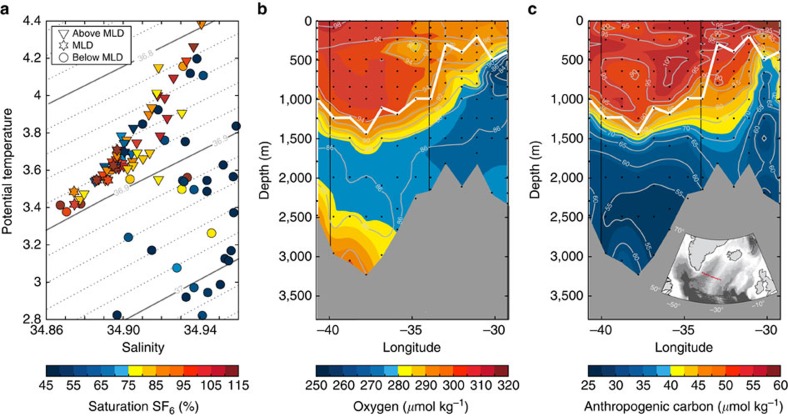
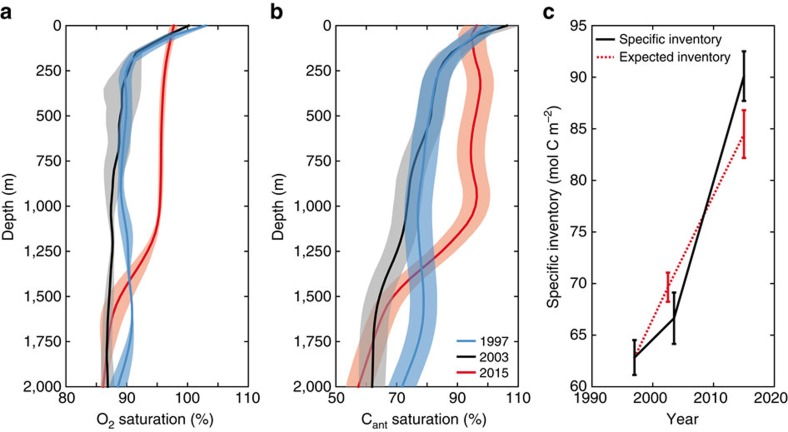
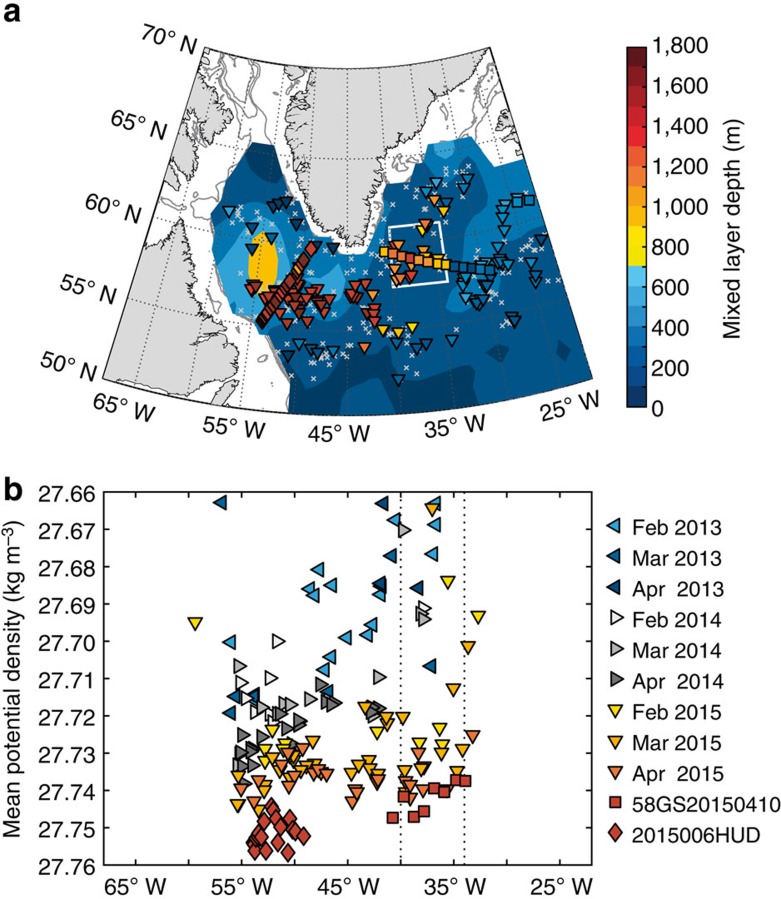
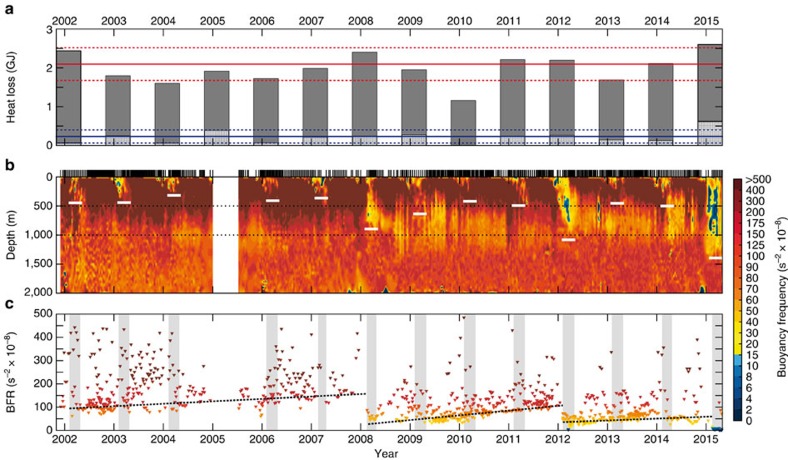
Deep convection in the subpolar North Atlantic ventilates the ocean for atmospheric gases through the formation of deep water masses. Variability in the intensity of deep convection is believed to have caused large variations in North Atlantic anthropogenic carbon storage over the past decades, but observations of the properties during active convection are missing. Here we document the origin, extent and chemical properties of the deepest winter mixed layers directly observed in the Irminger Sea. As a result of the deep convection in winter 2014-2015, driven by large oceanic heat loss, mid-depth oxygen concentrations were replenished and anthropogenic carbon storage rates almost tripled compared with Irminger Sea hydrographic section data in 1997 and 2003. Our observations provide unequivocal evidence that ocean ventilation and anthropogenic carbon uptake take place in the Irminger Sea and that their efficiency can be directly linked to atmospheric forcing.
北大西洋亚极地的深层对流通过深海水团的形成来为大气气体进行海洋通风。人们认为,深层对流强度的变化导致了过去几十年北大西洋人为碳储存的巨大变化,但在活跃对流期间对其特性的观测却缺失了。在这里,我们记录了在伊尔敏格尔海(Irminger Sea)直接观测到的最深冬季混合层的起源、范围和化学性质。由于 2014-2015 年冬季海洋热量大量损失导致的深层对流,中层氧浓度得到了补充,与 1997 年和 2003 年伊尔敏格尔海海洋学断面数据相比,人为碳储存率几乎增加了两倍。我们的观测结果提供了确凿的证据,表明海洋通风和人为碳吸收发生在伊尔敏格尔海,并且它们的效率可以直接与大气强迫联系起来。