Department of Physiology McGill University, Montreal, Quebec, Canada H3G1Y6.
Nat Commun. 2016 Oct 27;7:13229. doi: 10.1038/ncomms13229.
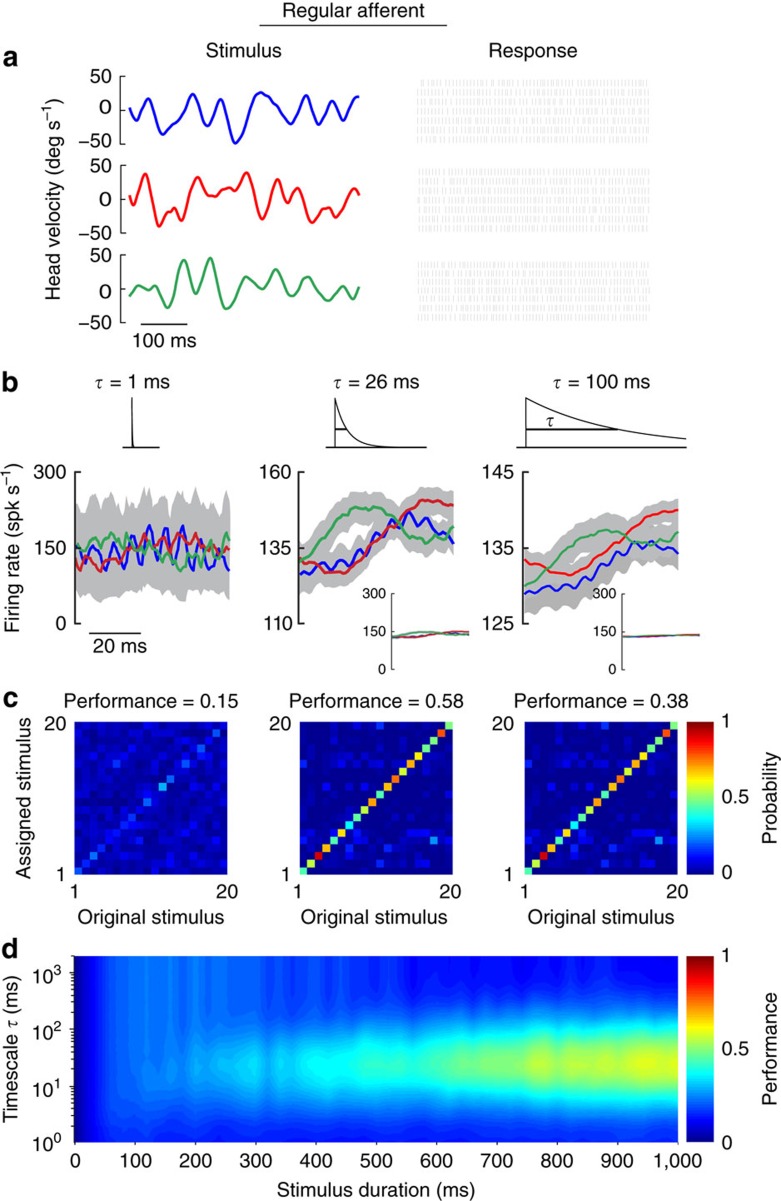
The accurate representation of self-motion requires the efficient processing of sensory input by the vestibular system. Conventional wisdom is that vestibular information is exclusively transmitted through changes in firing rate, yet under this assumption vestibular neurons display relatively poor detection and information transmission. Here, we carry out an analysis of the system's coding capabilities by recording neuronal responses to repeated presentations of naturalistic stimuli. We find that afferents with greater intrinsic variability reliably discriminate between different stimulus waveforms through differential patterns of precise (∼6 ms) spike timing, while those with minimal intrinsic variability do not. A simple mathematical model provides an explanation for this result. Postsynaptic central neurons also demonstrate precise spike timing, suggesting that higher brain areas also represent self-motion using temporally precise firing. These findings demonstrate that two distinct sensory channels represent vestibular information: one using rate coding and the other that takes advantage of precise spike timing.
准确地表示自身运动需要前庭系统有效地处理感觉输入。传统观点认为,前庭信息仅通过放电率的变化来传递,但根据这一假设,前庭神经元的检测和信息传输能力相对较差。在这里,我们通过记录神经元对自然刺激的重复呈现的反应来分析系统的编码能力。我们发现,固有变异性较大的传入神经通过精确(约 6 毫秒)的尖峰定时的差异模式可靠地区分不同的刺激波形,而固有变异性最小的传入神经则不能。一个简单的数学模型解释了这一结果。突触后中枢神经元也表现出精确的尖峰定时,这表明较高的大脑区域也使用时间精确的放电来表示自身运动。这些发现表明,有两个不同的感觉通道来表示前庭信息:一个使用率编码,另一个则利用精确的尖峰定时。