Trueba Davalillo Cesáreo Ángel, Trueba Vasavilbaso Cesáreo, Navarrete Álvarez José Mario, Coronel Granado Pilar, García Jiménez Ozcar Alejandro, Gimeno Del Sol Mercedes, Gil Orbezo Félix
School of Medicine (UNAM), México DF, Mexico; Orthopedic service, Hospital Español de México, México DF, Mexico.
Orthopedic service, Hospital Español de México, México DF, Mexico.
Open Access Rheumatol. 2015 Jan 9;7:9-18. doi: 10.2147/OARRR.S74553. eCollection 2015.
Osteoarthritis (OA) is the most common joint disease and leading cause of disability. Intra-articular (IA) administration of hyaluronic acid (HA) or corticosteroids (CS) have been previously studied, though using insufficient number of patients or short follow-up periods.
We evaluate HA and CS in patients with knee OA in terms of clinical efficacy over 12 months.
We used a prospective, randomized study with parallel groups. Randomized patients received IA injections of HA or betamethasone (BM). The primary outcomes were improvement in pain using Visual Analog Scale and function in the Western Ontario and McMaster University Osteoarthritis Index (Likert scale). Follow-up visits were scheduled at 3 months, 6 months, 9 months, and 12 months.
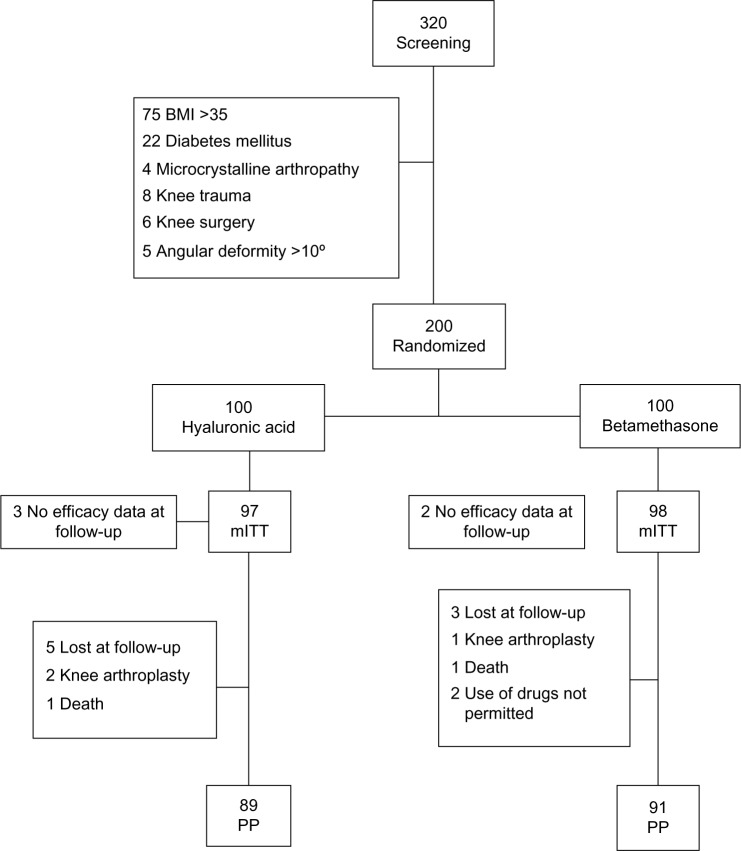
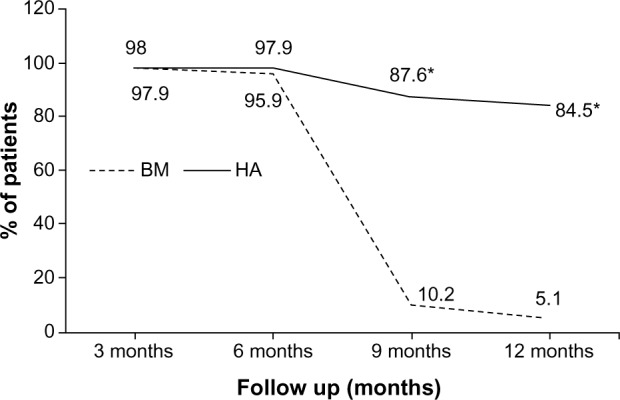
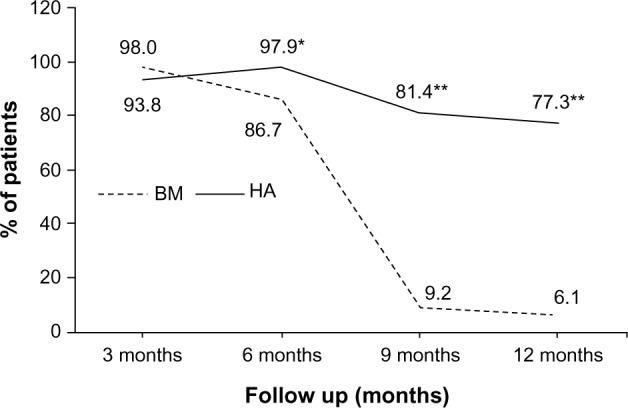
A total of 200 patients were included. Pain was significantly reduced in both groups at the first follow-ups. At 12 months, the mean pain reduction in the HA group was 33.6% (95% CI: 31.1-36.1) compared to 8.2% (95% CI: 5.2-11.1) in BM (<0.0001). Function improvement was higher in HA through every visit, and mean improvement at 12 months was 47.5% (95% CI: 45.6-49.3) in HA patients vs 13.2% (95% CI: 11.4-14.9) in the BM group (<0.0001). All patients from both groups achieved the Minimal Clinically Important Improvement (MCII) for both pain and function up to 6 months. At 9 months and 12 months, the MCII figures were higher in HA group with ≥80% compared to ≤10% in BM group (<0.0001). Adverse reactions were rare and related to the administration procedure.
Both treatments effectively controlled OA symptoms. BM showed higher short-term effectiveness, while HA showed better long-term effectiveness, maintaining clinical efficacy in a large number of patients 1 year after administration.
骨关节炎(OA)是最常见的关节疾病,也是导致残疾的主要原因。此前曾对关节内(IA)注射透明质酸(HA)或皮质类固醇(CS)进行过研究,但患者数量不足或随访期较短。
我们评估HA和CS对膝骨关节炎患者12个月的临床疗效。
我们采用了一项前瞻性平行组随机研究。随机分组的患者接受IA注射HA或倍他米松(BM)。主要结局指标是使用视觉模拟量表评估疼痛改善情况,以及使用西安大略和麦克马斯特大学骨关节炎指数(李克特量表)评估功能改善情况。随访安排在3个月、6个月、9个月和12个月。
共纳入200例患者。在首次随访时,两组疼痛均显著减轻。在12个月时,HA组平均疼痛减轻33.6%(95%置信区间:31.1-36.1),而BM组为8.2%(95%置信区间:5.2-11.1)(<0.0001)。在每次随访中,HA组的功能改善情况均更好,在12个月时,HA组患者的平均改善率为47.5%(95%置信区间:45.6-49.3),而BM组为13.2%(95%置信区间:11.4-14.9)(<0.0001)。两组所有患者在6个月时均实现了疼痛和功能的最小临床重要改善(MCII)。在9个月和12个月时,HA组的MCII数据更高,≥80%,而BM组≤10%(<0.0001)。不良反应罕见,且与给药程序有关。
两种治疗方法均能有效控制OA症状。BM显示出更高的短期疗效,但HA显示出更好的长期疗效,在给药1年后仍能在大量患者中维持临床疗效。