Hu Qiwen, Peng Huagang, Rao Xiancai
Department of Microbiology, College of Basic Medical Sciences, Third Military Medical University Chongqing, China.
Front Microbiol. 2016 Oct 13;7:1601. doi: 10.3389/fmicb.2016.01601. eCollection 2016.
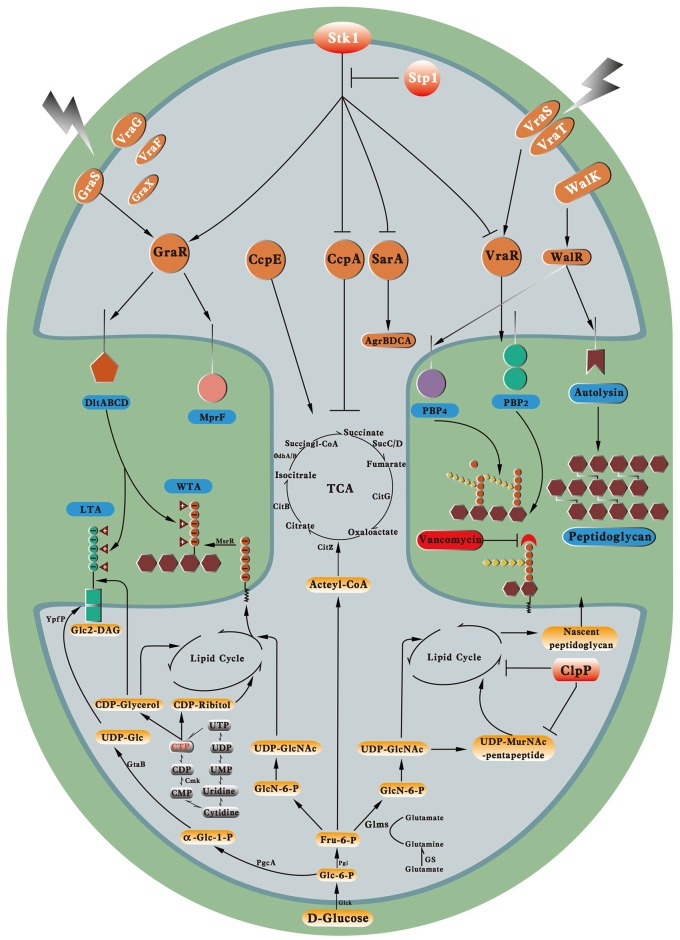
Vancomycin has been used as the last resort in the clinical treatment of serious infections. Vancomycin-intermediate (VISA) was discovered almost two decades ago. Aside from the vancomycin-intermediate phenotype, VISA strains from the clinic or laboratory exhibited common characteristics, such as thickened cell walls, reduced autolysis, and attenuated virulence. However, the genetic mechanisms responsible for the reduced vancomycin susceptibility in VISA are varied. The comparative genomics of vancomycin-susceptible (VSSA)/VISA pairs showed diverse genetic mutations in VISA; only a small number of these mutations have been experimentally verified. To connect the diversified genotypes and common phenotypes in VISA, we reviewed the genetic alterations in the relative determinants, including mutations in the , and genes. Especially, we analyzed the mechanism through which diverse mutations mediate vancomycin resistance. We propose a unified model that integrates diverse gene functions and complex biochemical processes in VISA upon the action of vancomycin.
万古霉素一直被用作严重感染临床治疗的最后手段。万古霉素中介(VISA)大约在二十年前被发现。除了万古霉素中介表型外,临床或实验室分离出的VISA菌株表现出一些共同特征,如细胞壁增厚、自溶减少和毒力减弱。然而,导致VISA对万古霉素敏感性降低的遗传机制各不相同。对万古霉素敏感(VSSA)/VISA菌株对的比较基因组学研究显示,VISA存在多种基因突变;其中只有少数突变经过了实验验证。为了将VISA中多样的基因型和共同的表型联系起来,我们回顾了相关决定因素中的遗传改变,包括 、 和 基因的突变。特别是,我们分析了不同突变介导万古霉素耐药性的机制。我们提出了一个统一模型,该模型整合了万古霉素作用下VISA中多样的基因功能和复杂的生化过程。