Adee Eric, Roozeboom Kraig, Balboa Guillermo R, Schlegel Alan, Ciampitti Ignacio A
Throckmorton Plant Science Center, Department of Agronomy, Kansas State University, Manhattan KS, USA.
Front Plant Sci. 2016 Oct 13;7:1534. doi: 10.3389/fpls.2016.01534. eCollection 2016.
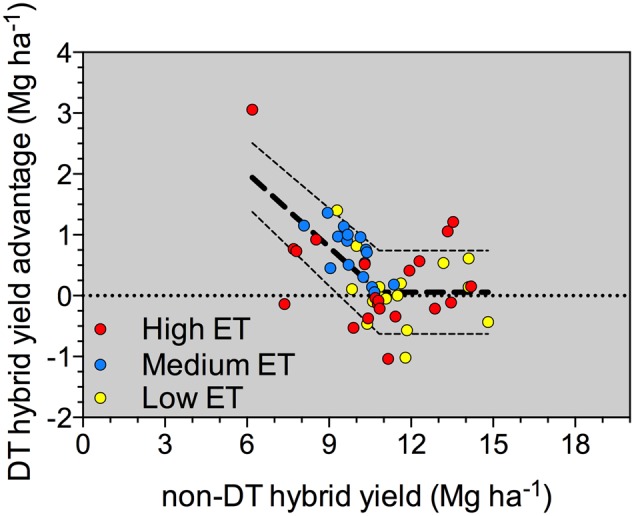
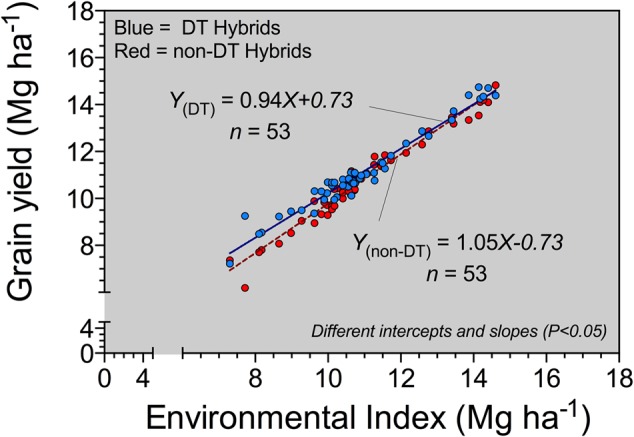
The potential benefit of drought-tolerant (DT) corn ( L.) hybrids may depend on drought intensity, duration, crop growth stage (timing), and the array of drought tolerance mechanisms present in selected hybrids. We hypothesized that corn hybrids containing DT traits would produce more consistent yields compared to non-DT hybrids in the presence of drought stress. The objective of this study was to define types of production environments where DT hybrids have a yield advantage compared to non-DT hybrids. Drought tolerant and non-DT hybrid pairs of similar maturity were planted in six site-years with different soil types, seasonal evapotranspiration (ET), and vapor pressure deficit (VPD), representing a range of macro-environments. Irrigation regimes and seeding rates were used to create several micro-environments within each macro-environment. Hybrid response to the range of macro and micro-environmental stresses were characterized in terms of water use efficiency, grain yield, and environmental index. Yield advantage of DT hybrids was positively correlated with environment ET and VPD. Drought tolerant hybrids yielded 5 to 7% more than non-DT hybrids in high and medium ET environments (>430 mm ET), corresponding to seasonal VPD greater than 1200 Pa. Environmental index analysis confirmed that DT hybrids were superior in stressful environments. Yield advantage for DT hybrids appeared as yield dropped below 10.8 Mg ha and averaged as much as 0.6-1 Mg ha at the low yield range. Hybrids with DT technology can offer a degree of buffering against drought stress by minimizing yield reduction, but also maintaining a comparable yield potential in high yielding environments. Further studies should focus on the physiological mechanisms presented in the commercially available corn drought tolerant hybrids.
耐旱型玉米杂交种的潜在益处可能取决于干旱强度、持续时间、作物生长阶段(时机)以及所选杂交种中存在的一系列耐旱机制。我们假设,在干旱胁迫下,含有耐旱性状的玉米杂交种相比非耐旱杂交种能产生更稳定的产量。本研究的目的是确定与非耐旱杂交种相比,耐旱杂交种具有产量优势的生产环境类型。将成熟期相似的耐旱和非耐旱杂交种成对种植在六个地点 - 年份,这些地点具有不同的土壤类型、季节性蒸散量(ET)和水汽压差(VPD),代表了一系列宏观环境。通过灌溉制度和播种量在每个宏观环境中创造了几种微观环境。根据水分利用效率、籽粒产量和环境指数来表征杂交种对一系列宏观和微观环境胁迫的响应。耐旱杂交种的产量优势与环境ET和VPD呈正相关。在高ET和中等ET环境(ET>430毫米)中,耐旱杂交种的产量比非耐旱杂交种高5%至7%,对应季节性VPD大于1200帕斯卡。环境指数分析证实,耐旱杂交种在胁迫环境中表现更优。当产量降至10.8公吨/公顷以下时,耐旱杂交种的产量优势显现出来,在低产范围内平均优势高达0.6 - 1公吨/公顷。具有耐旱技术的杂交种可以通过最大限度地减少产量下降来提供一定程度的抗旱缓冲,同时在高产环境中保持相当的产量潜力。进一步的研究应聚焦于市售耐旱玉米杂交种所呈现的生理机制。