Eakins Felicity, Pinali Christian, Gleeson Anthony, Knupp Carlo, Squire John M
Faculty of Medicine, Imperial College London, Exhibition Road, London SW7 2AZ, UK.
Biophysics Group, Optometry & Vision Sciences, University of Cardiff, Cardiff CF10 3XQ, UK.
Biology (Basel). 2016 Oct 26;5(4):41. doi: 10.3390/biology5040041.
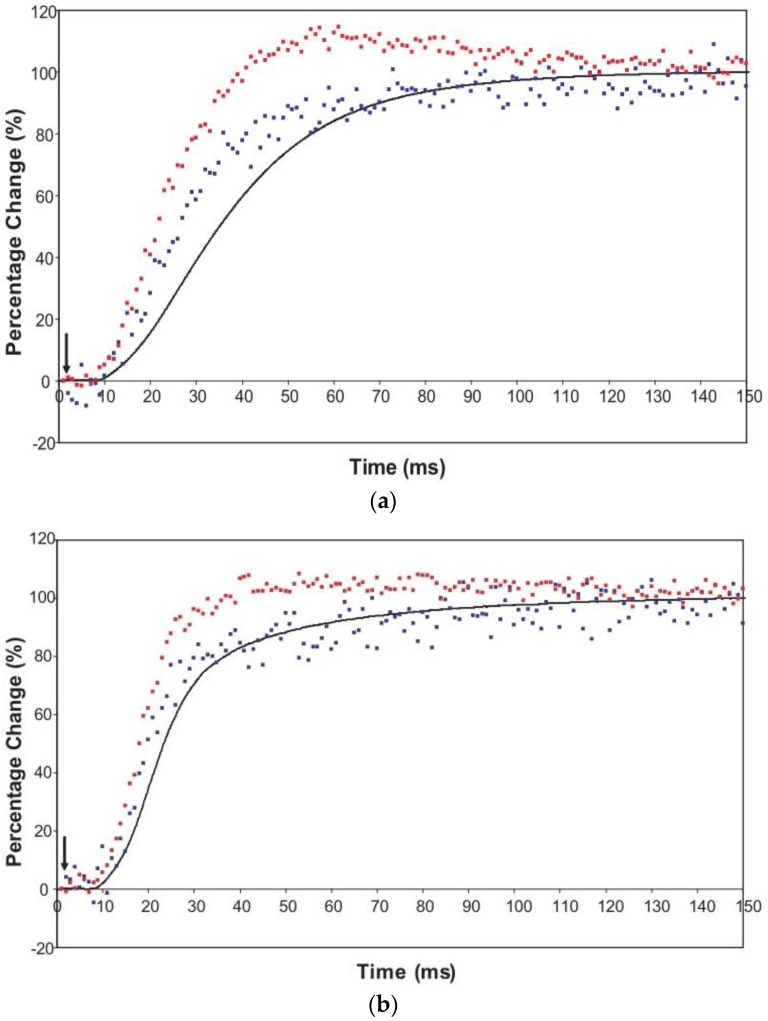
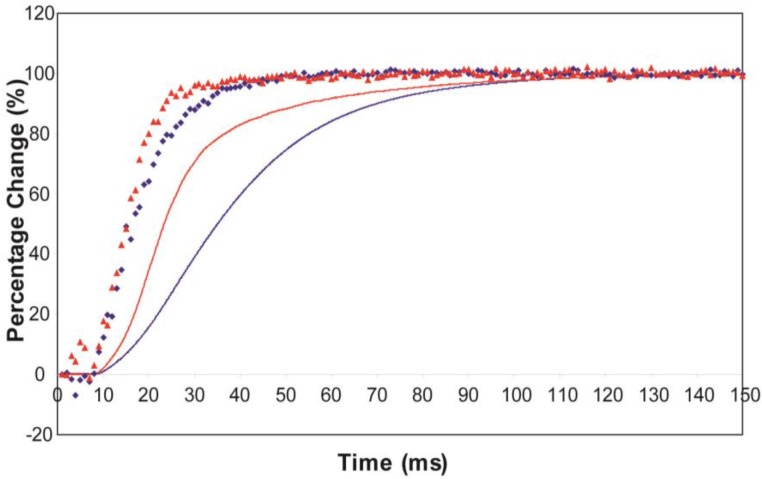
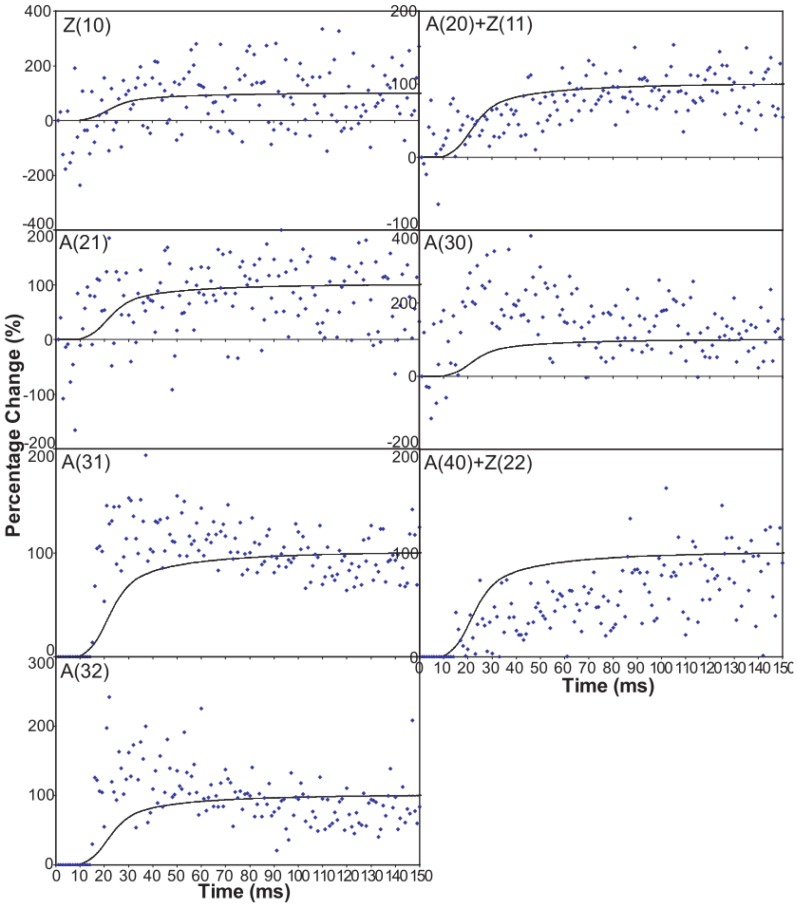
Defining the structural changes involved in the myosin cross-bridge cycle on actin in active muscle by X-ray diffraction will involve recording of the whole two dimensional (2D) X-ray diffraction pattern from active muscle in a time-resolved manner. Bony fish muscle is the most highly ordered vertebrate striated muscle to study. With partial sarcomere length (SL) control we show that changes in the fish muscle equatorial A-band (10) and (11) reflections, along with (10)/(11) intensity ratio and the tension, are much more rapid than without such control. Times to 50% change with SL control were 19.5 (±2.0) ms, 17.0 (±1.1) ms, 13.9 (±0.4) ms and 22.5 (±0.8) ms, respectively, compared to 25.0 (±3.4) ms, 20.5 (±2.6) ms, 15.4 (±0.6) ms and 33.8 (±0.6) ms without control. The (11) intensity and the (10)/(11) intensity ratio both still change ahead of tension, supporting the likelihood of the presence of a head population close to or on actin, but producing little or no force, in the early stages of the contractile cycle. Higher order equatorials (e.g., (30), (31), and (32)), more sensitive to crossbridge conformation and distribution, also change very rapidly and overshoot their tension plateau values by a factor of around two, well before the tension plateau has been reached, once again indicating an early low-force cross-bridge state in the contractile cycle. Modelling of these intensity changes suggests the presence of probably two different actin-attached myosin head structural states (mainly low-force attached and rigor-like). No more than two main attached structural states are necessary and sufficient to explain the observations. We find that 48% of the heads are off actin giving a resting diffraction pattern, 20% of heads are in the weak binding conformation and 32% of the heads are in the strong (rigor-like) state. The strong states account for 96% of the tension at the tetanus plateau.
通过X射线衍射确定活跃肌肉中肌动蛋白上肌球蛋白横桥循环所涉及的结构变化,将需要以时间分辨的方式记录活跃肌肉的整个二维(2D)X射线衍射图谱。硬骨鱼肌肉是用于研究的最高度有序的脊椎动物横纹肌。通过部分肌节长度(SL)控制,我们发现,与没有这种控制时相比,鱼肌肉赤道A带(10)和(11)反射的变化,以及(10)/(11)强度比和张力的变化要快得多。有SL控制时达到50%变化的时间分别为19.5(±2.0)毫秒、17.0(±1.1)毫秒、13.9(±0.4)毫秒和22.5(±0.8)毫秒,而没有控制时分别为25.0(±3.4)毫秒、20.5(±2.6)毫秒、15.4(±0.6)毫秒和33.8(±0.6)毫秒。(11)强度和(10)/(11)强度比在张力之前仍会发生变化,这支持了在收缩周期早期存在靠近或位于肌动蛋白上的头部群体的可能性,但产生的力很小或没有力。对横桥构象和分布更敏感的高阶赤道反射(例如,(30)、(31)和(32))变化也非常迅速,并且在达到张力平台值之前就超过其张力平台值约两倍,这再次表明收缩周期中存在早期低力横桥状态。对这些强度变化的建模表明可能存在两种不同的附着在肌动蛋白上的肌球蛋白头部结构状态(主要是低力附着和类似僵直的状态)。不超过两种主要的附着结构状态就足以解释这些观察结果。我们发现48%的头部脱离肌动蛋白,产生静息衍射图谱,20%的头部处于弱结合构象,32%的头部处于强(类似僵直)状态。在强直收缩平台期,强状态占张力的96%。