Głażewska Edyta Katarzyna, Niczyporuk Marek, Ławicki Sławomir, Szmitkowski Maciej, Zajkowska Monika, Będkowska Grażyna Ewa, Przylipiak Andrzej
Department of Esthetic Medicine.
Department of Biochemical Diagnostics.
Ther Clin Risk Manag. 2016 Oct 21;12:1579-1585. doi: 10.2147/TCRM.S113769. eCollection 2016.
Matrix metalloproteinases (MMPs), which show a significant ability to cleave the components of extracellular matrix, and tissue inhibitors of metalloproteinases (TIMPs), which slow down the activity of those enzymes, may be implicated in the pathogenesis and spread of psoriatic disease. This study aims to analyze plasma levels of MMP-2 and TIMP-2 in plaque psoriasis patients before and after the course of narrowband ultraviolet-B (NBUVB) therapy with respect to disease advancement.
A total of 49 patients suffering from plaque psoriasis and 40 healthy volunteers were enrolled into the study. Plasma levels of MMP-2 and TIMP-2 were determined using enzyme-linked immunosorbent assay, while Psoriasis Area and Severity Index (PASI) was used to define the disease advancement.
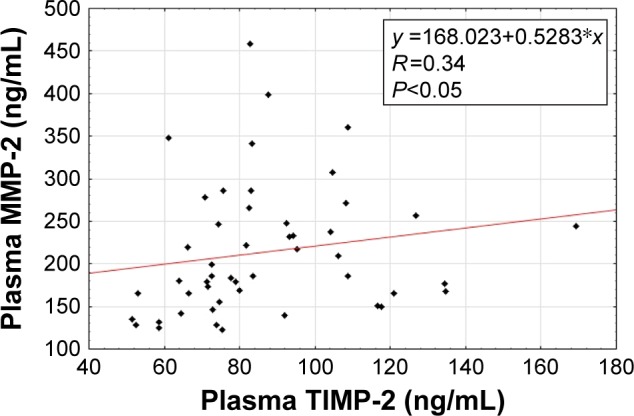
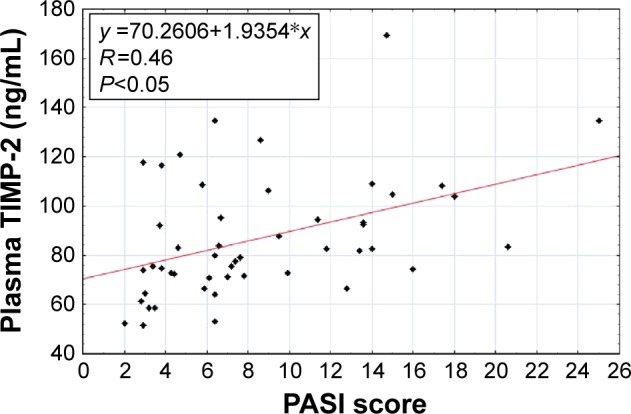
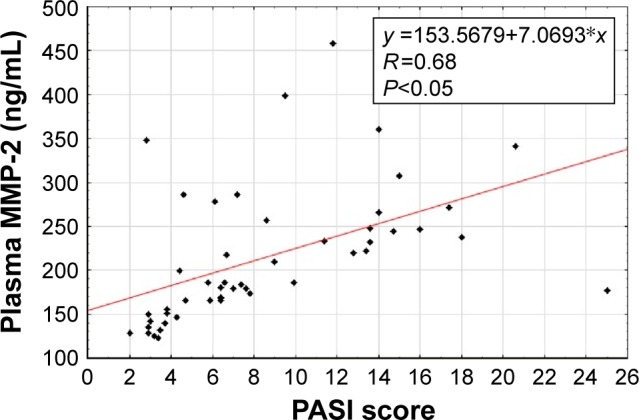
The results showed increased plasma levels of MMP-2 and TIMP-2, but this change was significant only in case of MMP-2 in total psoriatic group compared to healthy subjects. Moreover, there was an increase in the concentrations of chosen factors with an increase in the severity of the disease. The NBUVB therapy causes a decline in the concentration of the analyzed enzyme and its inhibitor, although this change was statistically significant in the total psoriatic group only in case of MMP-2. There was also a positive correlation between MMP-2, TIMP-2, and PASI score value.
Our study highlights a possible important role of MMP-2 in the activity of psoriasis and clearance of disease symptoms. Moreover, plasma MMP-2 seems to be a valuable psoriasis biomarker.
基质金属蛋白酶(MMPs)具有显著的裂解细胞外基质成分的能力,而金属蛋白酶组织抑制剂(TIMPs)则可减缓这些酶的活性,它们可能与银屑病的发病机制和扩散有关。本研究旨在分析斑块状银屑病患者在窄谱中波紫外线(NBUVB)治疗前后血浆中MMP-2和TIMP-2的水平与疾病进展的关系。
本研究共纳入49例斑块状银屑病患者和40名健康志愿者。采用酶联免疫吸附测定法测定血浆中MMP-2和TIMP-2的水平,同时使用银屑病面积和严重程度指数(PASI)来定义疾病进展情况。
结果显示,银屑病患者血浆中MMP-2和TIMP-2水平升高,但与健康受试者相比,仅MMP-2在整个银屑病组中的变化具有统计学意义。此外,所选因子的浓度随疾病严重程度的增加而升高。NBUVB治疗导致所分析的酶及其抑制剂浓度下降,尽管这种变化仅在整个银屑病组中MMP-2的情况下具有统计学意义。MMP-2、TIMP-2与PASI评分值之间也存在正相关。
我们的研究强调了MMP-2在银屑病活动和疾病症状清除中可能发挥的重要作用。此外,血浆MMP-2似乎是一种有价值的银屑病生物标志物。