Ahmed Toqeer, Scholz Miklas, Al-Faraj Furat, Niaz Wajeeha
Centre for Climate Research and Development, COMSAS Institute of Information Technology, Islamabad Campus, Park Road, Chak Shahzad, Islamabad 45550, Pakistan.
Division of Water Resources Engineering, Faculty of Engineering, Lund University, P.O. Box 118, Lund 22100, Sweden.
Int J Environ Res Public Health. 2016 Oct 27;13(11):1051. doi: 10.3390/ijerph13111051.
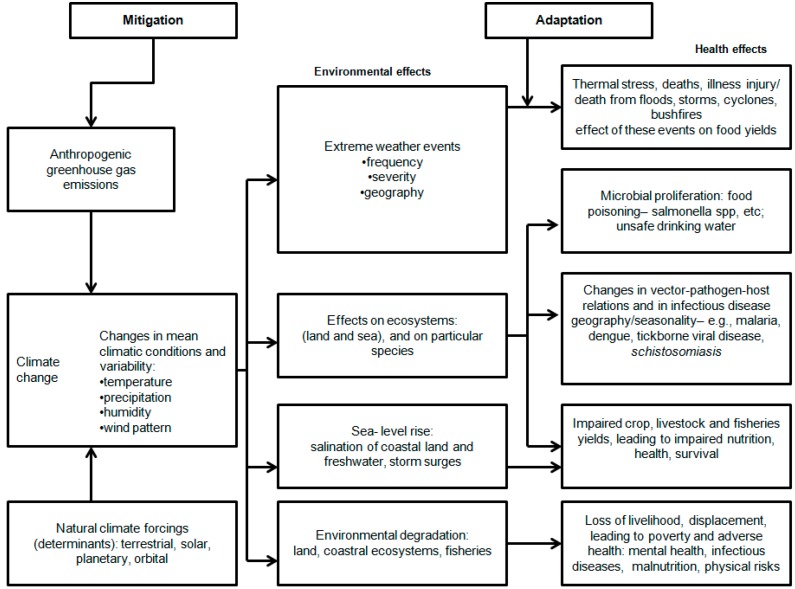
Water-related impacts due to change in climatic conditions ranging from water scarcity to intense floods and storms are increasing in developing countries like Pakistan. Water quality and waterborne diseases like hepatitis, cholera, typhoid, malaria and dengue fever are increasing due to chaotic urbanization, industrialization, poor hygienic conditions, and inappropriate water management. The morbidity rate is high due to lack of health care facilities, especially in developing countries. Organizations linked to the Government of Pakistan (e.g., Ministry of Environment, Ministry of Climate Change, Planning and Development, Ministry of Forest, Irrigation and Public Health, Pakistan Meteorological Department, National Disaster Management, Pakistan Agricultural Research Centre, Pakistan Council for Research in Water Resources, and Global Change Impact Study Centre), United Nation organizations, provincial government departments, non-governmental organizations (e.g., Global Facility and Disaster Reduction), research centers linked to universities, and international organizations (International Institute for Sustainable Development, Food and Agriculture, Global Climate Fund and World Bank) are trying to reduce the water-related impacts of climate change, but due to lack of public awareness and health care infrastructure, the death rate is steadily increasing. This paper critically reviews the scientific studies and reports both at national and at international level benefiting generalists concerned with environmental and public health challenges. The article underlines the urgent need for water conservation, risk management, and the development of mitigation measures to cope with the water-related impacts of climate change on agriculture and subsequently on public health. Novel solutions and bioremediation methods have been presented to control environmental pollution and to promote awareness among the scientific community. The focus is on diverse strategies to handle the forthcoming challenges associated with water resources management.
在巴基斯坦等发展中国家,气候条件变化导致的与水相关的影响不断增加,范围从水资源短缺到严重的洪水和风暴。由于混乱的城市化、工业化、卫生条件差以及水资源管理不当,水质和诸如肝炎、霍乱、伤寒、疟疾和登革热等水传播疾病正在增加。由于缺乏医疗保健设施,发病率很高,尤其是在发展中国家。与巴基斯坦政府相关的组织(例如,环境部、气候变化部、规划与发展部、林业、灌溉与公共卫生部、巴基斯坦气象局、国家灾害管理局、巴基斯坦农业研究中心、巴基斯坦水资源研究理事会以及全球变化影响研究中心)、联合国组织、省级政府部门、非政府组织(例如,全球减灾基金)、与大学相关的研究中心以及国际组织(国际可持续发展研究所、粮食及农业组织、全球气候基金和世界银行)都在努力减少气候变化与水相关的影响,但由于公众意识和医疗保健基础设施的缺乏,死亡率正在稳步上升。本文批判性地回顾了国家和国际层面的科学研究与报告,以惠及关注环境和公共卫生挑战的通才。文章强调迫切需要节约用水、风险管理以及制定缓解措施,以应对气候变化对农业进而对公共卫生产生的与水相关的影响。文中提出了新颖的解决方案和生物修复方法,以控制环境污染并提高科学界的认识。重点是应对与水资源管理相关的未来挑战的各种策略。