Sotero Roberto C
Hotchkiss Brain Institute, Department of Radiology, University of Calgary, Calgary, AB, Canada.
PLoS Comput Biol. 2016 Nov 1;12(11):e1005180. doi: 10.1371/journal.pcbi.1005180. eCollection 2016 Nov.
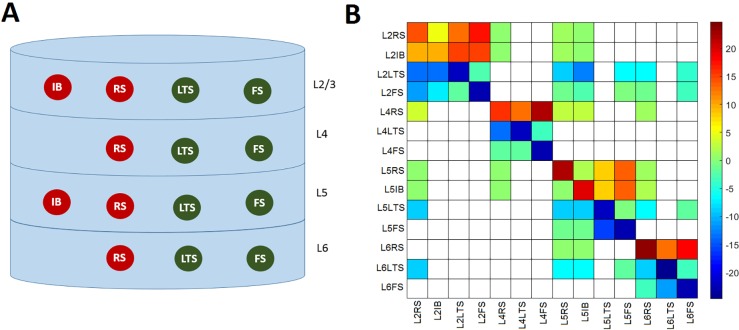
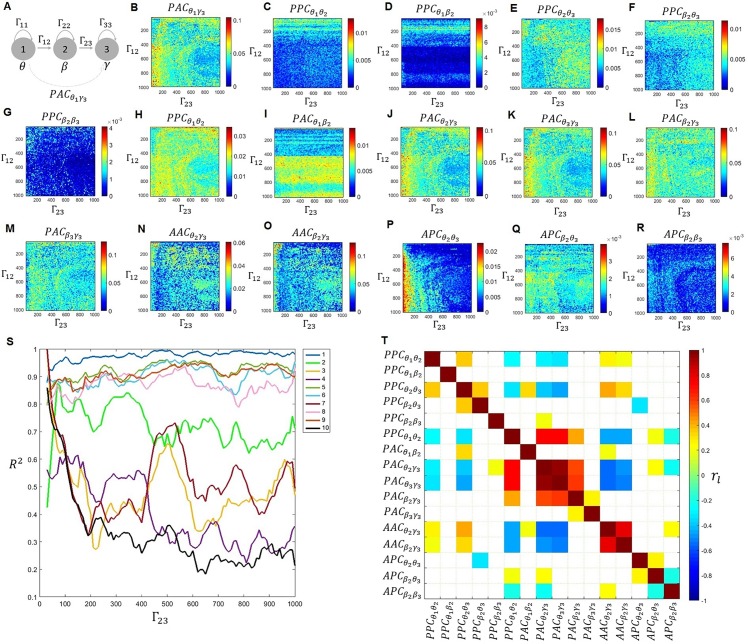
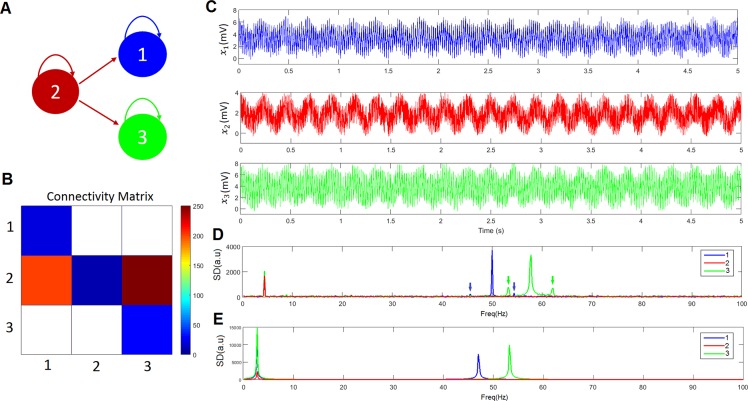
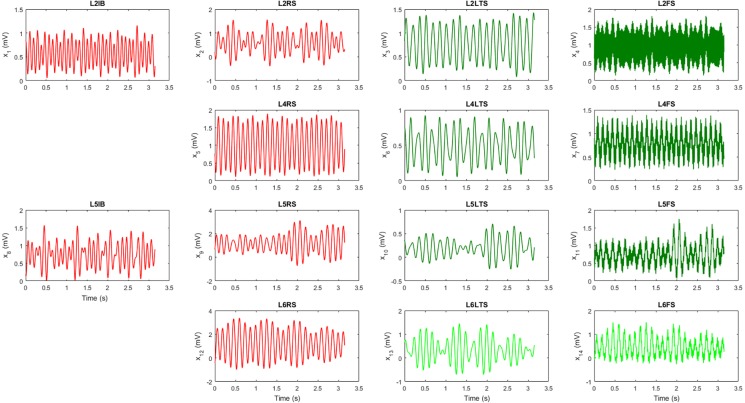
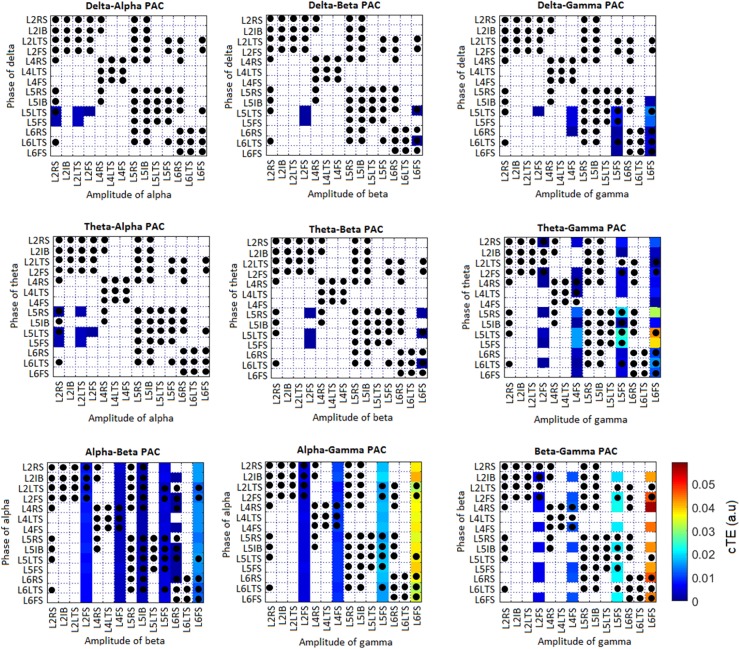
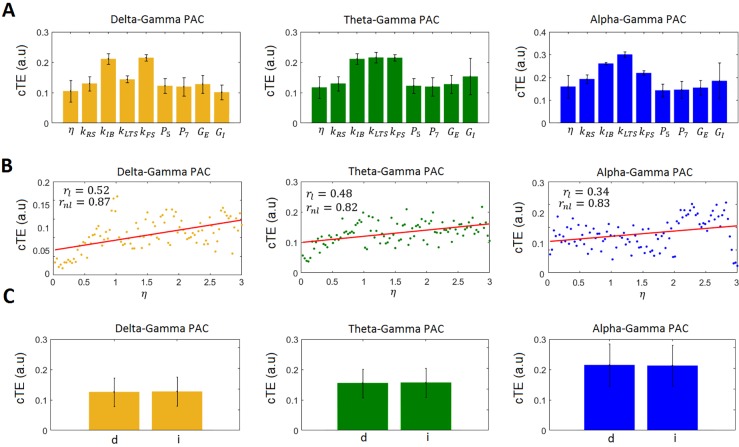
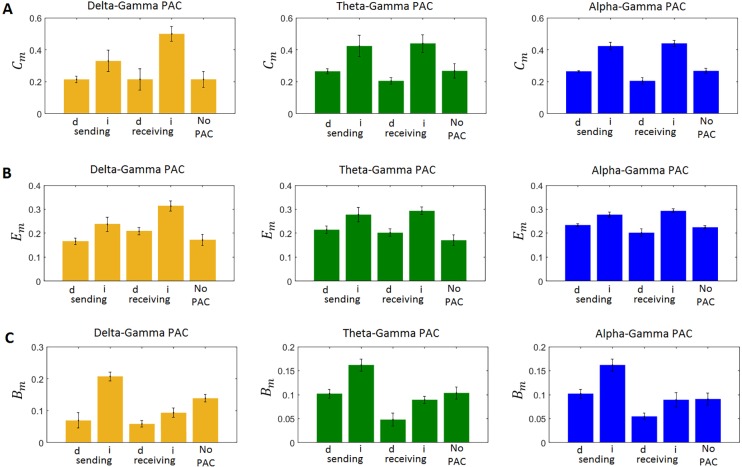
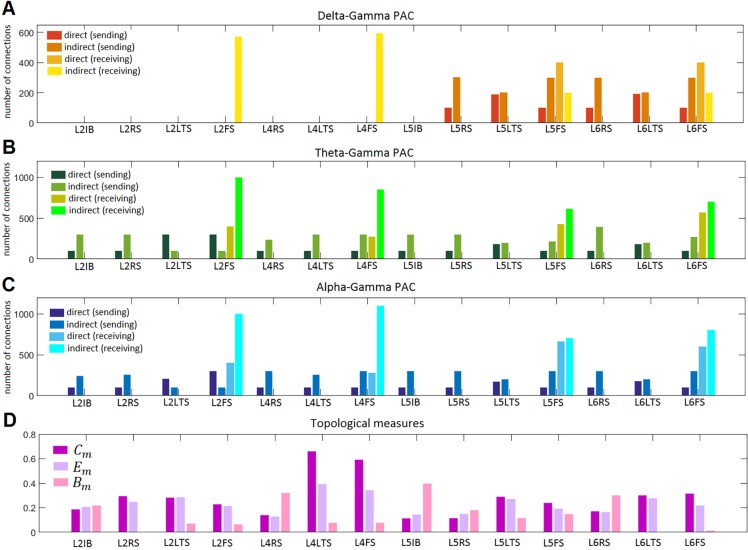
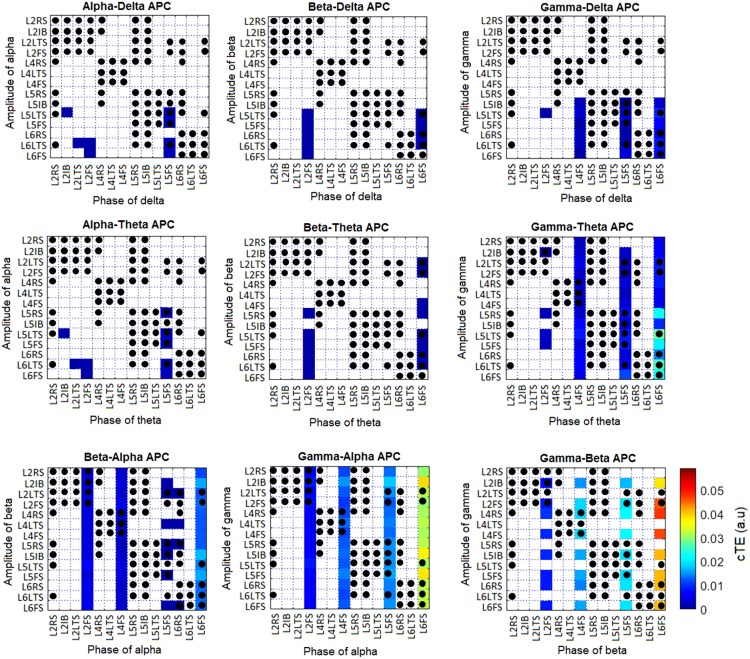
Phase-amplitude coupling (PAC), a type of cross-frequency coupling (CFC) where the phase of a low-frequency rhythm modulates the amplitude of a higher frequency, is becoming an important indicator of information transmission in the brain. However, the neurobiological mechanisms underlying its generation remain undetermined. A realistic, yet tractable computational model of the phenomenon is thus needed. Here we analyze a neural mass model of a cortical column, comprising fourteen neuronal populations distributed across four layers (L2/3, L4, L5 and L6). A control analysis showed that the conditional transfer entropy (cTE) measure is able to correctly estimate the flow of information between neuronal populations. Then, we computed cTE from the phases to the amplitudes of the oscillations generated in the cortical column. This approach provides information regarding directionality by distinguishing PAC from APC (amplitude-phase coupling), i.e. the information transfer from amplitudes to phases, and can be used to estimate other types of CFC such as amplitude-amplitude coupling (AAC) and phase-phase coupling (PPC). While experiments often only focus on one or two PAC combinations (e.g., theta-gamma or alpha-gamma), we found that a cortical column can simultaneously generate almost all possible PAC combinations, depending on connectivity parameters, time constants, and external inputs. PAC interactions with and without an anatomical equivalent (direct and indirect interactions, respectively) were analyzed. We found that the strength of PAC between two populations was strongly correlated with the strength of the effective connections between the populations and, on average, did not depend on whether the PAC connection was direct or indirect. When considering a cortical column circuit as a complex network, we found that neuronal populations making indirect PAC connections had, on average, higher local clustering coefficient, efficiency, and betweenness centrality than populations making direct connections and populations not involved in PAC connections. This suggests that their interactions were more effective when transmitting information. Since approximately 60% of the obtained interactions represented indirect connections, our results highlight the importance of the topology of cortical circuits for the generation of the PAC phenomenon. Finally, our results demonstrated that indirect PAC interactions can be explained by a cascade of direct CFC and same-frequency band interactions, suggesting that PAC analysis of experimental data should be accompanied by the estimation of other types of frequency interactions for an integrative understanding of the phenomenon.
相位-振幅耦合(PAC)是交叉频率耦合(CFC)的一种类型,其中低频节律的相位调制高频的振幅,它正成为大脑中信息传递的一个重要指标。然而,其产生背后的神经生物学机制仍未确定。因此,需要一个现实且易于处理的该现象的计算模型。在这里,我们分析了一个皮质柱的神经团模型,它由分布在四层(L2/3、L4、L5和L6)的14个神经元群体组成。一项对照分析表明,条件转移熵(cTE)测量能够正确估计神经元群体之间的信息流。然后,我们计算了从皮质柱中产生的振荡的相位到振幅的cTE。这种方法通过区分PAC和APC(振幅-相位耦合,即从振幅到相位的信息传递)来提供关于方向性的信息,并且可用于估计其他类型的CFC,如振幅-振幅耦合(AAC)和相位-相位耦合(PPC)。虽然实验通常只关注一两种PAC组合(例如,theta-γ或alpha-γ),但我们发现,根据连接参数、时间常数和外部输入,一个皮质柱可以同时产生几乎所有可能的PAC组合。分析了有无解剖学等效物的PAC相互作用(分别为直接和间接相互作用)。我们发现,两个群体之间的PAC强度与群体之间有效连接的强度密切相关,并且平均而言,不取决于PAC连接是直接的还是间接的。当将皮质柱回路视为一个复杂网络时,我们发现,进行间接PAC连接的神经元群体平均而言比进行直接连接的群体以及不参与PAC连接的群体具有更高的局部聚类系数、效率和介数中心性。这表明它们在传递信息时的相互作用更有效。由于所获得的相互作用中约60%代表间接连接,我们的结果突出了皮质回路拓扑结构对PAC现象产生的重要性。最后,我们的结果表明,间接PAC相互作用可以由一系列直接CFC和同频带相互作用来解释,这表明对实验数据的PAC分析应该伴随着对其他类型频率相互作用的估计,以便对该现象有一个综合的理解。