Bos Hannah, Diesmann Markus, Helias Moritz
Institute of Neuroscience and Medicine (INM-6) and Institute for Advanced Simulation (IAS-6) and JARA BRAIN Institute I, Jülich Research Centre, Jülich, Germany.
Department of Psychiatry, Psychotherapy and Psychosomatics, Medical Faculty, RWTH Aachen University, Aachen, Germany.
PLoS Comput Biol. 2016 Oct 13;12(10):e1005132. doi: 10.1371/journal.pcbi.1005132. eCollection 2016 Oct.
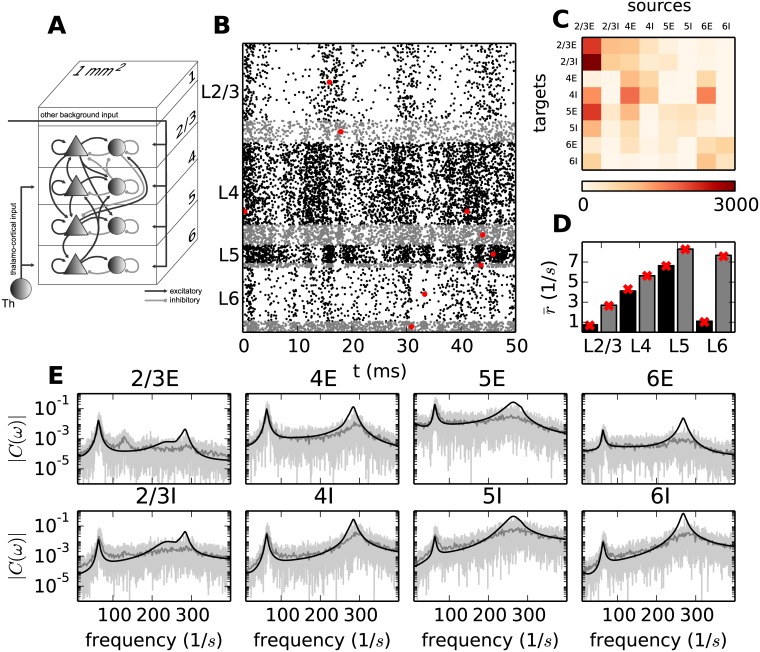
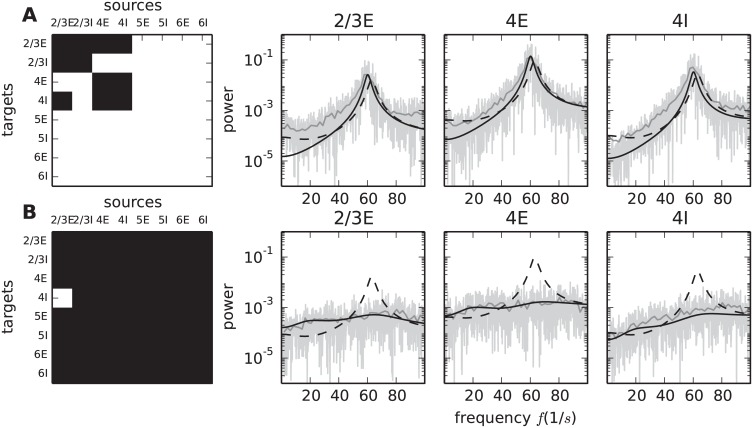
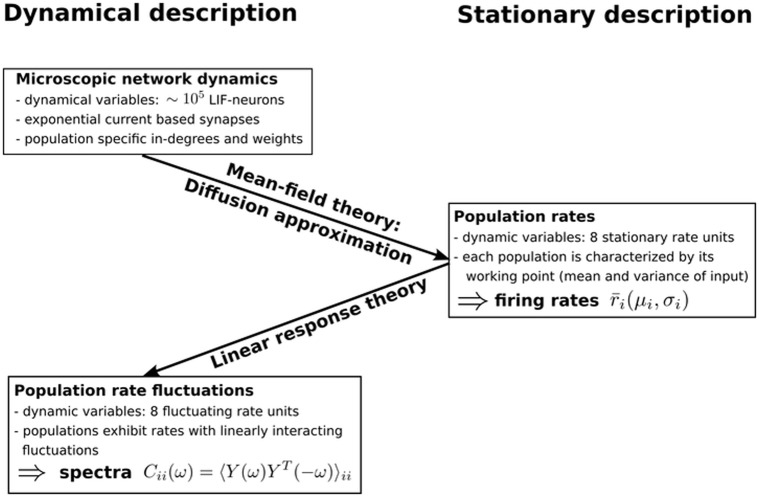
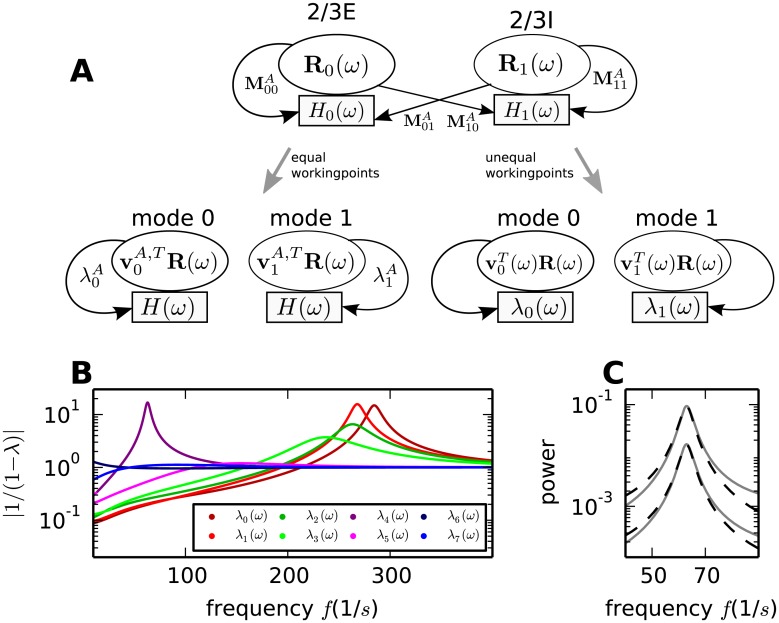
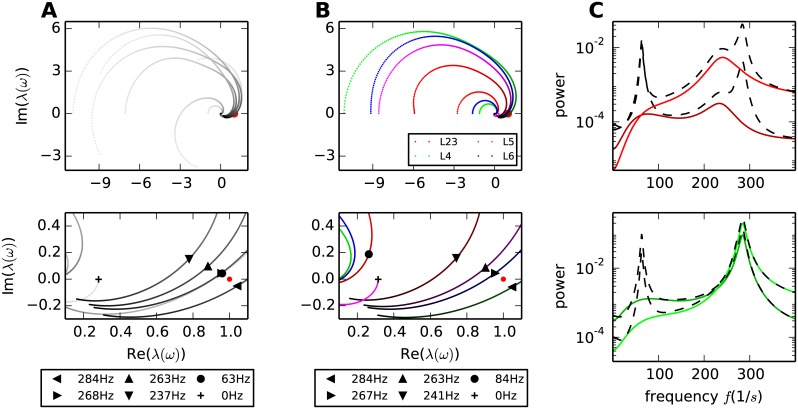
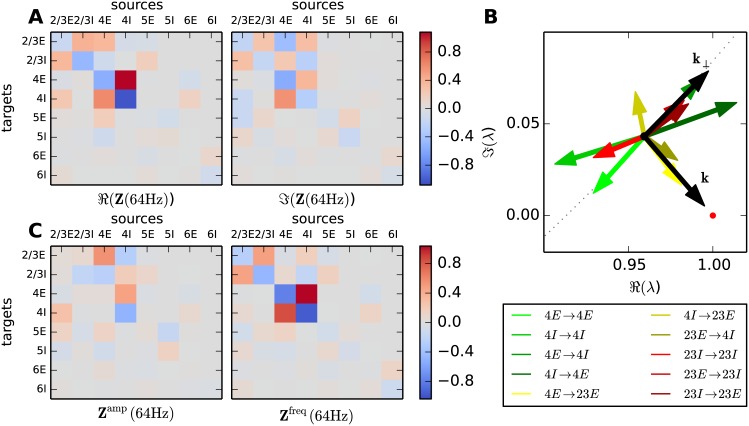
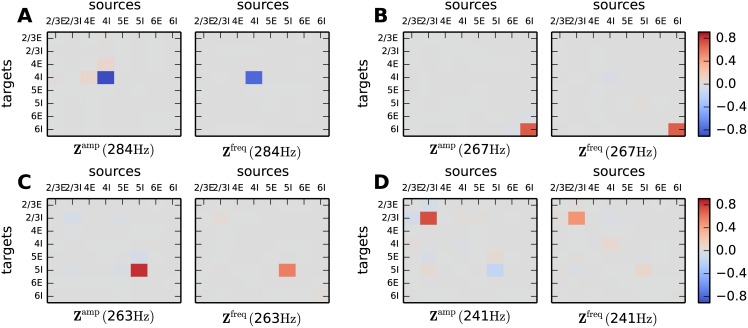
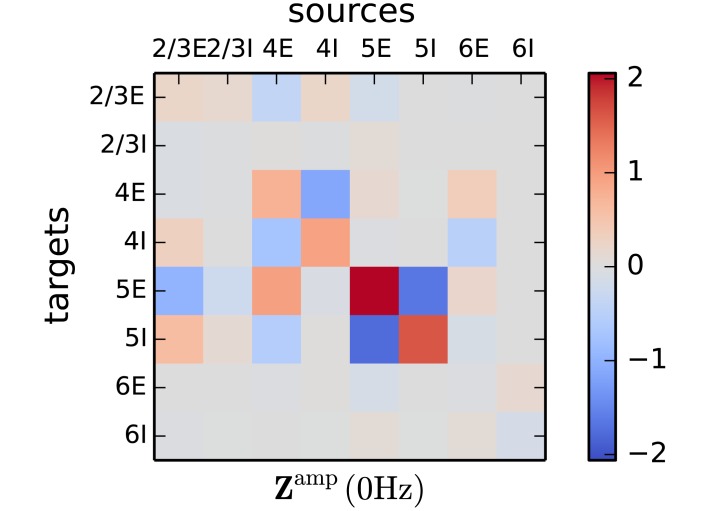
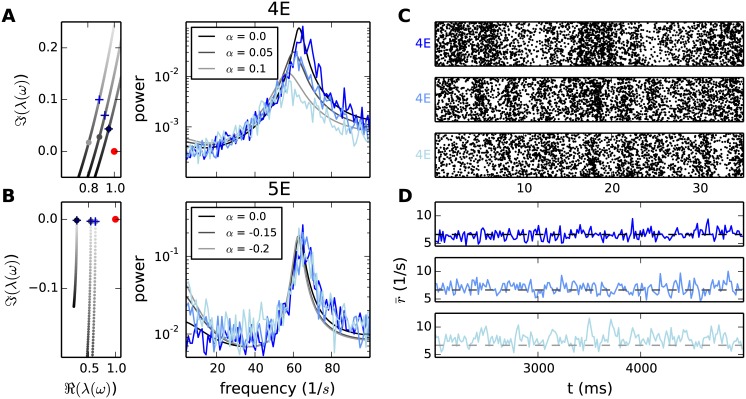
Oscillations are omnipresent in neural population signals, like multi-unit recordings, EEG/MEG, and the local field potential. They have been linked to the population firing rate of neurons, with individual neurons firing in a close-to-irregular fashion at low rates. Using a combination of mean-field and linear response theory we predict the spectra generated in a layered microcircuit model of V1, composed of leaky integrate-and-fire neurons and based on connectivity compiled from anatomical and electrophysiological studies. The model exhibits low- and high-γ oscillations visible in all populations. Since locally generated frequencies are imposed onto other populations, the origin of the oscillations cannot be deduced from the spectra. We develop an universally applicable systematic approach that identifies the anatomical circuits underlying the generation of oscillations in a given network. Based on a theoretical reduction of the dynamics, we derive a sensitivity measure resulting in a frequency-dependent connectivity map that reveals connections crucial for the peak amplitude and frequency of the observed oscillations and identifies the minimal circuit generating a given frequency. The low-γ peak turns out to be generated in a sub-circuit located in layer 2/3 and 4, while the high-γ peak emerges from the inter-neurons in layer 4. Connections within and onto layer 5 are found to regulate slow rate fluctuations. We further demonstrate how small perturbations of the crucial connections have significant impact on the population spectra, while the impairment of other connections leaves the dynamics on the population level unaltered. The study uncovers connections where mechanisms controlling the spectra of the cortical microcircuit are most effective.
振荡在神经群体信号中无处不在,如多单元记录、脑电图/脑磁图以及局部场电位。它们与神经元的群体放电率有关,在低放电率时单个神经元以接近不规则的方式放电。我们结合平均场理论和线性响应理论,预测了V1层状微电路模型中产生的频谱,该模型由漏电积分发放神经元组成,并基于解剖学和电生理学研究汇编的连接性构建。该模型在所有群体中都表现出低γ和高γ振荡。由于局部产生的频率会施加到其他群体上,因此无法从频谱中推断出振荡的起源。我们开发了一种普遍适用的系统方法,用于识别给定网络中产生振荡的解剖学回路。基于对动力学的理论简化,我们推导出一种灵敏度度量,得到一个频率依赖的连接性图谱,该图谱揭示了对观察到的振荡的峰值幅度和频率至关重要的连接,并确定了产生给定频率的最小回路。结果表明,低γ峰值是在位于第2/3层和第4层的一个子回路中产生的,而高γ峰值则来自第4层的中间神经元。发现第5层内部和与第5层的连接调节缓慢的速率波动。我们进一步证明了关键连接的微小扰动如何对群体频谱产生重大影响,而其他连接的损伤则使群体水平的动力学保持不变。这项研究揭示了控制皮质微电路频谱的机制最有效的连接。