Department of Psychology, Technische Universität Dresden, Dresden 01069, Germany.
Department of Psychological and Brain Sciences, Indiana University, Bloomington, Indiana 47405, USA.
Nat Commun. 2016 Nov 3;7:13217. doi: 10.1038/ncomms13217.
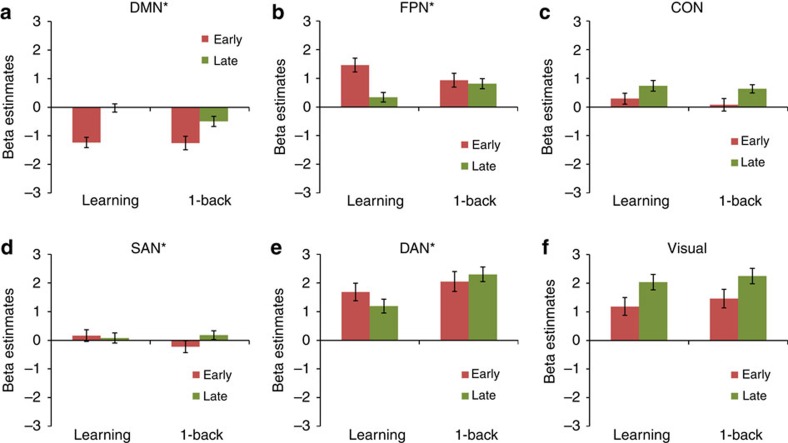
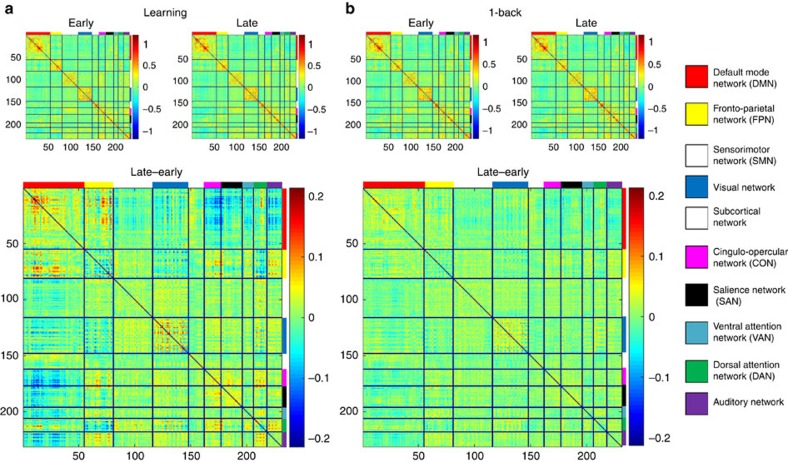
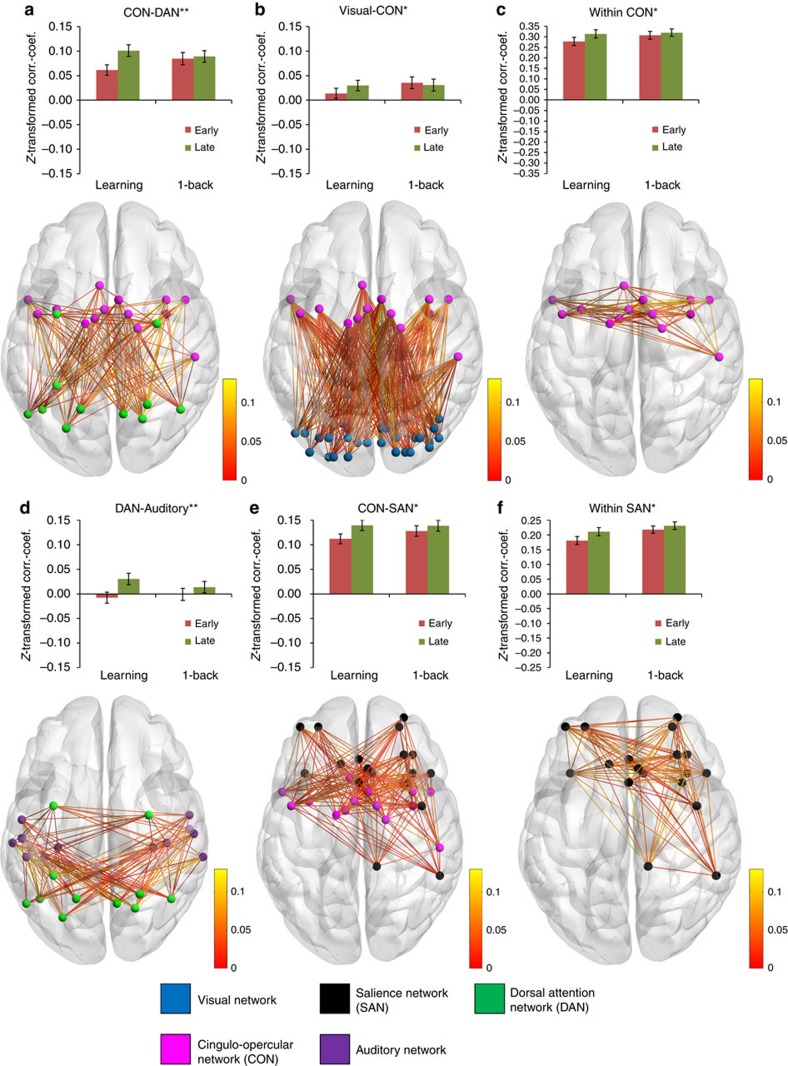
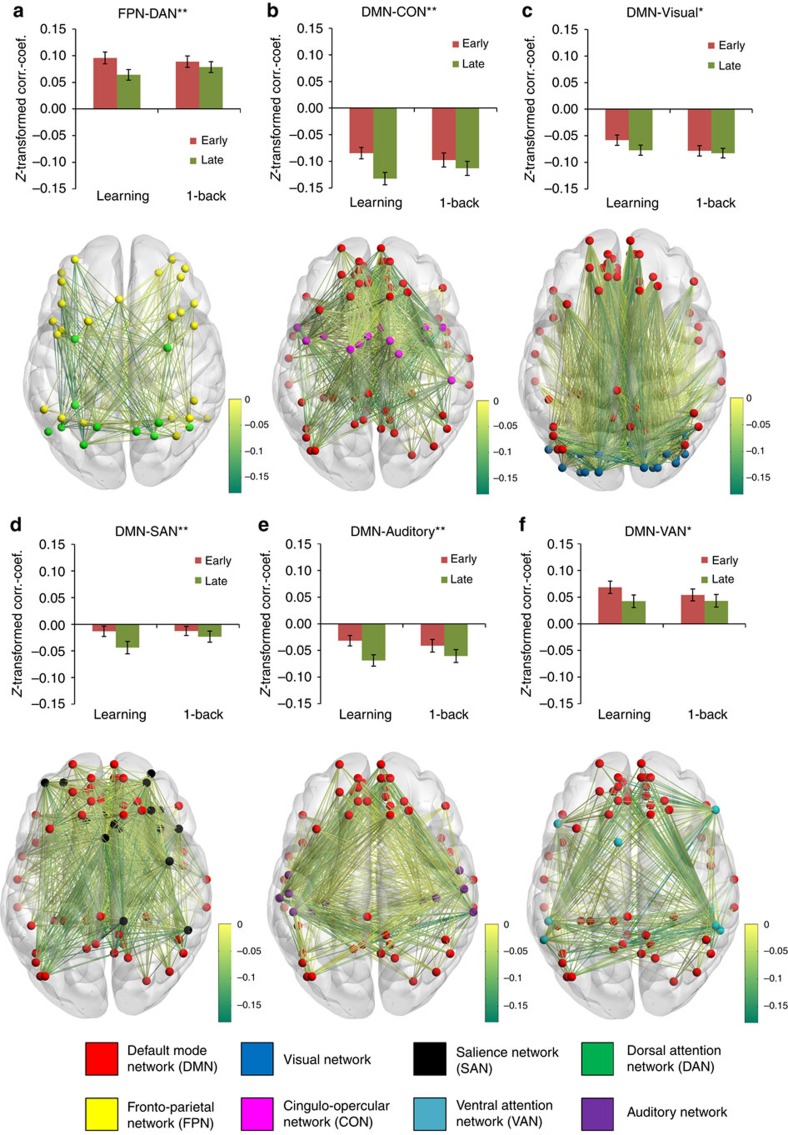
The human brain is organized into large-scale functional networks that can flexibly reconfigure their connectivity patterns, supporting both rapid adaptive control and long-term learning processes. However, it has remained unclear how short-term network dynamics support the rapid transformation of instructions into fluent behaviour. Comparing fMRI data of a learning sample (N=70) with a control sample (N=67), we find that increasingly efficient task processing during short-term practice is associated with a reorganization of large-scale network interactions. Practice-related efficiency gains are facilitated by enhanced coupling between the cingulo-opercular network and the dorsal attention network. Simultaneously, short-term task automatization is accompanied by decreasing activation of the fronto-parietal network, indicating a release of high-level cognitive control, and a segregation of the default mode network from task-related networks. These findings suggest that short-term task automatization is enabled by the brain's ability to rapidly reconfigure its large-scale network organization involving complementary integration and segregation processes.
人类大脑组织成大规模的功能网络,可以灵活地重新配置它们的连接模式,支持快速自适应控制和长期学习过程。然而,目前尚不清楚短期网络动态如何支持指令快速转化为流畅的行为。通过比较学习样本(N=70)和控制样本(N=67)的 fMRI 数据,我们发现,在短期实践中,任务处理效率的提高与大规模网络相互作用的重新组织有关。练习相关的效率提高得益于扣带前回-顶叶网络和背侧注意网络之间的增强耦合。同时,短期任务自动化伴随着额顶叶网络的激活降低,表明高级认知控制的释放,以及默认模式网络与任务相关网络的分离。这些发现表明,短期任务自动化是由大脑快速重新配置其涉及互补整合和分离过程的大规模网络组织的能力所实现的。