Kunisawa Susumu, Fushimi Kiyohide, Imanaka Yuichi
Department of Healthcare Economics and Quality Management, Graduate School of Medicine, Kyoto University, Kyoto, Japan.
Department of Health Policy and Informatics, Tokyo Medical and Dental University, Tokyo, Japan.
PLoS One. 2016 Nov 10;11(11):e0166269. doi: 10.1371/journal.pone.0166269. eCollection 2016.
The Japanese government has worked to reduce the length of hospital stay by introducing a per-diem hospital payment system that financially incentivizes the timely discharge of patients. However, there are concerns that excessively reducing length of stay may reduce healthcare quality, such as increasing readmission rates. The objective of this study was to investigate the temporal changes in length of stay and readmission rates as quality indicators in Japanese acute care hospitals.
We used an administrative claims database under the Diagnosis Procedure Combination Per-Diem Payment System for Japanese hospitals. Using this database, we selected hospitals that provided data continuously from July 2010 to March 2014 to enable analyses of temporal changes in length of stay and readmission rates. We selected stage I (T1N0M0) gastric, colon, and lung cancer surgical patients who had been discharged alive from the index hospitalization. The outcome measures were length of stay during the index hospitalization and unplanned emergency readmissions within 30 days after discharge.
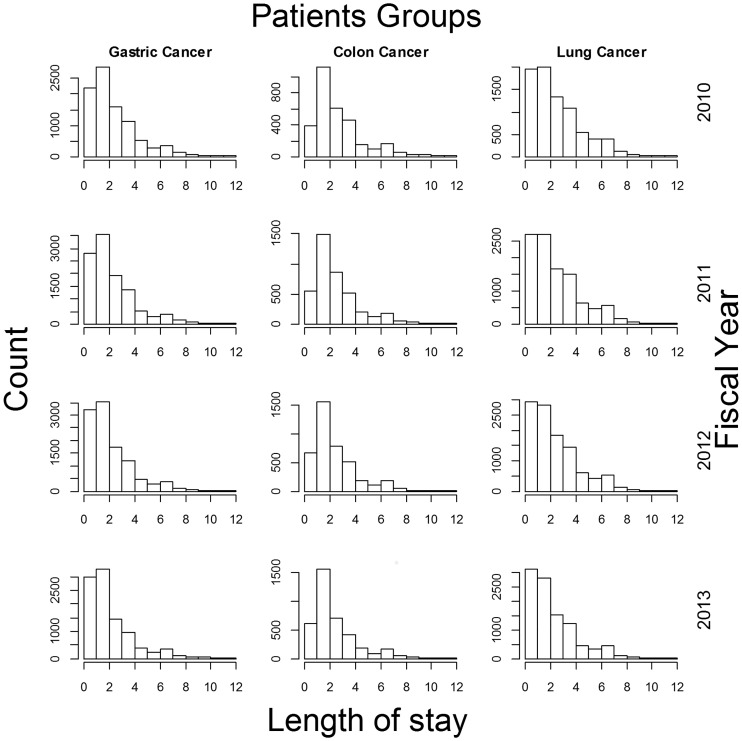
From among 804 hospitals, we analyzed 42,585, 15,467, and 40,156 surgical patients for gastric, colon, and lung cancer, respectively. Length of stay was reduced by approximately 0.5 days per year. In contrast, readmission rates were generally stable at approximately 2% or had decreased slightly over the 4-year period.
In early-stage gastric, colon, and lung cancer surgical patients in Japan, reductions in length of stay did not result in increased readmission rates.
日本政府通过引入每日住院费用支付系统来努力缩短住院时间,该系统在经济上激励患者及时出院。然而,有人担心过度缩短住院时间可能会降低医疗质量,比如导致再入院率上升。本研究的目的是调查日本急性护理医院住院时间和再入院率作为质量指标的时间变化情况。
我们使用了日本医院诊断程序组合每日支付系统下的行政索赔数据库。利用该数据库,我们选择了从2010年7月至2014年3月持续提供数据的医院,以便分析住院时间和再入院率的时间变化。我们选择了首次住院后存活出院的I期(T1N0M0)胃癌、结肠癌和肺癌手术患者。观察指标为首次住院期间的住院时间和出院后30天内的非计划紧急再入院情况。
在804家医院中,我们分别分析了42585例胃癌、15467例结肠癌和40156例肺癌手术患者。住院时间每年大约缩短0.5天。相比之下,再入院率总体稳定在约2%,或在4年期间略有下降。
在日本早期胃癌、结肠癌和肺癌手术患者中,住院时间的缩短并未导致再入院率上升。