Preissmann Delphine, Charbonnier Caecilia, Chagué Sylvain, Antonietti Jean-Philippe, Llobera Joan, Ansermet Francois, Magistretti Pierre J
Agalma FoundationGeneva, Switzerland; Department of Child and Adolescent Psychiatry, Faculty of Medicine, University of Geneva HospitalsGeneva, Switzerland; Cognitive Science Center, University of NeuchâtelNeuchâtel, Switzerland.
Medical Research Department, Artanim Foundation Geneva, Switzerland.
Front Psychol. 2016 Oct 27;7:1673. doi: 10.3389/fpsyg.2016.01673. eCollection 2016.
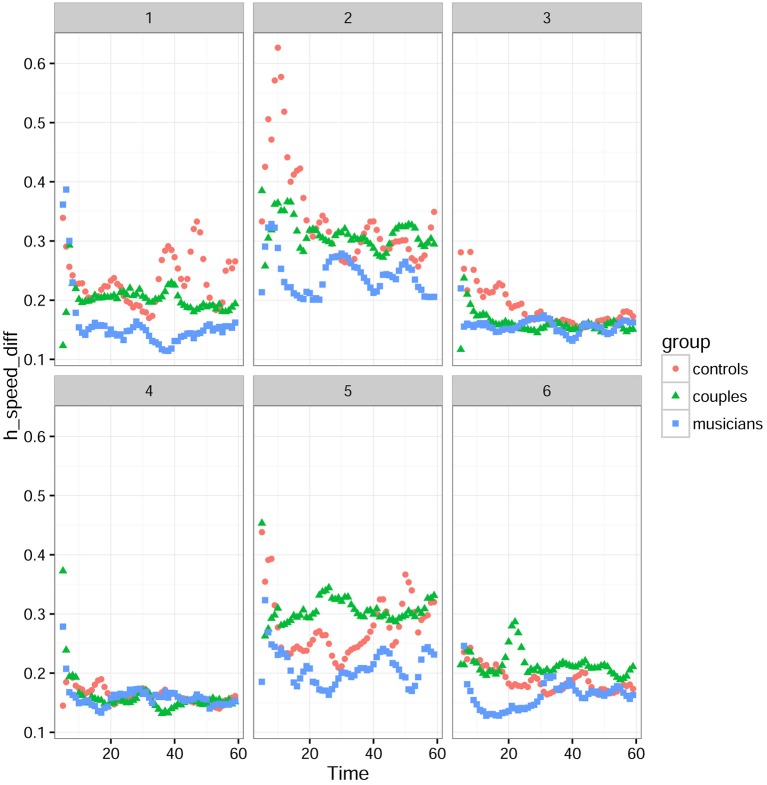
The feeling of synchrony is fundamental for most social activities and prosocial behaviors. However, little is known about the behavioral correlates of this feeling and its modulation by intergroup differences. We previously showed that the subjective feeling of synchrony in subjects involved in a mirror imitation task was modulated by objective behavioral measures, as well as contextual factors such as task difficulty and duration of the task performance. In the present study, we extended our methodology to investigate possible interindividual differences. We hypothesized that being in a romantic relationship or being a professional musician can modulate both implicit and explicit synchronization and the feeling of synchrony as well as the ability to detect synchrony from a third person perspective. Contrary to our hypothesis, we did not find significant differences between people in a romantic relationship and control subjects. However, we observed differences between musicians and control subjects. For the implicit synchrony (spontaneous synchronization during walking), the results revealed that musicians that had never met before spontaneously synchronized their movements earlier among themselves than control subjects, but not better than people sharing a romantic relationship. Moreover, in explicit behavioral synchronization tasks (mirror game), musicians reported earlier feeling of synchrony and had less speed errors than control subjects. This was in interaction with tasks difficulty as these differences appeared only in tasks with intermediate difficulty. Finally, when subjects had to judge synchrony from a third person perspective, musicians had a better performance to identify if they were present or not in the videos. Taken together, our results suggest that being a professional musician can play a role in the feeling of synchrony and its underlying mechanisms.
同步感是大多数社交活动和亲社会行为的基础。然而,对于这种感觉的行为关联及其受群体间差异的调节作用,我们知之甚少。我们之前表明,参与镜像模仿任务的受试者的同步主观感受会受到客观行为指标以及任务难度和任务执行持续时间等情境因素的调节。在本研究中,我们扩展了我们的方法来调查可能的个体间差异。我们假设处于恋爱关系或身为职业音乐家可以调节内隐和外显同步、同步感以及从第三人称视角检测同步的能力。与我们的假设相反,我们没有发现恋爱关系中的人与对照组受试者之间存在显著差异。然而,我们观察到音乐家与对照组受试者之间存在差异。对于内隐同步(行走过程中的自发同步),结果显示,之前从未见过面的音乐家之间比对照组受试者更早地自发同步他们的动作,但并不比处于恋爱关系中的人更好。此外,在外显行为同步任务(镜像游戏)中,音乐家报告的同步感出现得更早,并且速度错误比对照组受试者更少。这与任务难度相互作用,因为这些差异仅出现在中等难度的任务中。最后,当受试者必须从第三人称视角判断同步时,音乐家在识别视频中是否存在同步方面表现更好。综上所述,我们的结果表明,身为职业音乐家可能在同步感及其潜在机制中发挥作用。