Bhagia Samarthya, Li Hongjia, Gao Xiadi, Kumar Rajeev, Wyman Charles E
Department of Chemical and Environmental Engineering, Bourns College of Engineering, University of California Riverside, 900 University Ave, Riverside, CA 92521 USA ; Center for Environmental Research and Technology, Bourns College of Engineering, University of California Riverside, 1084 Columbia Ave, Riverside, CA 92507 USA ; BioEnergy Science Center (BESC), Oak Ridge National Laboratory, PO Box 2008 MS6341, Oak Ridge, TN 37831 USA.
Center for Environmental Research and Technology, Bourns College of Engineering, University of California Riverside, 1084 Columbia Ave, Riverside, CA 92507 USA ; BioEnergy Science Center (BESC), Oak Ridge National Laboratory, PO Box 2008 MS6341, Oak Ridge, TN 37831 USA.
Biotechnol Biofuels. 2016 Nov 10;9:245. doi: 10.1186/s13068-016-0660-5. eCollection 2016.
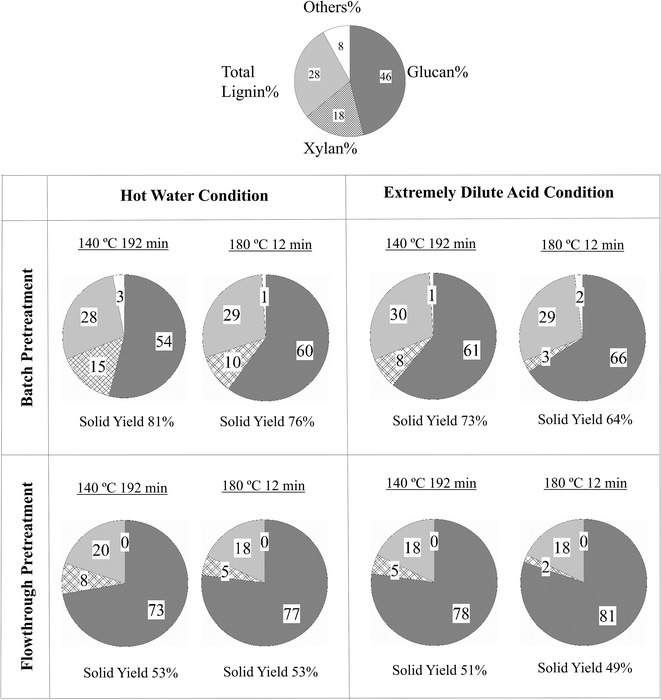
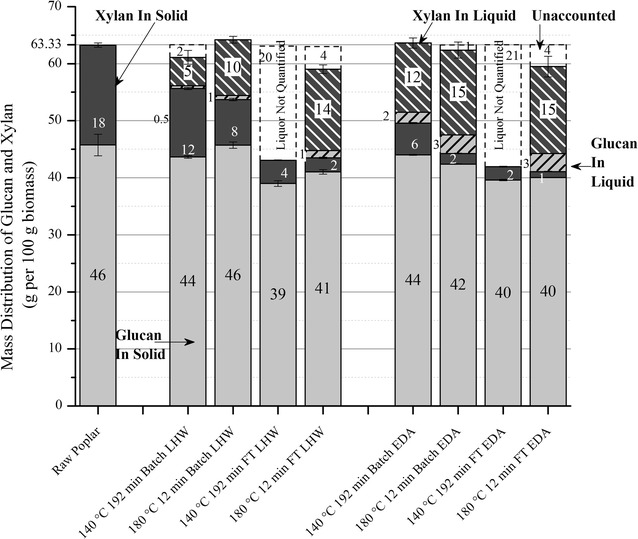
Flowthrough pretreatment is capable of removing much higher quantities of hemicellulose and lignin from lignocellulosic biomass than batch pretreatment performed at otherwise similar conditions. Comparison of these two pretreatment configurations for sugar yields and lignin removal can provide insights into lignocellulosic biomass deconstruction. Therefore, we applied liquid hot water (LHW) and extremely dilute acid (EDA, 0.05%) flowthrough and batch pretreatments of poplar at two temperatures and the same pretreatment severity for the solids. Composition of solids, sugar mass distribution with pretreatment, sugar yields, and lignin removal from pretreatment and enzymatic hydrolysis were measured.
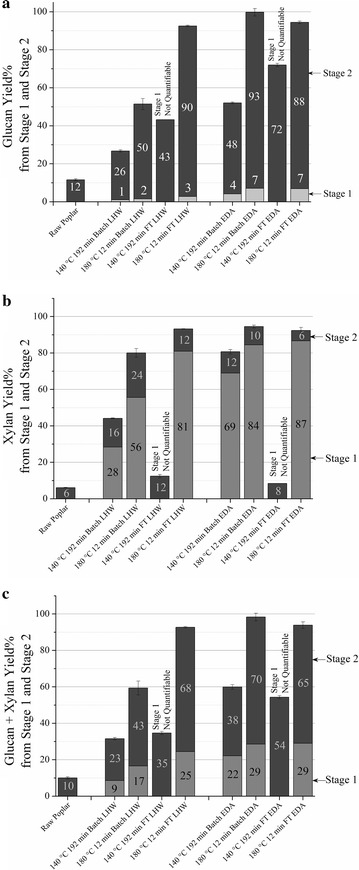
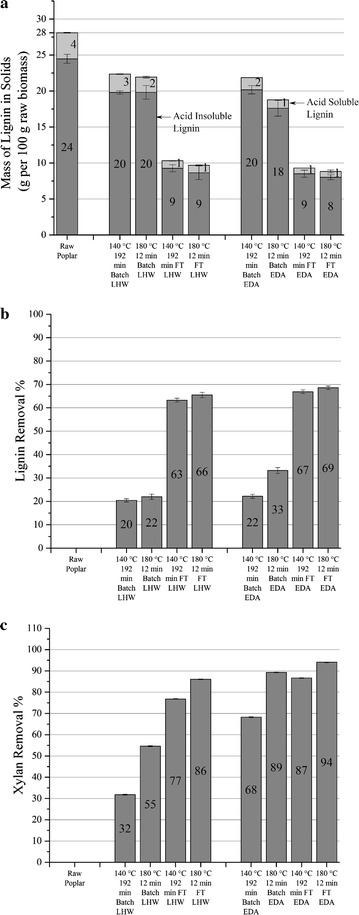
Flowthrough aqueous pretreatment of poplar showed between 63 and 69% lignin removal at both 140 and 180 °C, while batch pretreatments showed about 20 to 33% lignin removal at similar conditions. Extremely dilute acid slightly enhanced lignin removal from solids with flowthrough pretreatment at both pretreatment temperatures. However, extremely dilute acid batch pretreatment did realize greater than 70% xylan yields largely in the form of monomeric xylose. Close to 100% total sugar yields were measured from LHW and EDA flowthrough pretreatments and one batch EDA pretreatment at 180 °C. The high lignin removal by flowthrough pretreatment enhanced cellulose digestibility compared to batch pretreatment, consistent with lignin being a key contributor to biomass recalcitrance. Furthermore, solids from 180 °C flowthrough pretreatment were much more digestible than solids pretreated at 140 °C despite similar lignin and extensive hemicellulose removal.
Results with flowthrough pretreatment show that about 65-70% of the lignin is solubilized and removed before it can react further to form low solubility lignin rich fragments that deposit on the biomass surface in batch operations and hinder enzyme action. The leftover 30-35% lignin in poplar was a key player in biomass recalcitrance to enzymatic deconstruction and it might be more difficult to dislodge from biomass with lower temperature of pretreatment. These results also point to the possibility that hemicellulose removal is more important as an indicator of lignin disruption than in playing a direct role in reducing biomass recalcitrance.
与在其他条件相似的情况下进行的间歇式预处理相比,连续流预处理能够从木质纤维素生物质中去除更多的半纤维素和木质素。比较这两种预处理方式对糖产量和木质素去除效果的影响,可以深入了解木质纤维素生物质的解构过程。因此,我们在两个温度下,对杨树进行了液态热水(LHW)和极稀酸(EDA,0.05%)连续流预处理及间歇式预处理,且两种预处理方式下固体的预处理强度相同。测定了固体成分、预处理过程中的糖质量分布、糖产量以及预处理和酶水解过程中的木质素去除量。
在140℃和180℃下,杨树的连续流水相预处理木质素去除率在63%至69%之间,而在类似条件下间歇式预处理的木质素去除率约为20%至33%。在两个预处理温度下,极稀酸在连续流预处理中略微提高了固体中木质素的去除率。然而,极稀酸间歇式预处理确实实现了大于70%的木聚糖产量,主要以单体木糖的形式存在。在180℃下,LHW和EDA连续流预处理以及一次EDA间歇式预处理测得的总糖产量接近100%。与间歇式预处理相比,连续流预处理对木质素的高去除率提高了纤维素的消化率,这与木质素是生物质难降解性的关键因素一致。此外,尽管180℃连续流预处理和140℃预处理去除的木质素和半纤维素量相似,但前者的固体更易被消化。
连续流预处理的结果表明,约65%-70%的木质素在进一步反应形成低溶解度的富含木质素碎片之前就被溶解和去除,这些碎片在间歇式操作中沉积在生物质表面并阻碍酶的作用。杨树中剩余的30%-35%的木质素是生物质对酶解产生难降解性的关键因素,并且在较低预处理温度下可能更难从生物质中去除。这些结果还表明,半纤维素的去除作为木质素破坏的指标可能比在降低生物质难降解性方面直接发挥作用更为重要。