Dartmouth College, Hanover, NH, 03755, USA.
Biotechnol Biofuels. 2012 Jul 19;5(1):49. doi: 10.1186/1754-6834-5-49.
The impact of hydrothermal flowthrough (FT) pretreatment severity on pretreatment and solubilization performance metrics was evaluated for three milled feedstocks (corn stover, bagasse, and poplar) and two conversion systems (simultaneous saccharification and fermentation using yeast and fungal cellulase, and fermentation by Clostridium thermocellum).
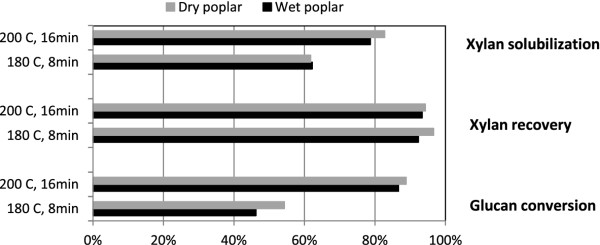
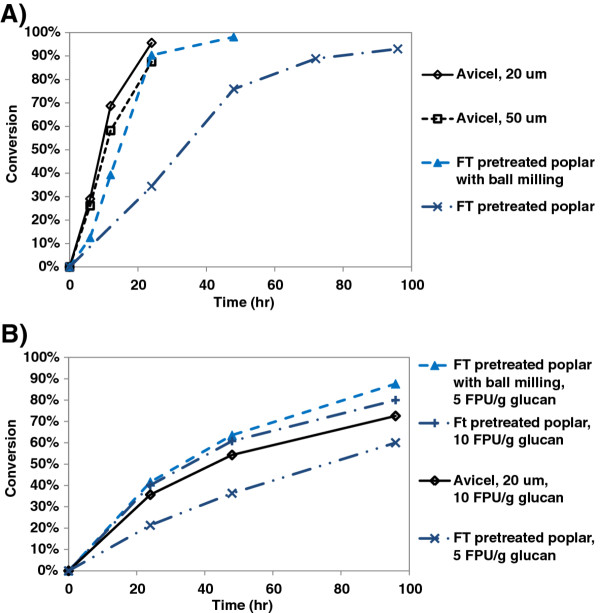
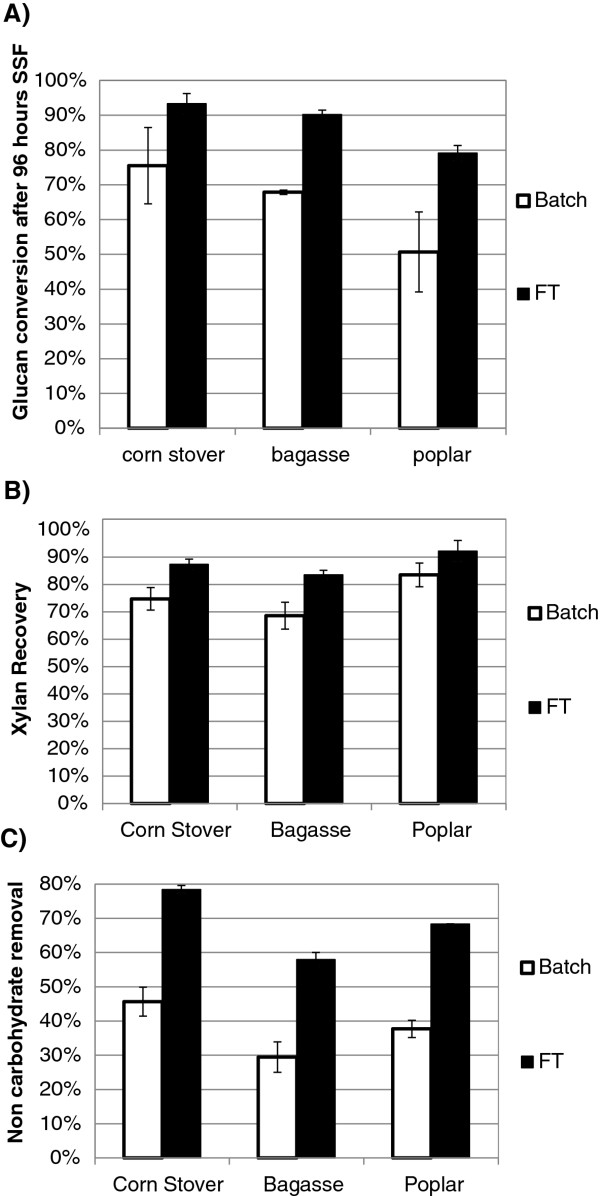
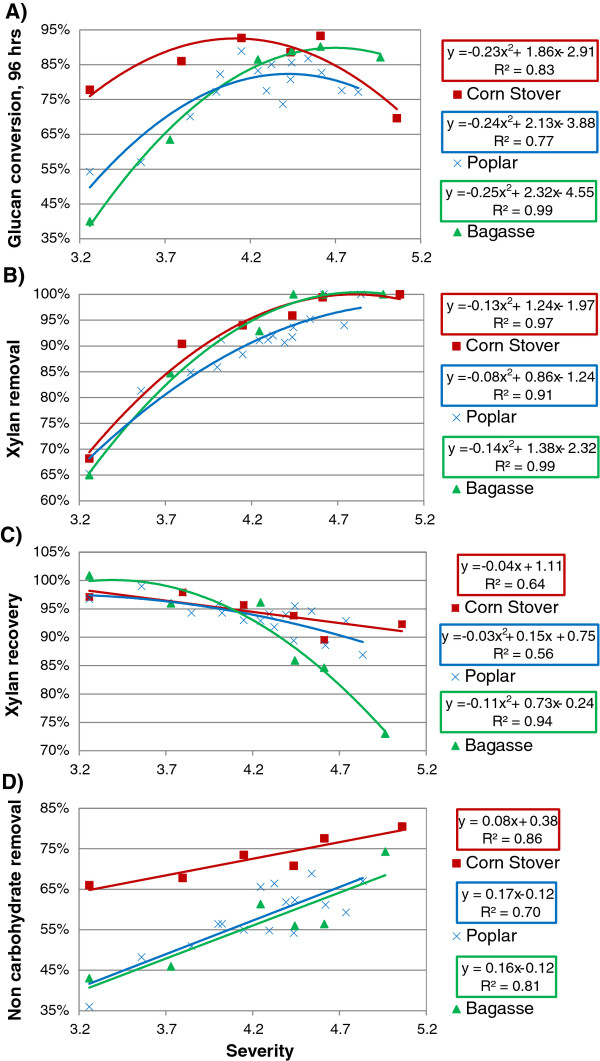
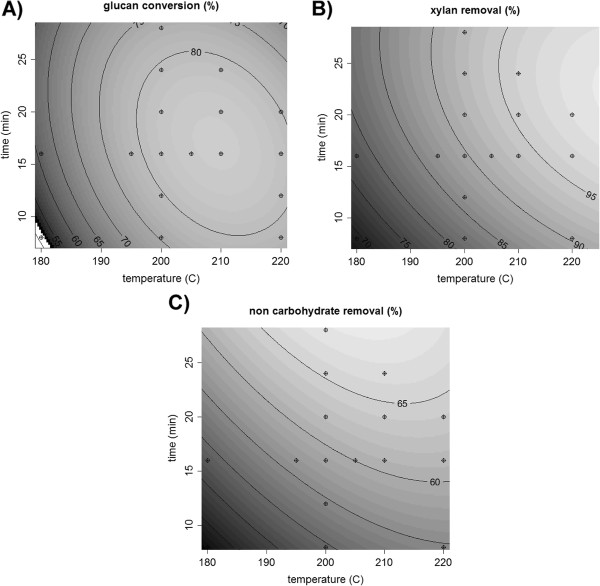
Compared to batch pretreatment, FT pretreatment consistently resulted in higher XMG recovery, higher removal of non-carbohydrate carbon and higher glucan solubilization by simultaneous saccharification and fermentation (SSF). XMG recovery was above 90% for FT pretreatment below 4.1 severity but decreased at higher severities, particularly for bagasse. Removal of non-carbohydrate carbon during FT pretreatment increased from 65% at low severity to 80% at high severity for corn stover, and from 40% to 70% for bagasse and poplar.Solids obtained by FT pretreatment were amenable to high conversion for all of the feedstocks and conversion systems examined. The optimal time and temperature for FT pretreatment on poplar were found to be 16 min and 210°C. At these conditions, SSF glucan conversion was about 85%, 94% of the XMG was removed, and 62% of the non carbohydrate mass was solubilized. Solubilization of FT-pretreated poplar was compared for C. thermocellum fermentation (10% inoculum), and for yeast-fungal cellulase SSF (5% inoculum, cellulase loading of 5 and 10 FPU/g glucan supplemented with β-glucosidase at 15 and 30 U/g glucan). Under the conditions tested, which featured low solids concentration, C. thermocellum fermentation achieved faster rates and more complete conversion of FT-pretreated poplar than did SSF. Compared to SSF, solubilization by C. thermocellum was 30% higher after 4 days, and was over twice as fast on ball-milled FT-pretreated poplar.
XMG removal trends were similar between feedstocks whereas glucan conversion trends were significantly different, suggesting that factors in addition to XMG removal impact amenability of glucan to enzymatic attack. Corn stover exhibited higher hydrolysis yields than bagasse or poplar, which could be due to higher removal of non-carbohydrate carbon. XMG in bagasse is more easily degraded than XMG in corn stover and poplar. Conversion of FT-pretreated substrates at low concentration was faster and more complete for C. thermocellum than for SSF.
为三种粉碎原料(玉米秸秆、甘蔗渣和杨木)和两种转化系统(同时糖化发酵使用酵母和真菌纤维素酶,以及嗜热梭菌发酵)评估了水热流动预处理的预处理严重程度对预处理和溶解性能指标的影响。
与分批预处理相比,流动预处理始终导致更高的 XMG 回收率、更高的非碳水化合物碳去除率和同时糖化发酵(SSF)的更高的葡聚糖溶解率。FT 预处理的 XMG 回收率在低于 4.1 严重程度下超过 90%,但在较高严重程度下下降,特别是对于甘蔗渣。在 FT 预处理过程中非碳水化合物碳的去除率从低严重程度的 65%增加到高严重程度的 80%,对于玉米秸秆,从 40%增加到 70%。对于所有研究的原料和转化系统,通过 FT 预处理获得的固体都适合高转化率。发现杨木 FT 预处理的最佳时间和温度为 16 分钟和 210°C。在这些条件下,SSF 葡聚糖转化率约为 85%,94%的 XMG 被去除,62%的非碳水化合物质量被溶解。比较了嗜热梭菌发酵(10%接种物)和酵母-真菌纤维素酶 SSF(5%接种物,5 和 10 FPU/g 葡聚糖的纤维素酶添加量,补充 15 和 30 U/g 葡聚糖的β-葡萄糖苷酶)对 FT 预处理杨木的溶解作用。在测试条件下,由于固体浓度低,嗜热梭菌发酵实现了比 SSF 更快的速率和更完全的 FT 预处理杨木转化。与 SSF 相比,4 天后,嗜热梭菌溶解作用提高了 30%,在球磨 FT 预处理杨木上的速度提高了一倍以上。
XMG 去除趋势在不同原料之间相似,而葡聚糖转化趋势则有很大差异,这表明除了 XMG 去除之外,还有其他因素影响葡聚糖对酶攻击的易感性。玉米秸秆的水解产率高于甘蔗渣或杨木,这可能是由于非碳水化合物碳的去除率更高。与玉米秸秆和杨木相比,甘蔗渣中的 XMG 更容易降解。在低浓度下,嗜热梭菌对 FT 预处理底物的转化速度更快,更完全。