
互联网提供的创伤后应激障碍认知疗法:一个开发试点系列
Internet-delivered cognitive therapy for PTSD: a development pilot series.
作者信息
Wild Jennifer, Warnock-Parkes Emma, Grey Nick, Stott Richard, Wiedemann Milan, Canvin Lauren, Rankin Harriet, Shepherd Emma, Forkert Ava, Clark David M, Ehlers Anke
机构信息
Department of Experimental Psychology, University of Oxford, Oxford, UK.
Oxford NIHR Cognitive Health Clinical Research Facility, Oxford, UK;
出版信息
Eur J Psychotraumatol. 2016 Nov 8;7:31019. doi: 10.3402/ejpt.v7.31019. eCollection 2016.
BACKGROUND
Randomised controlled trials have established that face-to-face cognitive therapy for posttraumatic stress disorder (CT-PTSD) based on Ehlers and Clark's cognitive model of PTSD is highly effective and feasible with low rates of dropout. Access to evidence-based psychological treatments for PTSD is insufficient. Several studies have shown that therapist-assisted treatment delivery over the Internet is a promising way of improving access to cognitive behavioural therapy interventions.
OBJECTIVE
To develop an Internet version of CT-PTSD that significantly reduces therapist contact time without compromising treatment integrity or retention rates.
METHODS
We describe the development of an Internet version of CT-PTSD. It implements all the key procedures of face-to-face CT-PTSD, including techniques that focus on the trauma memory, such as memory updating, stimulus discrimination and revisiting the trauma site, as well as restructuring individually relevant appraisals relating to overgeneralisation of danger, guilt, shame or anger, behavioural experiments and planning activities to reclaim quality of life. A cohort of 10 patients meeting DSM-IV criteria for PTSD worked through the programme, with remote guidance from a therapist, and they were assessed at pre- and post-treatment on PTSD outcome, mood, work and social adjustment and process measures.
RESULTS
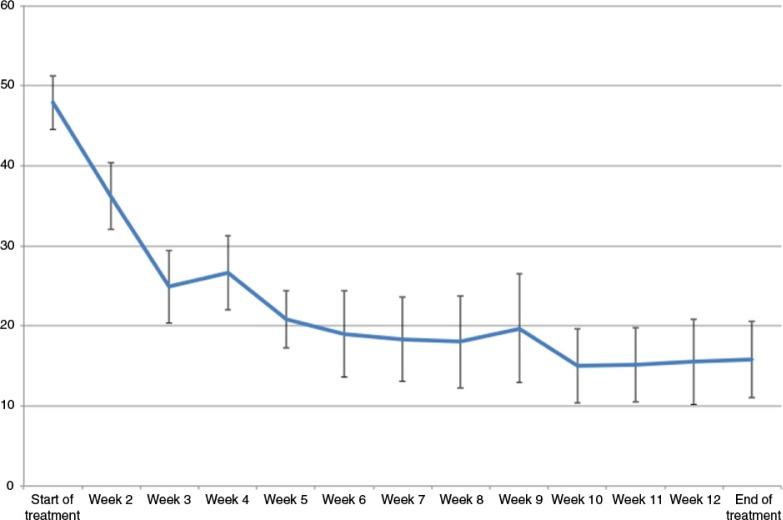
No patients dropped out. Therapists facilitated the treatment with 192 min of contact time per patient, plus 57 min for reviewing the patient's progress and messages. Internet-delivered CT-PTSD was associated with very large improvements on all outcome and process measures, with 80% of patients achieving clinically significant change and remission from PTSD.
CONCLUSIONS
Internet-delivered cognitive therapy for PTSD (iCT-PTSD) appears to be an acceptable and efficacious treatment. Therapist time was reduced to less than 25% of time in face-to-face CT-PTSD. Randomised controlled trials are required to evaluate systematically the acceptability and efficacy of iCT-PTSD.
背景
随机对照试验已证实,基于埃勒斯和克拉克创伤后应激障碍(PTSD)认知模型的面对面创伤后应激障碍认知疗法(CT-PTSD)非常有效且可行,脱落率较低。获得基于证据的PTSD心理治疗方法并不充分。多项研究表明,通过互联网进行治疗师辅助治疗是改善认知行为疗法干预措施可及性的一种有前景的方式。
目的
开发一种互联网版的CT-PTSD,在不影响治疗完整性或保留率的情况下,显著减少治疗师的接触时间。
方法
我们描述了互联网版CT-PTSD的开发过程。它实施了面对面CT-PTSD的所有关键程序,包括专注于创伤记忆的技术,如记忆更新、刺激辨别和重返创伤现场,以及重构与危险过度泛化、内疚、羞耻或愤怒相关的个体相关评估、行为实验和规划活动以恢复生活质量。一组符合DSM-IV创伤后应激障碍标准的10名患者在治疗师的远程指导下完成了该项目,并在治疗前后对创伤后应激障碍结果、情绪、工作和社会适应以及过程指标进行了评估。
结果
无患者退出。治疗师通过每位患者192分钟的接触时间促进治疗,另外还有57分钟用于审查患者的进展和信息。互联网提供的CT-PTSD在所有结果和过程指标上都有非常大的改善,80%的患者实现了临床上的显著变化并从创伤后应激障碍中缓解。
结论
互联网提供的创伤后应激障碍认知疗法(iCT-PTSD)似乎是一种可接受且有效的治疗方法。治疗师的时间减少到面对面CT-PTSD时间的不到25%。需要进行随机对照试验来系统评估iCT-PTSD的可接受性和有效性。
 Zotero 插件