Lennard Katie S, Goosen Ryan W, Blackburn Jonathan M
Institute of Infectious Disease and Molecular Medicine & Department of Integrative Biomedical Sciences, University of Cape Town, Cape Town, South Africa.
PLoS One. 2016 Nov 15;11(11):e0166282. doi: 10.1371/journal.pone.0166282. eCollection 2016.
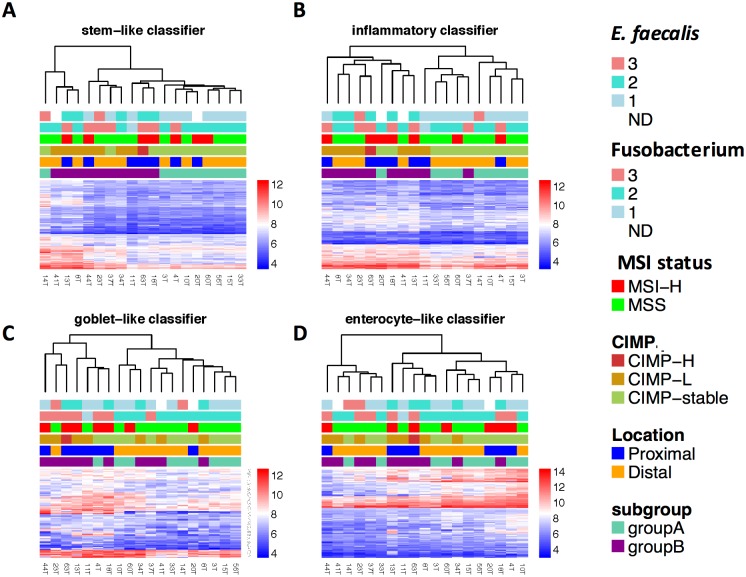
The relevance of specific microbial colonisation to colorectal cancer (CRC) disease pathogenesis is increasingly recognised, but our understanding of possible underlying molecular mechanisms that may link colonisation to disease in vivo remains limited. Here, we investigate the relationships between the most commonly studied CRC-associated bacteria (Enterotoxigenic Bacteroides fragilis, pks+ Escherichia coli, Fusobacterium spp., afaC+ E. coli, Enterococcus faecalis & Enteropathogenic E. coli) and altered transcriptomic and methylation profiles of CRC patients, in order to gain insight into the potential contribution of these bacteria in the aetiopathogenesis of CRC. We show that colonisation by E. faecalis and high levels of Fusobacterium is associated with a specific transcriptomic subtype of CRC that is characterised by CpG island methylation, microsatellite instability and a significant increase in inflammatory and DNA damage pathways. Analysis of the significant, bacterially-associated changes in host gene expression, both at the level of individual genes as well as pathways, revealed a transcriptional remodeling that provides a plausible mechanistic link between specific bacterial colonisation and colorectal cancer disease development and progression in this subtype; these included upregulation of REG3A, REG1A and REG1P in the case of high-level colonization by Fusobacterium, and CXCL10 and BMI1 in the case of colonisation by E. faecalis. The enrichment of both E. faecalis and Fusobacterium in this CRC subtype suggests that polymicrobial colonisation of the colonic epithelium may well be an important aspect of colonic tumourigenesis.
特定微生物定植与结直肠癌(CRC)发病机制的相关性日益受到认可,但我们对可能将定植与体内疾病联系起来的潜在分子机制的理解仍然有限。在此,我们研究了最常被研究的与CRC相关的细菌(产肠毒素脆弱拟杆菌、pks + 大肠杆菌、梭杆菌属、afaC + 大肠杆菌、粪肠球菌和肠致病性大肠杆菌)与CRC患者转录组和甲基化谱改变之间的关系,以便深入了解这些细菌在CRC病因发病机制中的潜在作用。我们发现,粪肠球菌定植和高水平的梭杆菌与CRC的一种特定转录组亚型相关,其特征为CpG岛甲基化、微卫星不稳定性以及炎症和DNA损伤途径的显著增加。对宿主基因表达中与细菌相关的显著变化进行的分析,无论是在单个基因还是通路水平,都揭示了一种转录重塑,这为该亚型中特定细菌定植与结直肠癌疾病发展和进展之间提供了一个合理的机制联系;这些变化包括在梭杆菌高水平定植的情况下REG3A、REG1A和REG1P的上调,以及在粪肠球菌定植的情况下CXCL10和BMI1的上调。粪肠球菌和梭杆菌在这种CRC亚型中的富集表明,结肠上皮的多微生物定植很可能是结肠肿瘤发生的一个重要方面。