Instituto de Biología Subtropical, CONICET-Universidad Nacional de Misiones (UNaM), Bertoni 85, (N3370AIA) Puerto Iguazú, Misiones, Argentina.
Asociación Civil Centro de Investigaciones del Bosque Atlántico, Bertoni 85, (N3370AIA) Puerto Iguazú, Misiones, Argentina.
Sci Rep. 2016 Nov 16;6:37147. doi: 10.1038/srep37147.
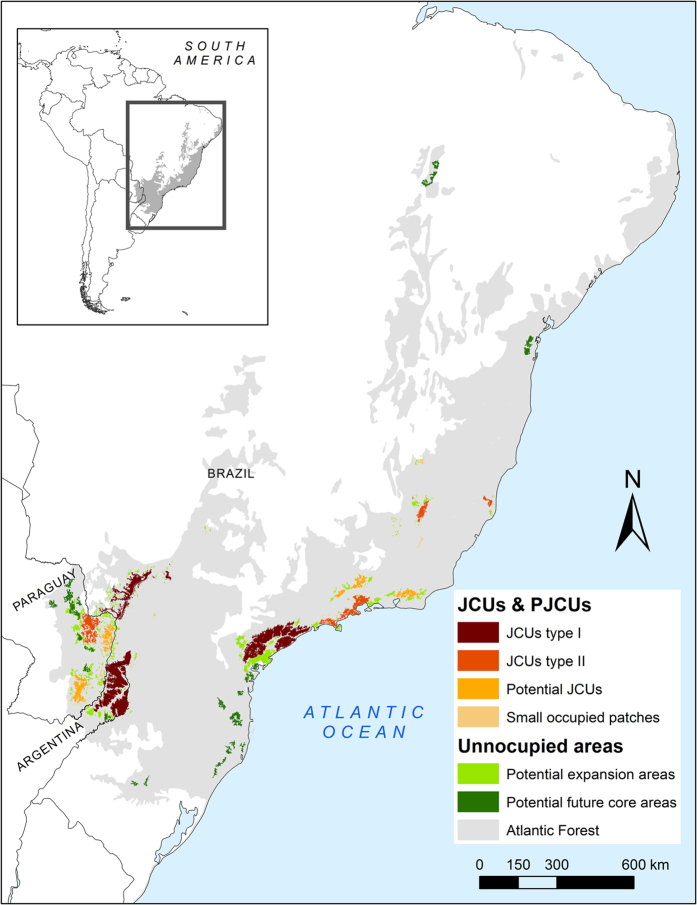
The jaguar is the top predator of the Atlantic Forest (AF), which is a highly threatened biodiversity hotspot that occurs in Brazil, Paraguay and Argentina. By combining data sets from 14 research groups across the region, we determine the population status of the jaguar and propose a spatial prioritization for conservation actions. About 85% of the jaguar's habitat in the AF has been lost and only 7% remains in good condition. Jaguars persist in around 2.8% of the region, and live in very low densities in most of the areas. The population of jaguars in the AF is probably lower than 300 individuals scattered in small sub-populations. We identified seven Jaguar Conservation Units (JCUs) and seven potential JCUs, and only three of these areas may have ≥50 individuals. A connectivity analysis shows that most of the JCUs are isolated. Habitat loss and fragmentation were the major causes for jaguar decline, but human induced mortality is the main threat for the remaining population. We classified areas according to their contribution to jaguar conservation and we recommend management actions for each of them. The methodology in this study could be used for conservation planning of other carnivore species.
美洲虎是大西洋森林(AF)的顶级掠食者,AF 是一个高度受威胁的生物多样性热点地区,分布在巴西、巴拉圭和阿根廷。通过整合来自该地区 14 个研究小组的数据,我们确定了美洲虎的种群状况,并提出了保护行动的空间优先级。大约 85%的 AF 地区的美洲虎栖息地已经消失,只有 7%的栖息地状况良好。美洲虎在该地区约 2.8%的范围内生存,在大多数地区的密度非常低。AF 地区的美洲虎数量可能低于 300 只,分散在小的亚种群中。我们确定了七个美洲虎保护单位(JCUs)和七个潜在的 JCUs,但只有三个区域可能有≥50 只个体。连通性分析表明,大多数 JCUs 是孤立的。栖息地丧失和破碎化是导致美洲虎数量下降的主要原因,但人为导致的死亡率是剩余种群的主要威胁。我们根据对美洲虎保护的贡献对区域进行了分类,并为每个区域推荐了管理措施。本研究中的方法可用于其他食肉动物物种的保护规划。