Hirayama Hiroki, Naito Akira, Fukuda Shigeo, Fujii Takashi, Asada Masatsugu, Inaba Yasushi, Takedomi Toshiro, Kawamata Masakazu, Moriyasu Satoru, Kageyama Soichi
Animal Biotechnology Group, Animal Research Center, Hokkaido Research Organization, Hokkaido 081-0038, Japan.
J Reprod Dev. 2017 Feb 16;63(1):95-100. doi: 10.1262/jrd.2016-019. Epub 2016 Nov 17.
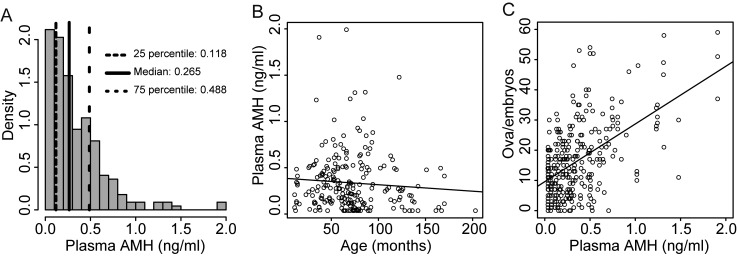
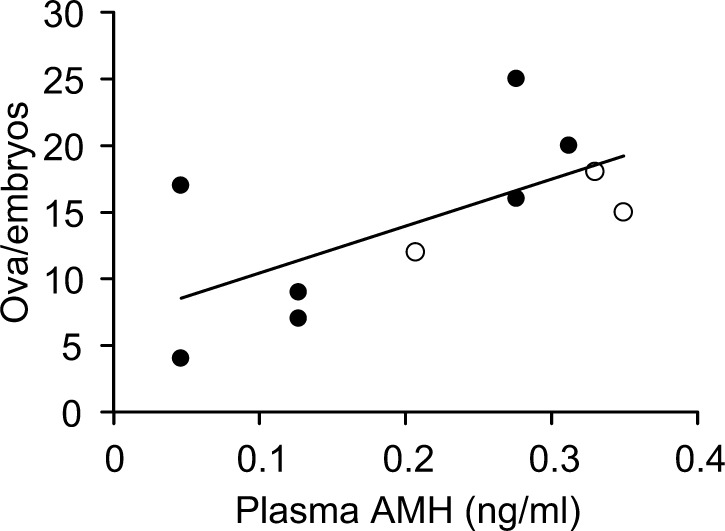
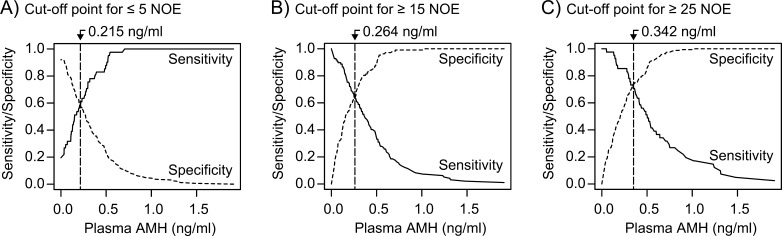
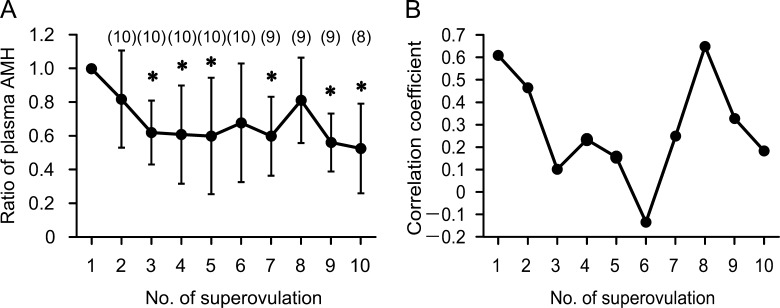
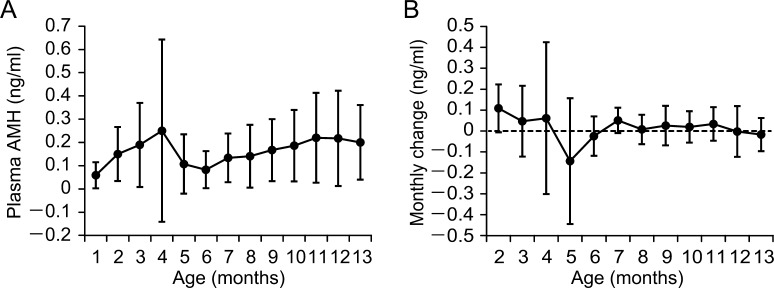
The concentration of circulating anti-Müllerian hormone (AMH) in cattle is a useful endocrine marker for ovarian response to superovulation. Although the AMH concentration undergoes little variation throughout the estrous cycle, its long-term changes remain incompletely understood. Here, we investigated the relationship between superovulation response and plasma AMH concentration in Japanese Black cattle and the long-term changes in plasma AMH concentration of embryo donor cows and heifers. The median, 25th percentile, and 75th percentile of AMH concentrations in 222 mature animals were 0.265, 0.118, and 0.488 ng/ml, respectively. The numbers of ova/embryos, fertilized embryos, and transferable embryos in a total of 295 superovulations were significantly different among the H (AMH ≥ 0.488 ng/ml), M (AMH 0.487-0.119 ng/ml), and L (AMH ≤ 0.118 ng/ml) groups. AMH concentrations during repeated superovulation in ten donor cows were significantly decreased after the third treatment. In heifers, the highest AMH concentration was observed in individuals during 2-13 months of age, with considerable individual variability. AMH concentrations of heifers at 10 or 11 months correlated with the number of ova/embryos during superovulation at 13-18 months (r = 0.641, P < 0.05). These results suggest that the 25th and 75th percentile values of AMH concentration would give a useful rough estimate of ovarian response; however, repeated superovulation may reduce the predictive accuracy of single measurements of AMH concentration. It would be possible to evaluate AMH concentration in heifers after approximately 11 months of age.
牛体内循环抗缪勒氏管激素(AMH)的浓度是卵巢对超数排卵反应的一种有用的内分泌标志物。尽管AMH浓度在整个发情周期中变化很小,但其长期变化仍未完全了解。在此,我们研究了日本黑牛超数排卵反应与血浆AMH浓度之间的关系,以及胚胎供体母牛和小母牛血浆AMH浓度的长期变化。222头成年动物中AMH浓度的中位数、第25百分位数和第75百分位数分别为0.265、0.118和0.488 ng/ml。在总共295次超数排卵中,H组(AMH≥0.488 ng/ml)、M组(AMH 0.487 - 0.119 ng/ml)和L组(AMH≤0.118 ng/ml)的卵子/胚胎数、受精胚胎数和可移植胚胎数存在显著差异。十头供体母牛重复超数排卵期间,第三次处理后AMH浓度显著降低。在小母牛中,10或11月龄时的AMH浓度与13 - 18月龄超数排卵期间的卵子/胚胎数相关(r = 0.641,P < 0.05)。这些结果表明,AMH浓度的第25和第75百分位数可对卵巢反应进行有用的粗略估计;然而,重复超数排卵可能会降低单次AMH浓度测量的预测准确性。在大约11月龄后评估小母牛的AMH浓度是可行的。