Achermann Peter, Rusterholz Thomas, Dürr Roland, König Thomas, Tarokh Leila
Institute of Pharmacology and Toxicology, University of Zurich, Zurich, Switzerland; Zurich Center for Integrative Human Physiology, University of Zurich, Zurich, Switzerland; Zurich Center for Interdisciplinary Sleep Research, University of Zurich, Zurich, Switzerland; Neuroscience Center Zurich, University of Zurich and ETH Zurich, Zurich, Switzerland.
Institute of Pharmacology and Toxicology, University of Zurich, Zurich, Switzerland; University Hospital of Child and Adolescent Psychiatry and Psychotherapy, University Hospital of Psychiatry, University of Bern, Bern, Switzerland.
R Soc Open Sci. 2016 Oct 12;3(10):160201. doi: 10.1098/rsos.160201. eCollection 2016 Oct.
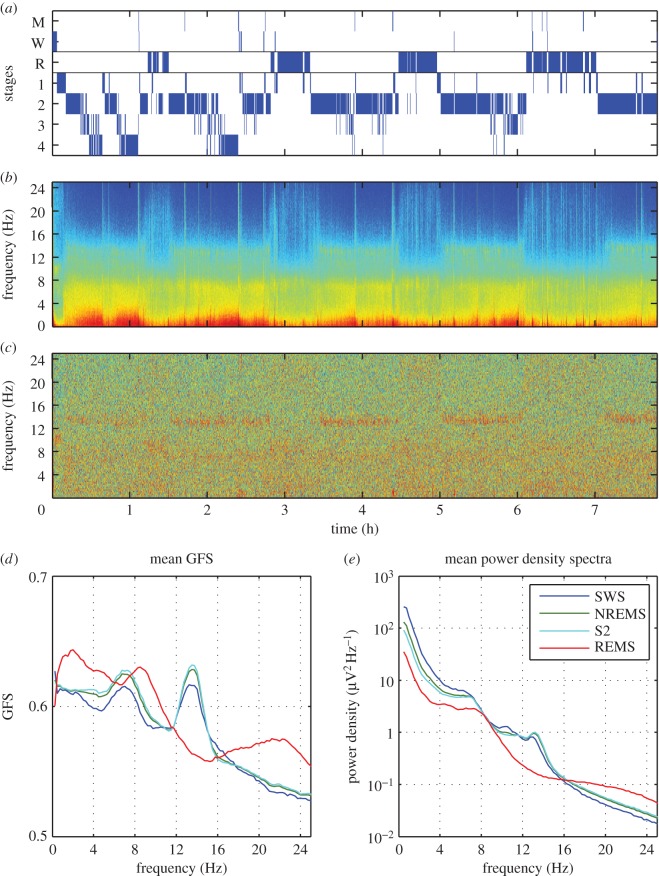
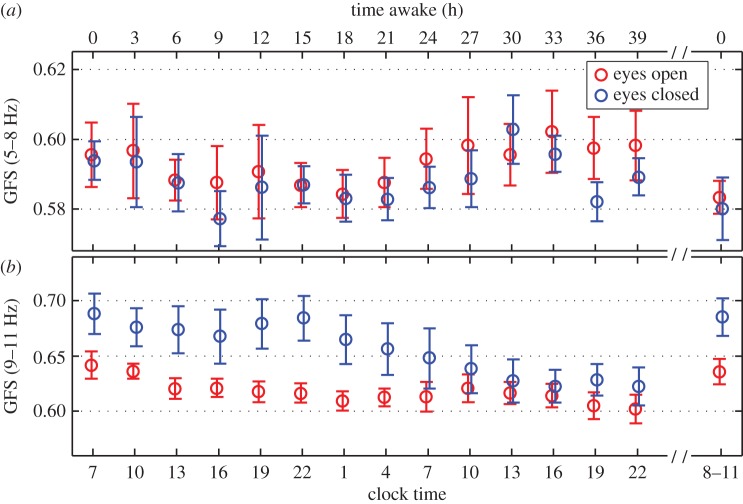
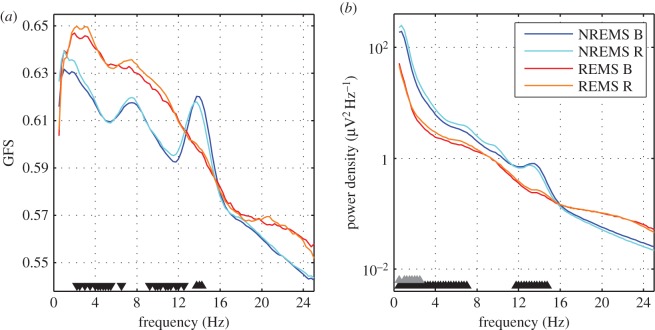
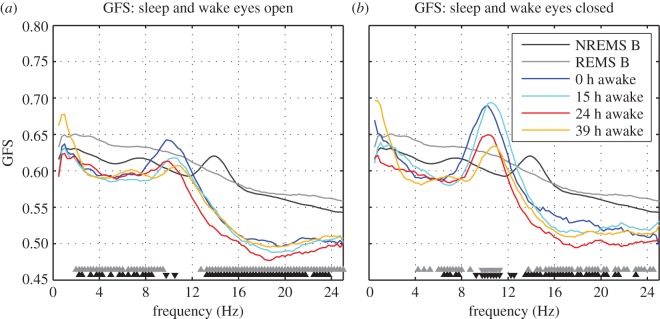
Sleep is characterized by a loss of consciousness, which has been attributed to a breakdown of functional connectivity between brain regions. Global field synchronization (GFS) can estimate functional connectivity of brain processes. GFS is a frequency-dependent measure of global synchronicity of multi-channel EEG data. Our aim was to explore and extend the hypothesis of disconnection during sleep by comparing GFS spectra of different vigilance states. The analysis was performed on eight healthy adult male subjects. EEG was recorded during a baseline night, a recovery night after 40 h of sustained wakefulness and at 3 h intervals during the 40 h of wakefulness. Compared to non-rapid eye movement (NREM) sleep, REM sleep showed larger GFS values in all frequencies except in the spindle and theta bands, where NREM sleep showed a peak in GFS. Sleep deprivation did not affect GFS spectra in REM and NREM sleep. Waking GFS values were lower compared with REM and NREM sleep except for the alpha band. Waking alpha GFS decreased following sleep deprivation in the eyes closed condition only. Our surprising finding of higher synchrony during REM sleep challenges the view of REM sleep as a desynchronized brain state and may provide insight into the function of REM sleep.
睡眠的特征是意识丧失,这被认为是由于脑区之间功能连接的中断所致。全局场同步(GFS)可以估计大脑活动的功能连接。GFS是一种基于频率的多通道脑电图数据全局同步性测量方法。我们的目的是通过比较不同警觉状态下的GFS频谱,探索并扩展睡眠期间断开连接的假说。对8名健康成年男性受试者进行了分析。在一个基线夜晚、持续清醒40小时后的恢复夜晚以及清醒40小时期间每隔3小时记录脑电图。与非快速眼动(NREM)睡眠相比,快速眼动(REM)睡眠在所有频率下的GFS值都更大,但在纺锤波和θ波频段除外,在这些频段NREM睡眠的GFS出现峰值。睡眠剥夺并未影响REM睡眠和NREM睡眠的GFS频谱。与REM睡眠和NREM睡眠相比,清醒时的GFS值较低,但在α波频段除外。仅在闭眼状态下,睡眠剥夺后清醒时的α波GFS降低。我们在REM睡眠期间发现更高同步性这一惊人发现,对将REM睡眠视为大脑去同步化状态的观点提出了挑战,并可能为深入了解REM睡眠的功能提供线索。