Dall'Olmo Giorgio, Dingle James, Polimene Luca, Brewin Robert J W, Claustre Hervé
Plymouth Marine Laboratory, UK; National Centre for Earth Observations, Plymouth Marine Laboratory, UK; Hjort Centre for Marine Ecosystem Dynamics, Bergen, Norway.
Plymouth Marine Laboratory, UK.
Nat Geosci. 2016 Nov;9(11):820-823. doi: 10.1038/ngeo2818. Epub 2016 Sep 26.
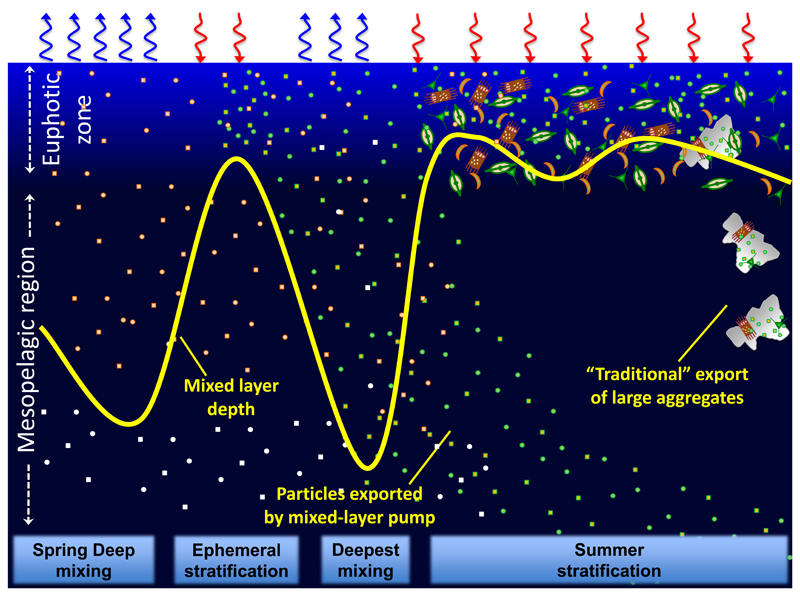
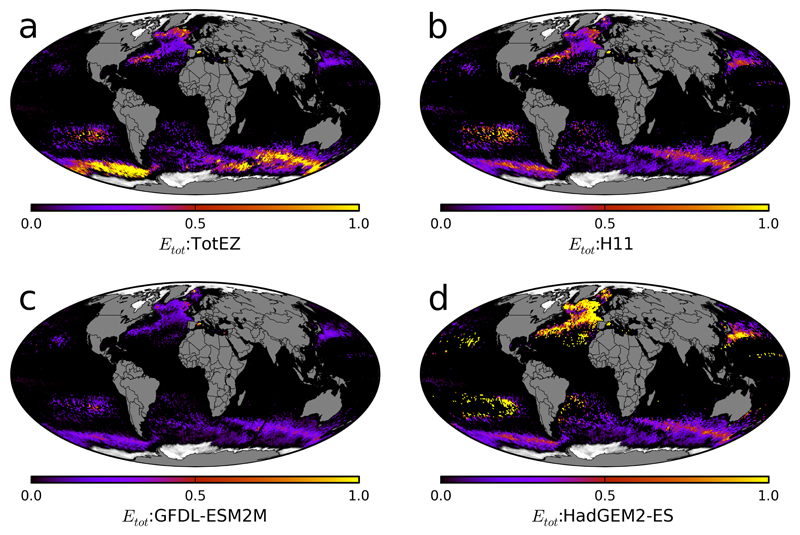
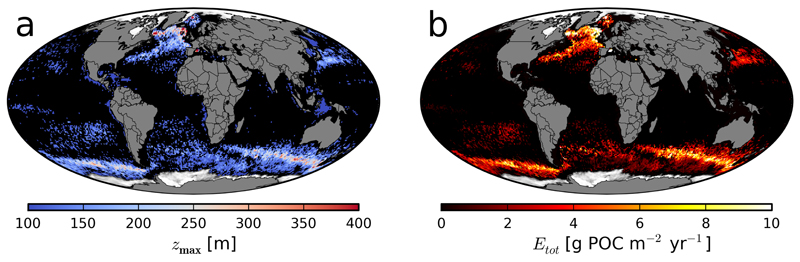
The "mesopelagic" is the region of the ocean between about 100 and 1000 m that harbours one of the largest ecosystems and fish stocks on the planet1,2. This vastly unexplored ecosystem is believed to be mostly sustained by chemical energy, in the form of fast-sinking particulate organic carbon, supplied by the biological carbon pump3. Yet, this supply appears insufficient to match mesopelagic metabolic demands4-6. The mixed-layer pump is a physically-driven biogeochemical process7-11 that could further contribute to meet these energetic requirements. However, little is known about the magnitude and spatial distribution of this process at the global scale. Here we show that the mixed-layer pump supplies an important seasonal flux of organic carbon to the mesopelagic. By combining mixed-layer depths from Argo floats with satellite retrievals of particulate organic carbon, we estimate that this pump exports a global flux of about 0.3 Pg C yr (range 0.1 - 0.5 Pg C yr). In high-latitude regions where mixed-layers are deep, this flux is on average 23%, but can be greater than 100% of the carbon supplied by fast sinking particles. Our results imply that a relatively large flux of organic carbon is missing from current energy budgets of the mesopelagic.
“中层带”是指海洋中大约100至1000米的区域,这里拥有地球上最大的生态系统和鱼类种群之一。这个尚未得到充分探索的生态系统被认为主要由生物碳泵提供的快速下沉的颗粒有机碳形式的化学能量维持。然而,这种供应似乎不足以满足中层带的代谢需求。混合层泵是一个由物理驱动的生物地球化学过程,它可能进一步有助于满足这些能量需求。然而,在全球范围内,对于这个过程的规模和空间分布知之甚少。在这里,我们表明混合层泵向中层带提供了重要的季节性有机碳通量。通过将Argo浮标测得的混合层深度与卫星反演的颗粒有机碳相结合,我们估计这个泵输出的全球通量约为0.3Pg C/年(范围为0.1 - 0.5Pg C/年)。在混合层较深的高纬度地区,这个通量平均为23%,但可能大于快速下沉颗粒提供的碳的100%。我们的结果表明,中层带当前的能量预算中缺少相对较大的有机碳通量。